Benjamin Franklin
Freedom Through The Word
Stained Glass / View All Windows

INSCRIPTION
“To the Glory of God, in honor of John Paul Jones, Captain, U.S.N.
and in memory of
Richard Dale,
November 6, 1756 – February 26, 1826,
First Lieutenant of the
Bon Homme Richard,
Captain, U.S.N.
June 5, 1794,
Commodore, 1801.
This window is given
by his great-grandson
Edward C. Dale
1917”
“To the Glory of God, in honor of
“To The Glory of God
In honor of Benjamin Franklin
In tribute to All Who Made the World Free and Opened the Scriptures
to the English-speaking Nations
Given By John Wanamaker, 1922.”
“If ye continue in my word, then are ye my disciples indeed; and ye shall know the truth and the truth shall make you free.”
— John 8:31-32
Original Installation: October 1922
Repaired and restored through gift of:
Restored by the family of Barbara Vaughan Watson Honoring Her Volunteer Work Transcribing the Bible Into Braille Opening ‘The Word’ to the Blind.
Rededication: May 2021
Medallion Reading Order:
Left to right, top to bottom.
Overview
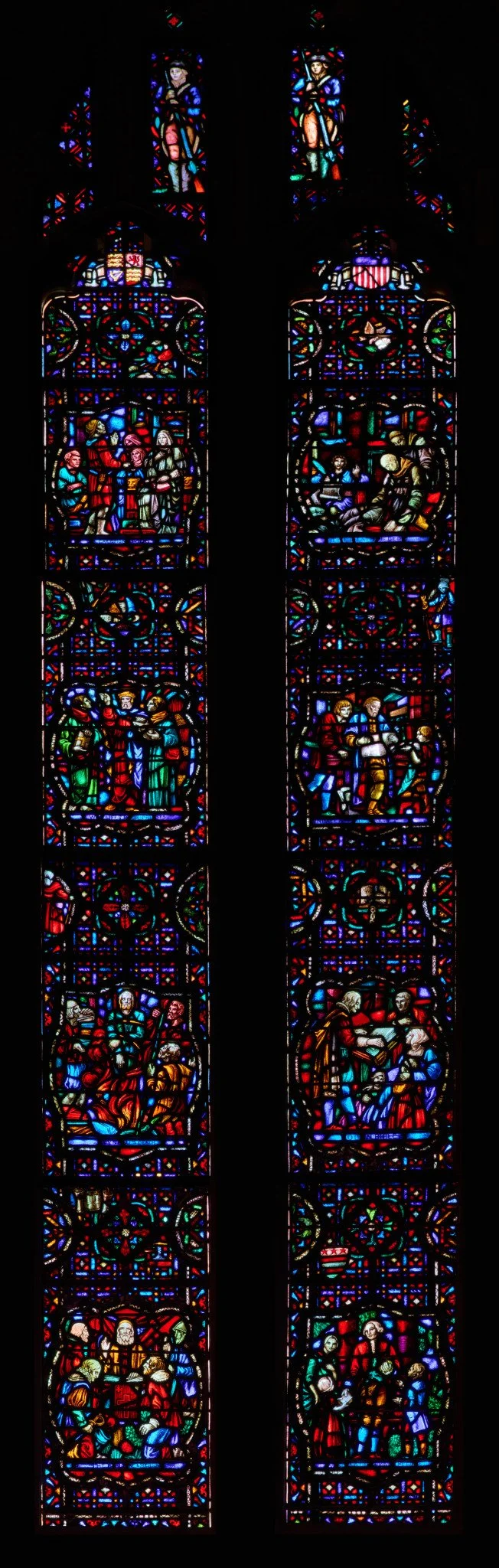
This window depicts the saga of the English-language Holy Bible from Anglo-Saxon times to 1761, portraying its extensive impact on Britain and beyond.
The decorations between the scenes include coats of arms, crosses, Scripture scrolls, writing materials, and flying creatures. These emphasize the themes of freedom through growing literacy and access to God's Word.
“No true history of the United States can be written,” The Reverend W. Herbert Burk argued, “without a profound appreciation of the place the Bible held in the development of the people who made the great Republic.” This is particularly true of the much-misunderstood Benjamin Franklin.
Raised in a devout Puritan home, Franklin was initially intended to become a minister. He recalled that his English ancestors during Queen Mary's persecutions ingeniously attached their English Bible in an open position on an upside-down stool, which could be flipped upright again to hide the illegal translation from the authorities. [1] This intense heritage of saturation in God's Word deeply impacted young Benjamin, and his youthful rejection of the Bible was short-lived. As a mature adult, he viewed his teenage deism as “horrible Errors.” [2]
By age twenty-two (1728), Franklin's deism had morphed into a polytheistic compromise, with an aloof deistic God as the Creator of the universe and a kindly, active Providence as the Creator of our solar system. [3] He went on to become a skeptical monotheist by twenty-five (1731) and at age twenty-nine (1735) he wrote “I believe in Christ, and exert my best Endeavours to understand his Will aright, and strictly to follow it.” [4] After this, his religious remarks do not fundamentally conflict with Christianity. [5]
Franklin had become a moderate Dissenter—questioning some troubling verses, and remaining skeptical of organized religion, but also lauding the Bible as the most accurate history book ever written and the Old Testament legal code as “the Dictate of divine Wisdom infinitely superior to human.” [6] It seems that his minimalist personal creedal statements may have stemmed from his well-attested love of tolerance rather than a lack of more specific beliefs.
Franklin noted the “wonderful” change which came over his spiritually indifferent neighbors in Philadelphia when the great evangelist George Whitefield arrived on the scene in 1739: “it seem'd as if all the World were growing Religious; so that one could not walk thro' the Town in an Evening without Hearing Psalms sung in different Families of every Street.” [7] He and Whitefield famously became friends, and he had an immense impact on American society by publishing Whitefield's works, which fanned the flames of the Great Awakening. Whitefield was concerned that Franklin had not had an intense emotional conversion experience, but Franklin did not believe such “Pangs and Convulsions” were necessary to prove faith. [8] This ongoing disagreement did not stop Franklin from suggesting in 1756 that the two of them should found a missionary colony together on the Ohio River as a witness to the Indians for “pure Religion.” [9]
These views provide context for the excerpt of Franklin's 1764 letter to his daughter which is inscribed on the back of one of the Chapel's pews: “Go constantly to Church whoever preaches. The Acts of Devotion in the common Prayer Book, are your principal Business there; and if properly attended to, will do more towards mending the Heart than Sermons generally can do. ...And therefore I wish you wou'd never miss the Prayer Days.” [10]
At the end of his life, Franklin admitted that he had developed some doubts about Christ's divinity, but added that he had never studied the question and was not going to bother now “when I expect soon an Opportunity of knowing the Truth with less Trouble” in Heaven, given that God did not seem to disapprove of people worshipping Jesus. This may indicate that he was still holding onto his faith despite losing arguments to his Unitarian friends. [11]
NKH
Motifs Throughout
The window’s field is of red, with green lozenges between a blue lattice with green intersections. It is possible that the intersections were recolored later; D’Ascenzo and Burk trade somewhat heated correspondence on this window being “lighter” than the others, apparently to cast better light on the lectern.
NKH
The demilunes surrounding the intermedallions feature several recurring images of stylized crosses including foliate crosses, Greek crosses, and six-pointed stars. Each of these images continue the color theme of the windows throughout but may also refer to the heritage of the translations of the Bible as depicted within the medallions, including the translation to the vernacular from Greek and Hebrew.
ACG
Stained Glass Design
Each of the windows in Washington Memorial Chapel have “medallions” depicting scenes or stories. In between those major medallions are smaller “intermedallions” which represent a theme or motif.
Within the tracery (intricate stonework window atop a stained glass window) are sections called daggers (dagger shaped), kites (diamond shaped) and panels (larger sections).
The slider below shows each section within the window.
-
![Caedmon at Whitby]()
01 Caedmon at Whitby
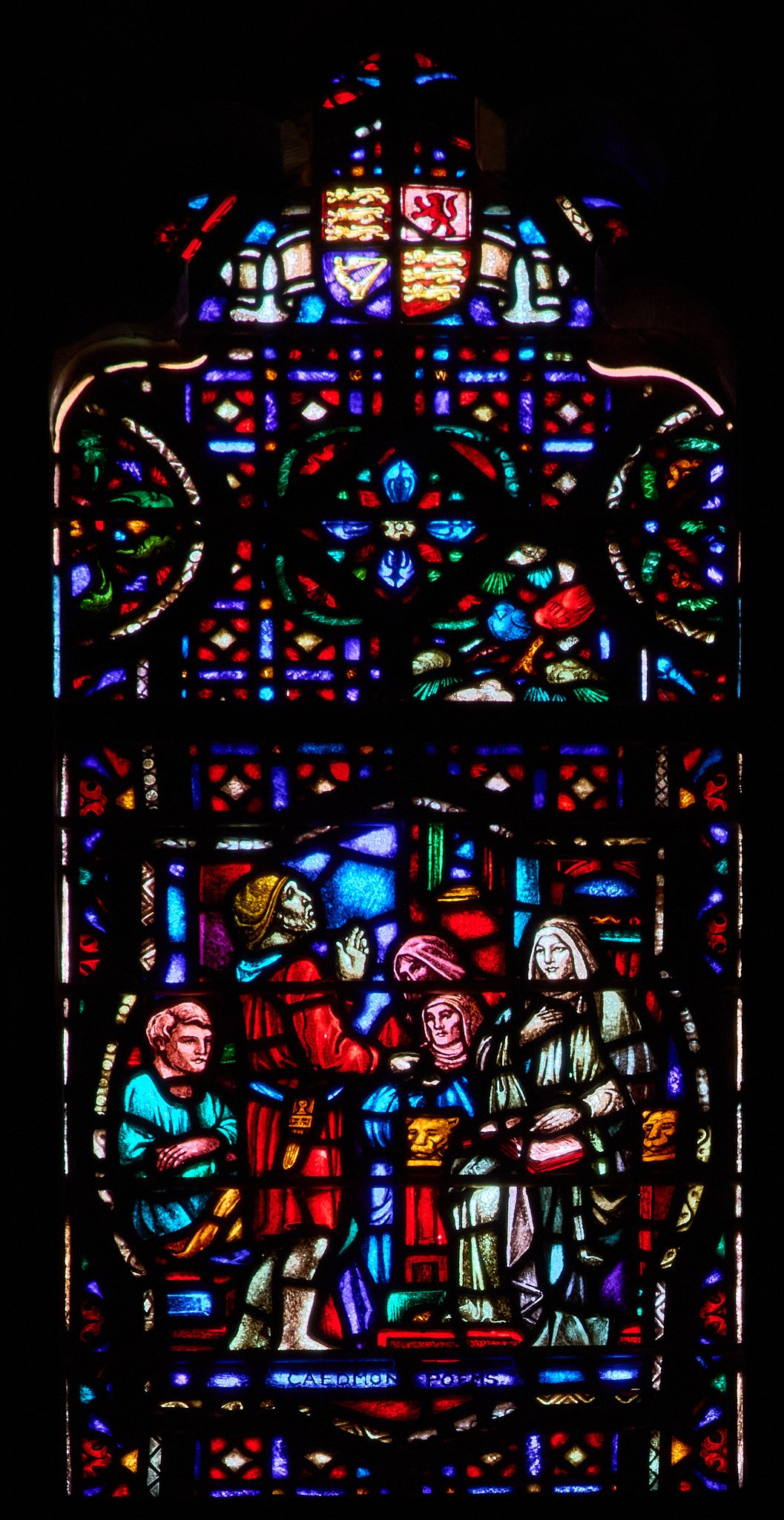
The medallion shows Caedmon reciting his poem to Lady Hilda, the Abbess of Whitby Abbey. The Abbess holds a Bible in her lap and two nuns stand behind her listening. A fourth figure, probably the abbey steward to whom Caedmon reported his dream, sits listening to the recitation.
-
![The Death of the Venerable Bede]()
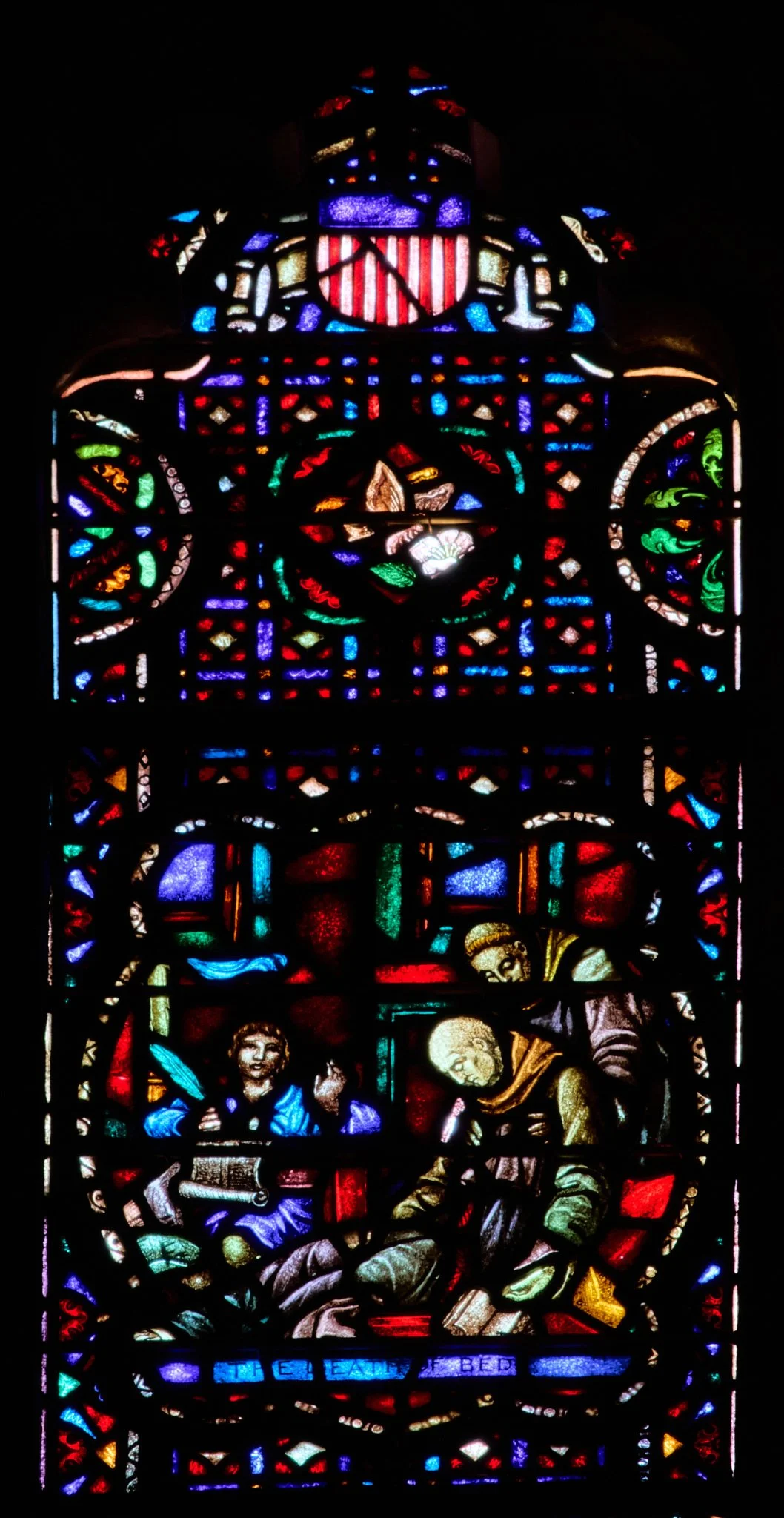
02 The Death of the Venerable Bede
“The Venerable Bede” is lying on a couch, dying, propped up with pillows. The boy scribe, Wilbert, bends over a parchment writing, according to The Reverend W. Herbert Burk’s description, “the last words of England’s scholar and saint, while the lamp of life burns low and the writer’s candle sputters in its socket.
-
![Wyclif Translates the Bible Into English]()
03 Wyclif Translates the Bible Into English
John Wycliffe, flanked by his translation collaborators, Nicholas Hereford (left) and John Purvey (right), gestures authoritatively while resting his other hand on the English Bible.
-
![The First Printed English Bible]()
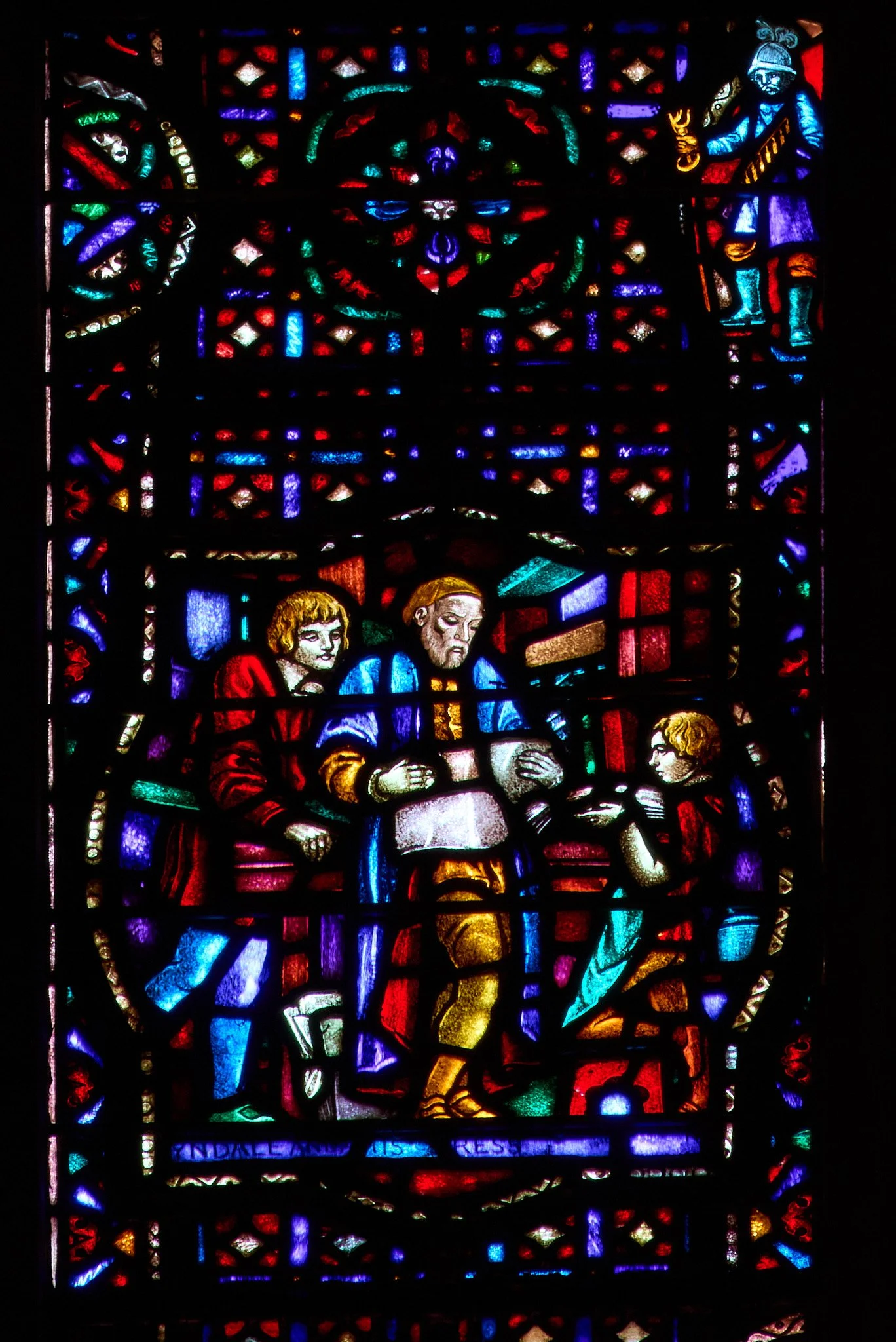
04 The First Printed English Bible
William Tyndale, flanked by Peter Guenthal and his apprentice, stands in front of Guenthal’s printing press, examining the first impressions of his English New Testament. The apprentice, in the background, prepares to make the second impressions.
-
![The Burning of the English Bible and Its Translator]()
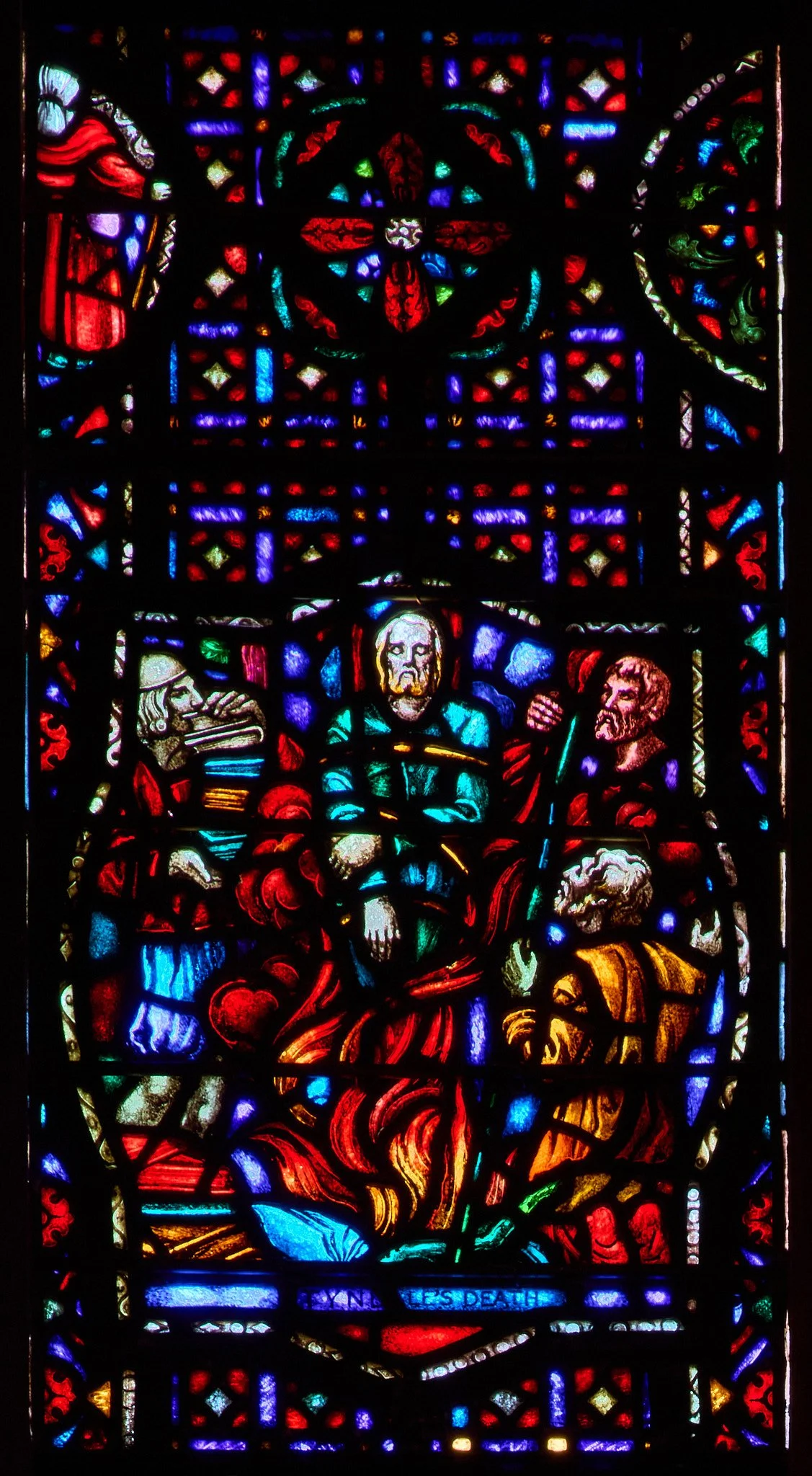
05 The Burning of the English Bible and Its Translator
The medallion shows William Tyndale, and copies of his translated English Bible, being burned at the stake in 1536 at Vilvoorde Castle, near Brussels in current day Netherlands. To his right is a figure carrying more Bibles to add to the pyre. To his left are two figures, one standing and one kneeling, perhaps representing some of his fellow translators .
-
![The Open Bible in St. Paul’s Cathedral]()
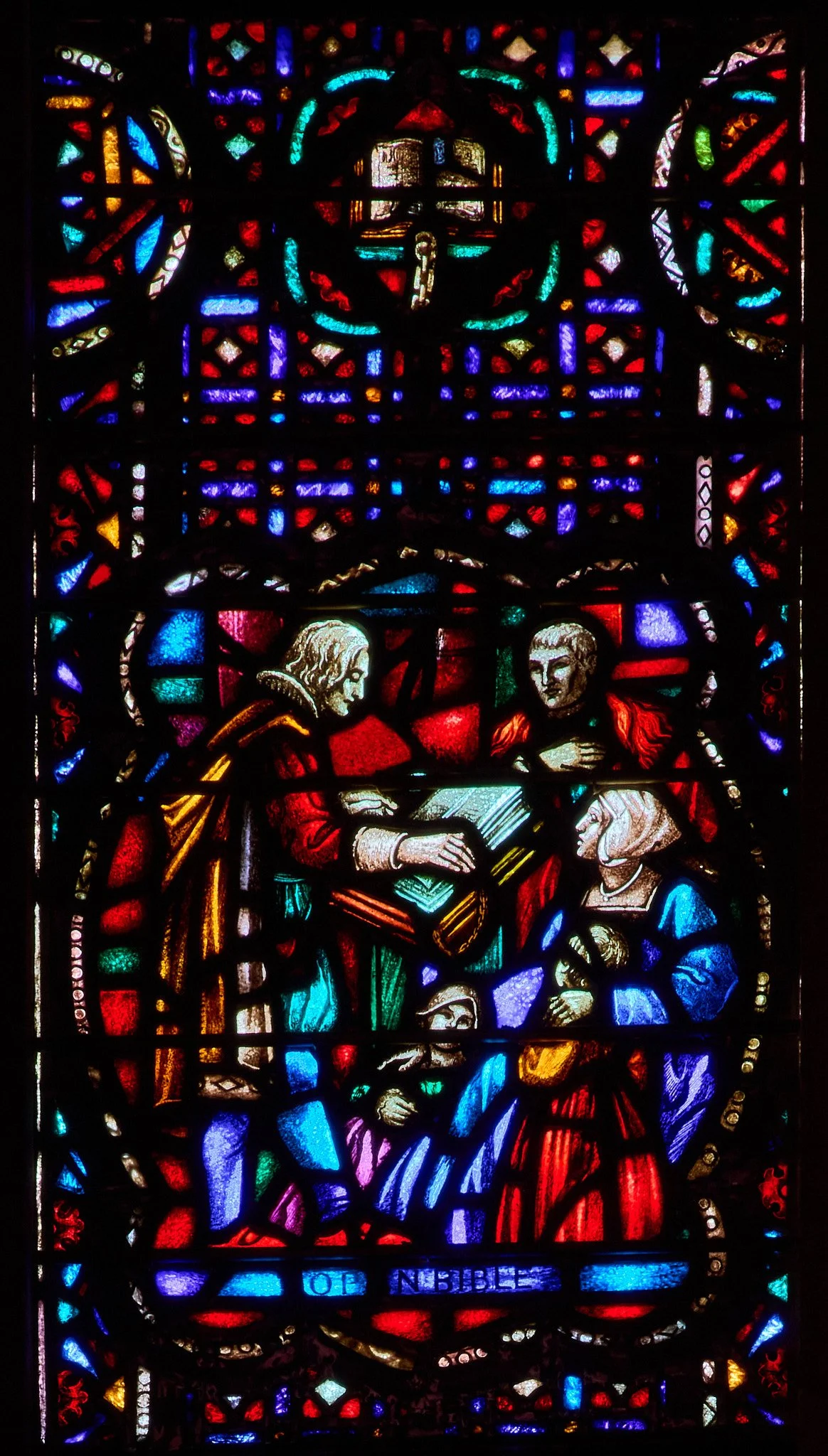
06 The Open Bible in St. Paul’s Cathedral
The medallion shows the Great Bible chained to the pulpit at St Paul’s Cathedral in London. Men, women, and children crowd around the pulpit to hear God’s message being delivered in their own language.
-
![The Bible in America - Reading the Bible at Jamestown]()
07 The Bible in America - Reading the Bible at Jamestown
This scene shows Jamestown’s chaplain, The Reverend Robert Hunt, the central figure, reading the Bible. In the left foreground kneels Captain John Smith, other Jamestown settlers are gathered around them.
-
![Washington Gives the Bible to the Youth of America]()
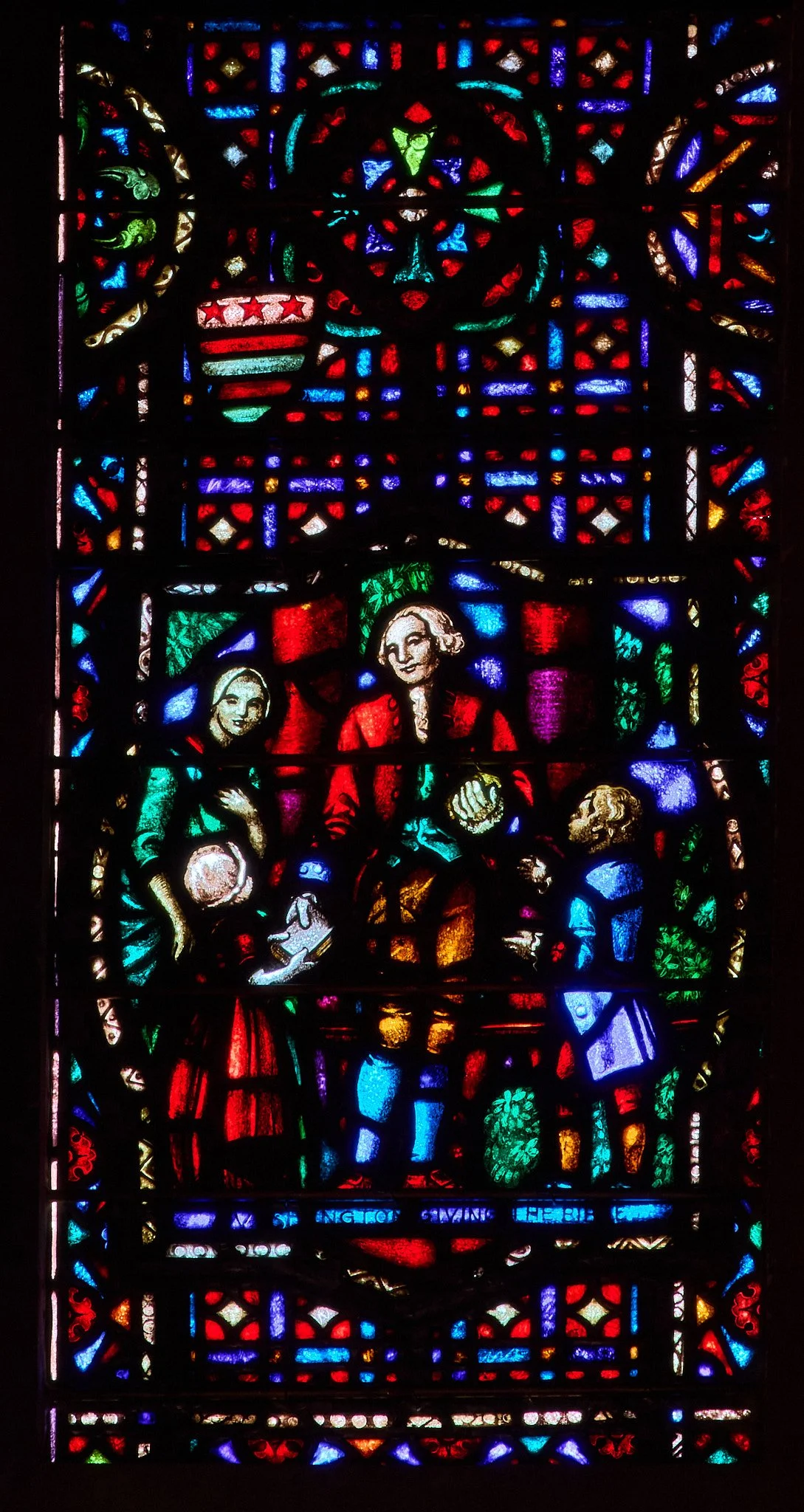
08 Washington Gives the Bible to the Youth of America
George Washington, in the center, is presenting his two step-children, George Parke Custis and Nellie Custis, with the gift of the Bible in English. Martha Washington stands observing on the left.
-
![Tracery Glass 1 (Panel) Continental Soldier]()
Tracery Glass 1 (Panel) Continental Soldier
Learn the significance of different Continental Army uniform facing and cuff colors throughout the chapel windows.
-
![Tracery Glass 2 (Panel) Continental Soldier]()
Tracery Glass 2 (Panel) Continental Soldier
Learn the significance of different Continental Army uniform facing and cuff colors throughout the chapel windows.


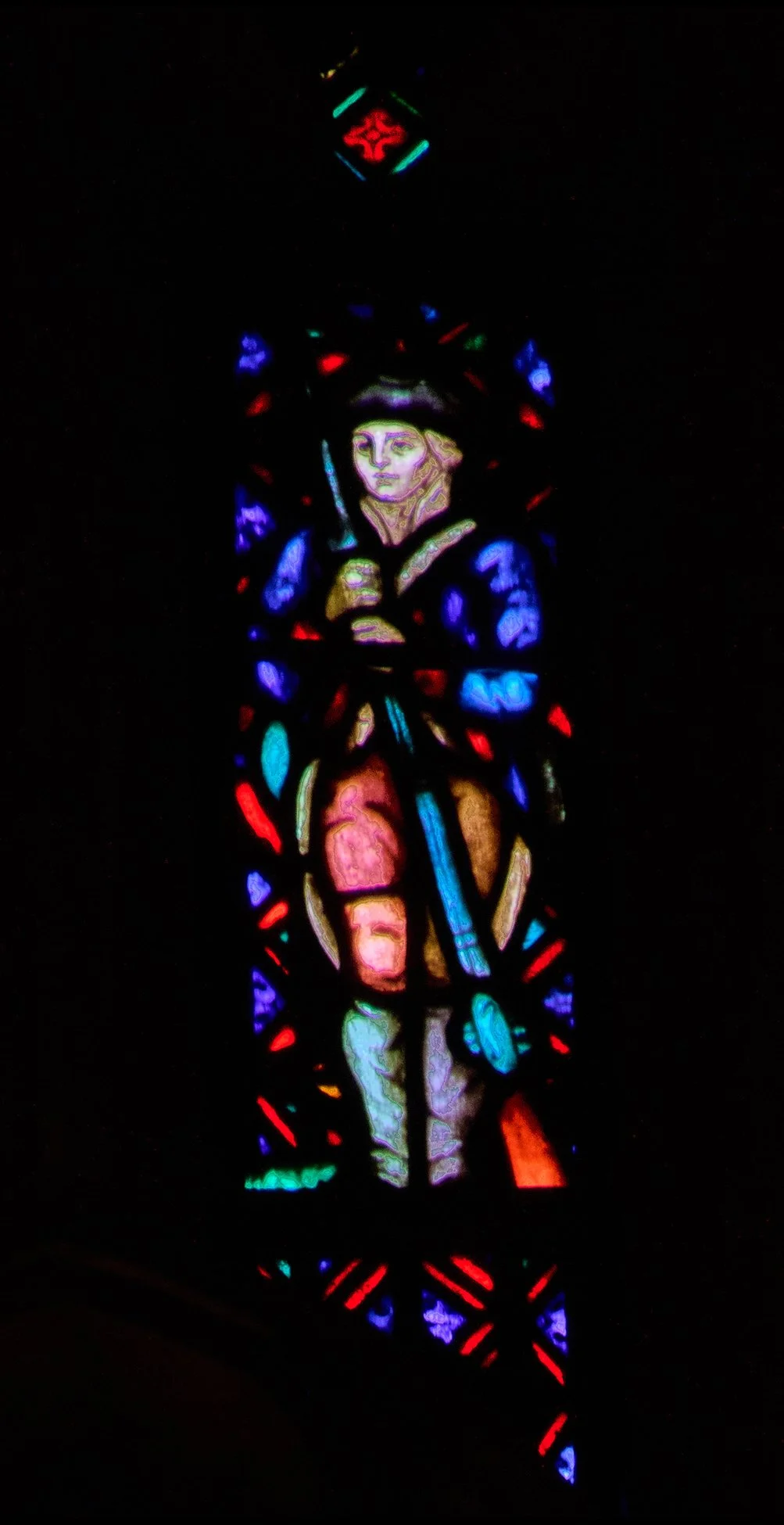
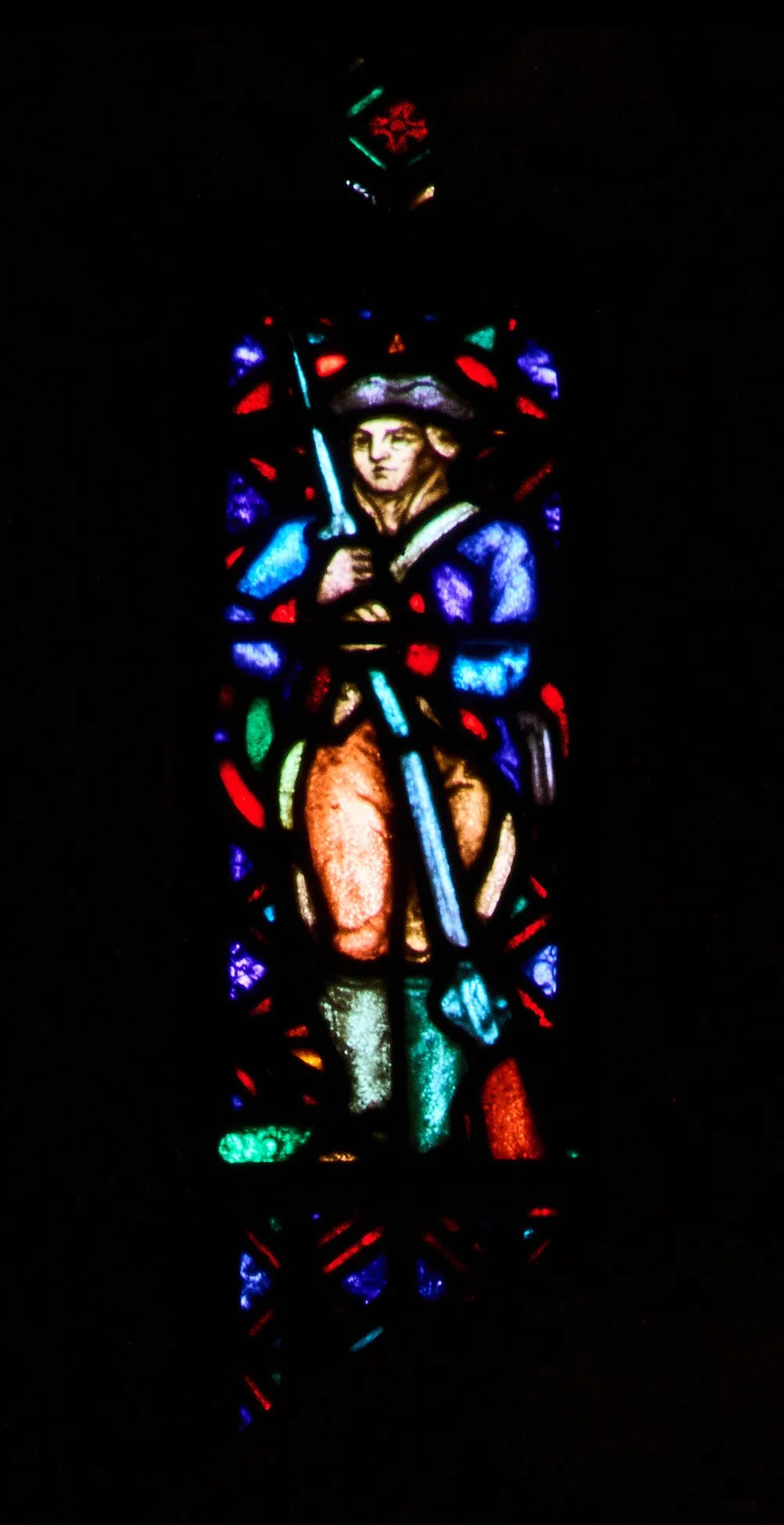
1 Caedmon at Whitby
Medallion 1: Caedmon at Whitby
Location: Left lancet, top
Description:
The medallion shows Caedmon reciting his poem to Lady Hilda, the Abbess of Whitby Abbey. The Abbess holds a Bible in her lap and two nuns stand behind her listening. A fourth figure, probably the abbey steward to whom Caedmon reported his dream, sits listening to the recitation.
Background:
In the late seventh century AD, a probably illiterate cowherd working at an abbey in Northern England created a poem honoring God that is the oldest example of (Old) English poetry.
In 657 AD the king of Northumbria, a Saxon kingdom in what is now northeastern England, founded Streoneshalch Abbey, a double monastery of monks and nuns. He appointed Lady (later Saint) Hilda, great-niece of the first Christian king of Northumbria, the first abbess. Sometime between 658 and 680, Caedmon, an illiterate herdsman employed by the Abbey, composed what is now the oldest recorded Old English poem. The text and the music came to him in a dream, and from then on he composed hymns based on Biblical passages. He subsequently became a monk and a religious poet.
Streoneshalch Abbey was laid waste by Danish raiders in the ninth century, was revived as Whitby Abbey, a Benedictine monastery, sometime in the eleventh century, and was finally destroyed under Henry VIII in 1540 during the “Dissolution of the Monasteries.” Caedmon’s poem, now known as Caedmon’s Hymn, has survived, however.
The Reverend W. Herbert Burk placed the story of Caedmon as the first medallion in the Freedom Through the Word Window to illustrate that “the English Bible and English language and literature are inseparably united.” “We go back,” he wrote, “into the past to find our first illustration of this fact - true in the very beginning of national existence as in its later days. For the very first great English song was inspired by the Bible, and was in fact a translation into the vernacular.”
Thus, Caedmon’s authorship of the first recorded Christian hymn in English, albeit Old English, not only further develops Burk’s theme of the spread of Christianity to the nations of the world, specifically the English speaking world, but also sets the stage for the importance of the translation of the Bible into English.
GPP
Intermedallion [Above Caedmon at Whitby]
- Top center: Modern Arms of the United Kingdom with a scroll behind; this may represent the written word in the English-speaking world. NKH
- Birds: Lower right: Panel of red and blue birds seated on a pine bough. This decoration may be an allusion to Caedmon's song about Creation; the evergreen bough may symbolize renewal and eternal life; the coloration of the birds is likely to match the red-blue color scheme of the windows rather than to convey any further symbolism.
NKH
2 The Death of the Venerable Bede
Medallion 2: The Death of the Venerable Bede
Location: Right lancet, top
Description:
“The Venerable Bede” is lying on a couch, dying, propped up with pillows. The boy scribe, Wilbert, bends over a parchment writing, according to The Reverend W. Herbert Burk’s description, “the last words of England’s scholar and saint, while the lamp of life burns low and the writer’s candle sputters in its socket.”
Background:
Bede produced the first translation of a part of the Bible into English. The “last words” Burk refers to were Bede’s dictation of the last chapter of the Gospel of John. He completed this work on his deathbed in 735 and the account appears in a contemporary letter from a certain Cuthbert to his friend Cuthwin.
An English monk known variously as the Venerable Bede and Saint Bede, Bede (c. 672-735) served in the Abbey of Monkwearmouth-Jarrow in Northumberland. He is best known for his Ecclesiastical History of the English People, which drew upon a wide variety of sources to trace the history of England from 55 BC to the late 7th Century. For this five volume book he is known as “the father of English history,” but he also wrote theological works, including commentaries on the books of the Bible and scientific works, including one on the correct dating of Easter. It is to Bede that we owe the story and recording of Caedmon’s Hymn.
Bede was well educated and could read Latin and Greek. The Abbey reportedly was a center of learning, possessing over two hundred manuscripts in its library, many of them brought from Europe. These were the resources Bede used for his theological works as well as his History. But Bede believed that the Word of God should be available to the uneducated in their own language. In a letter to the Archbishop of York in the early 730s, Bede suggested that the scriptures “should be known and constantly repeated in their own tongue by those who are unlearned.” Burk focused on Bede’s translation of the Gospel of John as a key element in his theme of the translation of the Bible into English.
GPP
Intermedallion [Above The Death of the Venerable Bede]
- Top center: Arms of the United States with a scroll behind; this may represent the written word in the United States.
- Center astroid: butterfly in flight above flower, possibly lily. The life cycle of a butterfly is a Christian symbol for rebirth and renewal; the caterpillar reflects earthly life; the chrysalis represents death; the butterfly represents resurrection. The life cycle of the lily, a dormant bulb that blooms to life, has similar connotations.
ACG
3 Wycliffe Translates the Bible into English
Medallion 3: Wycliffe Translates the Bible into English
Location: Left lancet, second from the top
Description:
John Wycliffe, flanked by his translation collaborators, Nicholas Hereford (left) and John Purvey (right), gestures authoritatively while resting his other hand on the English Bible.
Background:
John Wycliffe (c.1328-1384) preeminent scholar, religious teacher, and reformer oversaw the Bible’s first translation into English. In the words of The Reverend W. Herbert Burk, “It took learning and love of country and spirituality and courage to dare to translate the Bible into the common tongue, and thus to ‘cast pearls before swine’ as the schoolmen phrased it.”
Wycliffe, already recognized as the Morning Star of the Reformation in the Hamilton Window of Freedom Through Truth, is featured in this medallion for his oversight of the first full translation of the Bible into English. Burk saw this accomplishment not only as an important religious act but also as a “monument of patriotism.” For him it represented “a new spirit of nationalism” because, since the Norman conquest, French had been the official language of English law and the nobility, while Latin was the language of religion. The overwhelming majority of English men and women, therefore, understood neither the language in which they worshipped nor the language of the laws to which they were subject.
In 1362 Parliament passed a law making English the language of the courts. The Church, however, maintained its prohibition on the translation of the Bible from Latin. In stark contrast stood Wycliffe’s vision that it was the right of every Englishman to have access to the entire Word of God. To accomplish this, Wycliffe set about, late in life, to create an English translation of the Bible.
Born in Yorkshire, Wycliffe served as Master at Oxford University’s Balliol College (1361-1362), earning his Doctorate of Divinity there in 1372. In the late 1370s Wycliffe assembled his Bible translation team, chief among whom were his students Nicholas Hereford and John Purvey pictured in this medallion. It is likely that Hereford, Purvey, and their associates did most or all of the translating, with Wycliffe acting as mentor and expert consultant.
Wycliffe died in 1384 before the translation was complete. The translation effort continued, however, and translations of the Old and New Testaments were available in the late 1380s. A highly readable lay edition of the Wycliffe Bible was finished by 1395. Noteworthy: the invention of the printing press was still nearly 70 years in the future. Until the late 15th century copies were made by teams of scribes in a process that could take months.
Wycliffe's writings and his translation continued to raise controversy in the Church long after his death. Copies of his Bible were burned and his followers arrested and often executed. In 1415 the Church declared him a heretic and decreed his works should be banned and his bones burned. Over time, both Hereford and Purvey were also condemned as heretics, though they recanted to avoid death or imprisonment. But, as Burk wrote, "Men might nickname Wycliffe's followers 'Lollards,' or imprison them or put them to death, but they could not bind the Word of God. . . ."
Burk characterized the impact of Wycliffe’s translation with this sweeping summary: “It marks the beginning of a new era in England. It tolls the death-knell of medievalism. It rings the first joy bells of the New Birth.”
The Wycliffite Bible became “the most widely copied Middle English text ever.” A global legacy, one of which Wycliffe could never have dreamed, was formally established as the Wycliffe Bible Translators in 1942. Bringing together centuries of missional translation work, this ministry aims to complete Bible translations in every living language.
NKH
Intermedallion [Above Wycliffe Translates the Bible into English]
- Center astroid: Book and quill pen. The writing implements relate directly to Wyclif who translated the Bible into Middle English in order for ordinary Christians to have direct access to the scripture, rather than only clergy.
ACG
4 Tyndale and his Press/The First Printed English Bible
Medallion 4: Tyndale and his Press/The First Printed English Bible
Location: Right lancet; second from the top
Description:
William Tyndale, flanked by Peter Guenthal and his apprentice, stands in front of Guenthal’s printing press, examining the first impressions of his English New Testament. The apprentice, in the background, prepares to make the second impressions.
Background:
In the hundred and fifty years between Wycliff’s written Bible and the first printed Bible, the known world - and the English language - changed significantly. Greek-speaking scholars who had fled the fall of Constantinople brought with them precious texts from antiquity (This historic event is pictured in medallion 3 of the Alexander Hamilton window titled, The Fall of Constantinople). The end of the Hundred Years’ War (1453) saw the deprecation of Norman French in most civic applications in England. Migration from the countryside to London following recurrent outbreaks of bubonic plague (the Black Death) in the 14th and 15th centuries caused the development of a new, prestige dialect of English spoken by the educated classes. Finally, the establishment of printing presses - William Caxton’s establishment of 1476 being the first in England - ensured that the codification of Early Modern English would occur and would abide.
William Tyndale was born about 1494, and studied at Oxford, obtaining a Master of Arts degree in 1515 before beginning to study theology. In the course of his studies, he became dissatisfied with the lack of any official systematic study of Scripture in preparing for the priesthood; once he had been ordained, he clashed regularly with his fellow clergy. In 1523 he traveled to London, seeking the permission of then-Bishop Cuthbert Tunstall to translate the New Testament into English. Although Tunstall had assisted Erasmus in the preparation of his 1516 Latin/Greek Novum Testamentum Omnium, he declined to endorse Tyndale’s project.
Tyndale left England, sailing for Germany in the spring of 1524, where he completed his translation of the English New Testament and contracted with Peter Guenthal (or Quentell or de Quinty) of Cologne to print 31,000 copies. Although this edition would not be completed due to a local outbreak of anti-Protestant sentiment, subsequent printings were undertaken by printers at Worms and Antwerp. Tyndale, against the counsel of the Bishop of London, had succeeded in preparing an English New Testament, and within a few years, he prayed, “The boy that driveth the plough [would] know more of Scripture” than the intellectuals with which he had feuded.
The Reverend W. Herbert Burk in describing this medallion wrote, “The printing of this Bible is one of the greatest events in the history of English civilization . . . .”
JRW
Intermedallion [Above Tyndale and his Press/The First Printed English Bible]
- Right demilune: 16th-century soldier with helmet, jacket, sword, and powder charges for his weapon hanging from the bandolier on his chest. This soldier may represent those seeking to arrest Tyndale, who printed the first translation of the New Testament from Greek and Hebrew in 1526.
ACG
5 Burning the English Bible and Tyndale, its Translator
Medallion 5: Burning the English Bible and Tyndale, its Translator
Location: Left lancet, third from the top
Description:
The medallion shows William Tyndale, and copies of his translated English Bible, being burned at the stake in 1536 at Vilvoorde Castle, near Brussels in current day Netherlands. To his right is a figure carrying more Bibles to add to the pyre. To his left are two figures, one standing and one kneeling, perhaps representing some of his fellow translators .
Background:
William Tyndale (c. 1494 - 1536) was a prominent English theologian, priest, scholar, linguist, and translator of the Bible to the English language. Tyndale’s work and persistence in translating and publishing English language Bibles was critical to the Protestant Reformation in England. He believed in the primacy of Holy Scripture, Prima Scriptura, in areas of dogma, instruction, and salvation, and wanted commoners to have direct access to God’s word in a language they could understand. He was the first to translate directly from Hebrew and Greek to English. His Bible would become the standard English language Bible of its age and inspire the creation of the King James Version (KJV) Bible in 1611- the most consequential English language Bible in history. Indeed it is estimated that 80 to 90% of the content in the KJV is from Tyndale’s translation. Due to religious persecution, he fled his native England in 1524 and worked in Germany and elsewhere in Europe to get his translations into print.
The history of the translation of the Bible stretches back to the beginnings of the Church. Initially both the Old and New Testaments were written in Hebrew or Aramaic. Scholars later converted those texts to Greek and Latin. St. Jerome authored the definitive translation into Latin from Hebrew, The Vulgate Bible, in 405 AD. This Bible would remain the standard Bible of the Roman Catholic Church for over a millennium.
Maintaining the Bible in a language that only the educated clergy and wealthy elite could read and understand was a primary method to ensure the Church’s control over Christian teaching. Most in the Church believed that if everyone could read the Bible, misinterpretation leading to heresy would inevitably result. Secular leaders also feared that certain passages in the Bible could be used to challenge political authority. Church and state, therefore, viewed translations into the language of the people, and the translators themselves, as threats. The leaders of some European states, however, protected such reformers as Luther and Calvin. Tyndale, among others, sought refuge in these states in order to pursue his work.
A century before Tyndale’s death, ecclesiastical authorities in Europe had condemned the English Bible translator John Wycliffe as a heretic and ordered his bones burnt at the stake along with his English language Bibles. Given that the leading two English Bible translators were burnt at the stake for their evangelism, this medallion also has symbolic significance. The Reverend W. Herbert Burk himself wrote in his description of this scene, “the flame consumes the man and his work but illumines the world which he sought to save.”
Perhaps these words from a seventeenth century writer summed up this theme best in referencing Wycliffe’s demise:
They burned his bones to ashes and cast them into the Swift, a neighbouring brook running hard by. Thus the brook conveyed his ashes into the Avon, the Avon into the Severn, the Severn into the narrow seas and then into the main ocean. And so the ashes of Wycliffe are symbolic of his doctrine, which is now spread throughout the world.
DRS
Intermedallion [Above Burning the English Bible and Tyndale, its Translator ]
- Left demilune: Person in red mantle with wig or long white hair, back to the viewer, holding a walking stick. This may represent one of the Lollard preachers, followers of Wyclif. Lollard preachers wore plain russet robes, adopted a life of voluntary poverty to mirror the life of Jesus, and spread the reformist idea that ordinary people should have direct access to God's word.
ACG
6 The Open Bible in St. Paul's Cathedral
Medallion 6: The Open Bible in St. Paul's Cathedral
Location: Right lancet, third from the top
Description:
The medallion shows the Great Bible chained to the pulpit at St Paul's Cathedral in London. Men, women, and children crowd around the pulpit to hear God's message being delivered in their own language.
Background:
The 1539 English Bible, known as the “Great Bible,” was the first authorized edition of the Bible in English. Henry VIII of England ordered this Bible to be read aloud in all Church of England services.
The 1534 Act of Supremacy declared Henry VIII as the “only supreme head on earth of the Church of England,” formalizing Henry VIII’s break with the Pope and the Roman Catholic Church. With supreme political and financial control over the Church of England, Henry VIII played a central role in the authorization and promotion of what became known as the Great Bible. The decision to authorize the 1539 English Bible overturned long standing laws that had prohibited English translations of the Bible. It was politically and religiously significant as it helped solidify his break with Rome.
The project began under the direction of Thomas Cromwell, Henry VIII’s Secretary and Vicar General. Myles Coverdale, an experienced translator, was tasked with preparing the text. The Matthew Bible (1537), which combined William Tyndale’s New Testament and parts of his Old Testament translations, served as the foundation. Where Tyndale’s work was incomplete, Coverdale relied on the Latin Vulgate and Martin Luther’s German Bible. This approach ensured a complete English Bible.
Over 9000 copies of the Great Bible were printed between 1539 and 1541. The Bible was printed in two columns of Gothic script and included woodcut illustrations. The Bible’s large size earned it the name, the “Great Bible.” According to most sources, its pages measured 11 inches wide by 16.5 inches long. The Bible was about 14 inches thick, and contained an estimated 1600 to 1800 pages. By royal injunction, every parish in England was required to display a copy of the Great Bible in a convenient place for parishioners to read. In addition, it was called the “Chained Bible” because copies were often chained to church pulpits to prevent theft. For many, it was their first exposure to the Bible in their own language and for the first time laypeople could engage directly with scripture.
In summary, the 1539 Great Bible was important because it was the first officially sanctioned English Bible; it became a symbol of the English Reformation and was a tool for spreading Protestantism. The Great Bible laid the foundation for subsequent English Bible translations like the Geneva Bible and the King James version making it a landmark in the history of English Christianity.
FPS
Intermedallion [Above The Open Bible in St. Paul's Cathedral]
- Center astroid: Open Bible with chain hanging from center. In 1538, King Henry VIII funded the Great Bible, the first English Bible for public use. As the large tomes were highly valuable, churches chained them to desks to ensure that all could have direct access to the scripture.
ACG
7 The Bible in America - Reading the Bible at Jamestown
Medallion 7: The Bible in America - Reading the Bible at Jamestown
Location: Right lancet, third from the top
Description:
This scene shows Jamestown's chaplain, The Reverend Robert Hunt, the central figure, reading the Bible. In the left foreground kneels Captain John Smith, other Jamestown settlers are gathered around them.
Background:
In April 1607, the English Bible arrived in North America, and with it, in the words of The Reverend W. Herbert Burk, ". . . the old church was established in the new world."
Three ships, the Susan Constant, Godspeed, and Discovery, carrying 104 settlers, set sail from England on December 6th, 1606, for the New World. The expedition was sponsored by the Virginia Company of London, chartered by King James I to establish a colony in Virginia. Among the 104 were The Reverend Robert Hunt and Captain John Smith. The Archbishop of Canterbury had recruited Hunt to be the Chaplain of the settlement group. Capt. Bartholomew Gosnold, founder of the Virginia Company of London, had chosen Smith.
Smith, an adventurer, soldier, explorer, and author, had fought in France and the Holy Lands, had been captured by the Ottoman Turks and been enslaved, and had subsequently escaped. He had a reputation as a skilled jouster and fighter, which had attracted the attention of Gosnold.
The ships landed in the Chesapeake Bay in April 1607. The settlers established a settlement on May 13 which they named Jamestown to honor their king. Both Smith and Hunt played prominent roles in the early years of the struggling settlement, though their tenure there was remarkably short. Smith had been imprisoned for mutiny on board ship on the way to Virgina. He was freed upon landing when settlers opened and read written orders from the Virginia Company directing Smith to serve on the settlement's council. Smith eventually became president of the council and provided rigid and disciplined governance to the settlement. He also explored and mapped much of the Chesapeake/Virginia coastline.
Hunt, a Vicar in the Church of England who was unpopular with his parishioners, supported Smith in his governance role in the settlement and played a prominent role keeping peace among the quarreling settlers. More importantly, he established a foothold of the Anglican Church in the New World by providing regular worship, sermons, and prayer services to the settlers of Jamestown.
Burk chose this scene for the Benjamin Franklin Window's theme of Freedom Through the Word because, with its arrival in Jamestown, the Bible, in Burk's words, ". . . came to America to do its part in the creation and development of a new Nation. . . ."
At Jamestown, the settlers battled disease, food shortages, and tenuous relations with the Powhatan Indians. In the first year alone the 104 settlers were reduced to 38 in number by disease. There were constant food shortages and warfare with the Powhatan Indians. At times Smith bartered successfully with Chief Powhatan; other times their relationship brought skirmishes. Hunt became ill and died in the spring of 1608. Smith was injured in a mysterious gunpowder explosion in 1609 and returned to England to recover, never to return to Jamestown. While in Virginia and back in England, Smith wrote extensively of his experiences and explorations. Jamestown struggled as a colony until 1610, when re-enforcements and supplies arrived from England to strengthen the colony, along with an effective new governor - Lord De La Warr.
KRD
Intermedallion [Above The Bible in America - Reading the Bible at Jamestown]
- Top Left: Torah scroll, possibly bearing the letters "YHWH." This might be an allusion to the use of the Geneva Bible in early American history, which features direct translation of the Old Testament from Hebrew.
- Lower Right: Light blue screw from printing press. This could symbolize the use of printed Bibles throughout early America, specifically the Aitken Bible which was the first Bible printed in North America under Congressional approval, thereby avoiding the import of English translations to the colonies.
ACG
8 Washington Gives the Bible to the Youth of America
Medallion 8: Washington Gives the Bible to the Youth of America
Location: Right lancet, bottom
Description:
George Washington, in the center, is presenting his two step-children, George Parke Custis and Nellie Custis, with the gift of the Bible in English. Martha Washington stands observing on the left.
Background:
This image marks a simple event in George Washington’s life, his gift to his step-children of personalized Bibles with their names engraved on the covers. But The Reverend W. Herbert Burk also intended it to represent a larger theme, the importance to Washington of the Bible and its influence on his life. As Burk wrote, “The Bible was Washington’s school-master and school-book, comfort and inspiration.” Indeed, Burk intended the entire Benjamin Franklin Window to reflect Washington’s “... relationship to the Word of God.”
Washington was reared by a devout mother, and like most Americans of his time, intimately familiar with the Bible. As illustrated in a medallion in the George Washington Window, Washington at the age of 23 read the Service for the Burial of the Dead from the Anglican Book of Common Prayer over the grave of Major General Edward Braddock following the Battle of Monongahela in 1755. The Burial Service includes passages from both the Old and New Testaments as well as selected Psalms.
In his June 1783 Circular to the States, Washington said that the “pure and benign light of Revelation,” the Bible, “had a meliorating influence on Mankind and increased the blessings of Society.” Of the many biblical passages found in his papers, Washington most frequently referenced “ … the Hebrew blessing and vision for the New Jerusalem.” In this blessing, every man sits safely “under his vine and under his fig tree.” (Micah 4:4; see also 1 Kings 4:25; Zechariah 3:10; and 1 Maccabees 14:12).
According to his step-grandson, George Washington Parke Custis, Washington while President “was a strict and decorous observer of the Sabbath. He always attended divine service in the morning and read a sermon or some portion of the Bible to Mrs. Washington in the afternoon.”
George Washington demonstrated his Christian piety in public behavior as well. In the first presidential oath, Washington opened the Bible, placed his left hand on it, and ended the oath with “So help me God.” Washington then bent in reverence to God, whom he credited with saving him so many times during the Revolution and kissed the Bible. In his Farewell Address of 1796, George Washington stated that, “Of all the dispositions and habits which lead to political prosperity, religion and morality are indispensable supports.”
To effectively reach his biblically literate audience, George Washington referenced the Bible more than any other literary text, though he often omitted quotes or citations from his Bible references likely due to the high rate of biblical literacy in Colonial America, the result of nearly three hundred years of the Bible’s availability to the common man in English.
DCS
Intermedallion [Above Washington Gives the Bible to the Youth of America]
- Top Left: Washington's coat of arms, signifying the Bible reaching Valley Forge with him.
ACG
Overview Endnotes
[2] In the margin of an October 16, 1746 letter manuscript, Franklin clarifies the phrase “horrible Errors I led myself into as a young man” (through excessive speculation in metaphysics) by specifying that those mistakes are to be found in his 1725 deistic pamphlet, A Dissertation on Liberty and Necessity, Pleasure and Pain. Leonard W. Labaree, ed., The Papers of Benjamin Franklin, vol. 1 (New Haven: Yale University Press, 1961), 88-89, 89n1.
[3] Labaree, Papers of Franklin, 1:102-3.
[4] In 1731 Franklin declared that “there is one God Father of the Universe... he ought to be worshipped.” (Labaree, Papers of Franklin, 1:213). His statement of belief in Christ was in the context of arguing that Christians should not be so heatedly divided over theology (Labaree, Papers of Franklin, 2:78).
[5] The following are some notable examples of Franklin's Christian statements (for an annotated collection of Franklin's significant religious comments in context and in chronological order, see Bill Fortenberry, Franklin on Faith: The Definitive Guide to the Religion of the First American). In defending the accused minister during the first American Presbyterian heresy trial in 1735, Franklin clearly articulated the Gospel and referred to Christ as “Our Saviour” (Labaree, Papers of Franklin, 2:116). In a 1742 issue of Poor Richard's Almanac, Franklin gives several reasons why a “sober Diet” is healthy, concluding with “it makes the Body a fit Tabernacle for the Lord to dwell in; which makes us happy in this World, and eternally happy in the World to come, through Jesus Christ our Lord and Saviour” (Labaree, Papers of Franklin, 2:341). In his 1773 editor's preface to a shortened Anglican liturgy he co-authored (as an attempt to increase church attendance), Franklin explains that the reason for including New Testament readings and leaving out Old Testament readings was that the former were “more suitable to teach the so-much-to-be-revered doctrine of Christ, and of more immediate importance to Christians; altho' the Old Testament is allowed by all to be an accurate and concise history, and, as such, may more properly be read at home” (“Franklin's Contributions to an Abridgment of the Book of Common Prayer, [before August 5, 1773],” Founders Online, National Archives). In passing while recounting an anecdote of a missionary's sermon, Franklin referred to the Fall of Mankind and the life and miracles of Christ as “the principal historical Facts on which our Religion is founded.” (“Remarks concerning the Savages of North America,” [before January 7, 1784], Founders Online, National Archives.)
[6] “[T]he most faithful of all histories, the Holy Bible....” (K [Benjamin
Franklin| to the Editor of the Federal Gazette, April 8, 1788); “If we really believe, as we profess to believe, that the Law of Moses was the Law of God, the Dictate of divine Wisdom infinitely superior to human, on what Principles do we ordain Death as the Punishment of an Offence, which according to that Law was only to be punish'd by a Restitution of Fourfold?” (Benjamin Franklin to Benjamin Vaughan, March 14, 1785, Founders Online, National Archives.) Franklin also referred his sister to a Jonathan Edwards passage to validate his theology. (Benjamin Franklin to Jane Mecom, July 28, 1743, Founders Online, National Archives.)
[7] Franklin, Autobiography, 128.
[8] Much has been made of Franklin saying that Whitefield “used, indeed, sometimes to pray for my conversion, but never had the satisfaction of believing that his prayers were heard” (Franklin, Autobiography, 129). This is not because Franklin did not return from deism, but rather because he vehemently disagreed with the idea that someone like himself who had been raised as a Christian would necessarily have an intense emotional experience as part of making a deeper personal commitment (see Labaree, Papers of Franklin, 2:54). This was a common controversy during the Great Awakening.
[9] Benjamin Franklin to George Whitefield, July 2, 1756, Founders Online, National Archives.
[10] Benjamin Franklin to Sarah Franklin, November 8, 1764, Founders Online, National Archives.
[11] Benjamin Franklin to Ezra Stiles, March 9, 1790 [unpublished].
© Text copyright of Washington Memorial Chapel and courtesy of the God's Glass Project.
© Photos copyright of Sam Cornwall, licensed exclusively to Washington Memorial Chapel and courtesy of the God's Glass Project.
Unauthorized sharing or distribution of text or images from this website is strictly prohibited without written permission from the copyright holders.