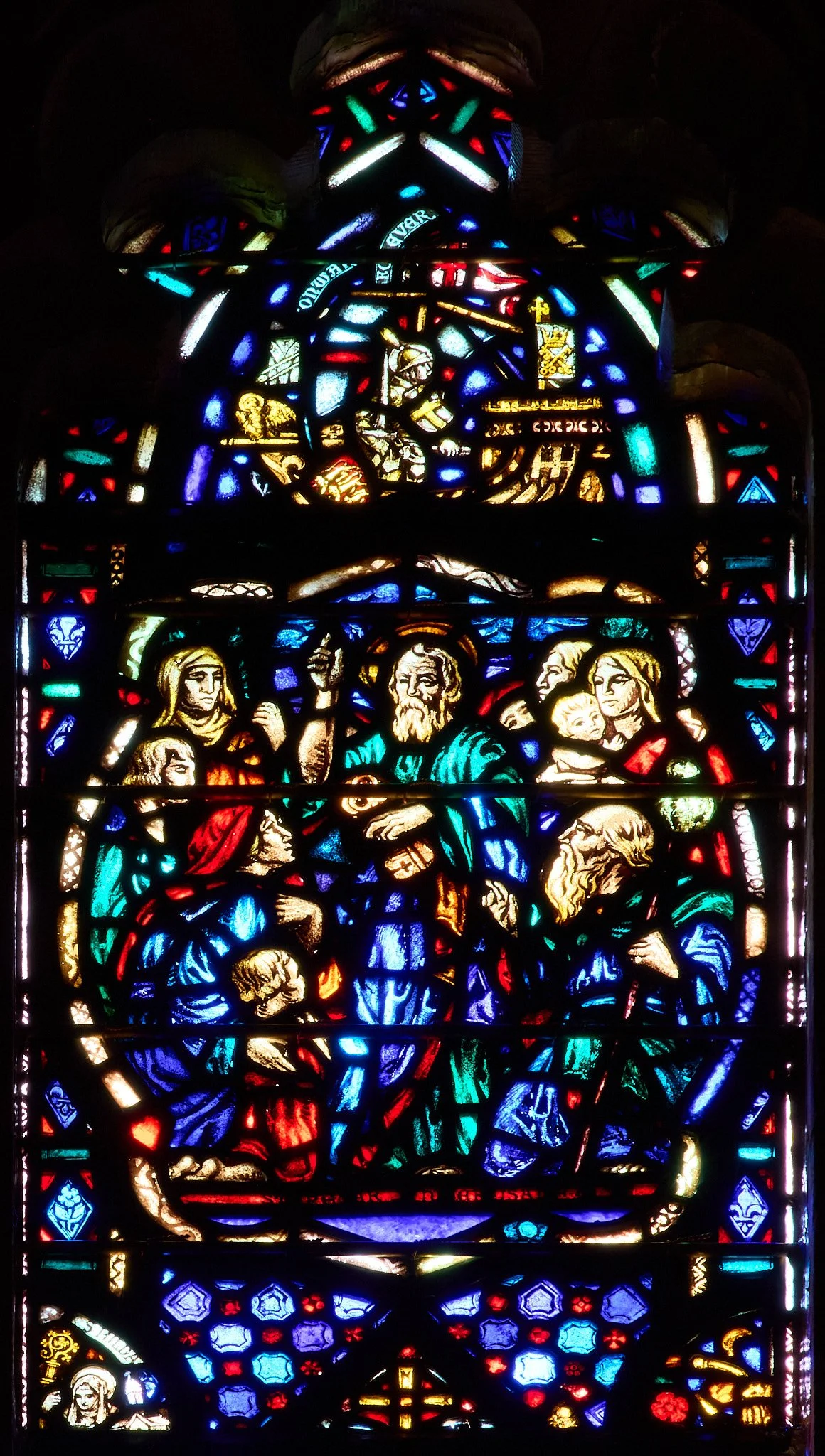
Bishop White
The Church’s Conquest of the World
Stained Glass / View All Windows

INSCRIPTION
“To the Glory of God, in honor of John Paul Jones, Captain, U.S.N.
and in memory of
Richard Dale,
November 6, 1756 – February 26, 1826,
First Lieutenant of the
Bon Homme Richard,
Captain, U.S.N.
June 5, 1794,
Commodore, 1801.
This window is given
by his great-grandson
Edward C. Dale
1917”
“To the Glory of Godand in
Memory of The Rt. Rev. William White,
First Bishop of Pennsylvania
The Gift of Miss Harriet Blanchard”
“Go ye therefore, and teach all nations,
baptizing them in the name of the Father,
and of the Son, and of the Holy Ghost.
Teaching them to observe all things
whatsoever I have commanded you:
and lo, I am with you always,
even unto the end of the world. Amen.”
— Matthew 28: 19-20
Original Installation: October 1920 (circa)
Repaired and restored through gift of:
George Eckhardt
Rededication: 2026
Medallion Reading Order:
Right lancet, top to bottom, then left lancet, top to bottom.
Overview
This side window to the immediate left of the altar continues the theme of the Martha Washington Window of the Abundant Life, connecting the life of Christ with the rest of the history portrayed in the Chapel windows. The Reverend W. Herbert Burk wanted this window “to represent Christ giving life to the Nations” through the unfolding of the Great Commission, Jesus’s evangelistic directive to His Apostles which serves as the window’s theme verse. Its scenes portray the gradual fulfillment of Biblical prophecy; what the window’s honoree himself, The Right Reverend Bishop William White, called “the perpetuating and the extending of the light of divine truth…until all the nations of the earth shall be covered with its blaze.” [1]
The window traces the spread of Christianity, from the Apostle Peter’s sermon on the Day of Pentecost that converted 3,000 hearers to the building of the National Cathedral in Washington DC. White described this remarkable expansion of the Church as the Providential “disproportionate increase of the kingdom of the Redeemer,” [2] Burk may have been inspired by White’s sermon to the 1786 Episcopal General Convention, which emphasizes these themes:
“And lo! I am with you always, even unto the end of the world.” …Yes, blessed Jesus! Thou art always with thy church by thy Divine Spirit! … How wonderful was the progress of Christianity from the most humble beginnings! …The malice and the ridicule of the great, the indifference and the labours of philosophers, have in their turn contributed to that establishment which was pre-determined by God; in whose hands they have been the unconscious instruments of his will. [3]
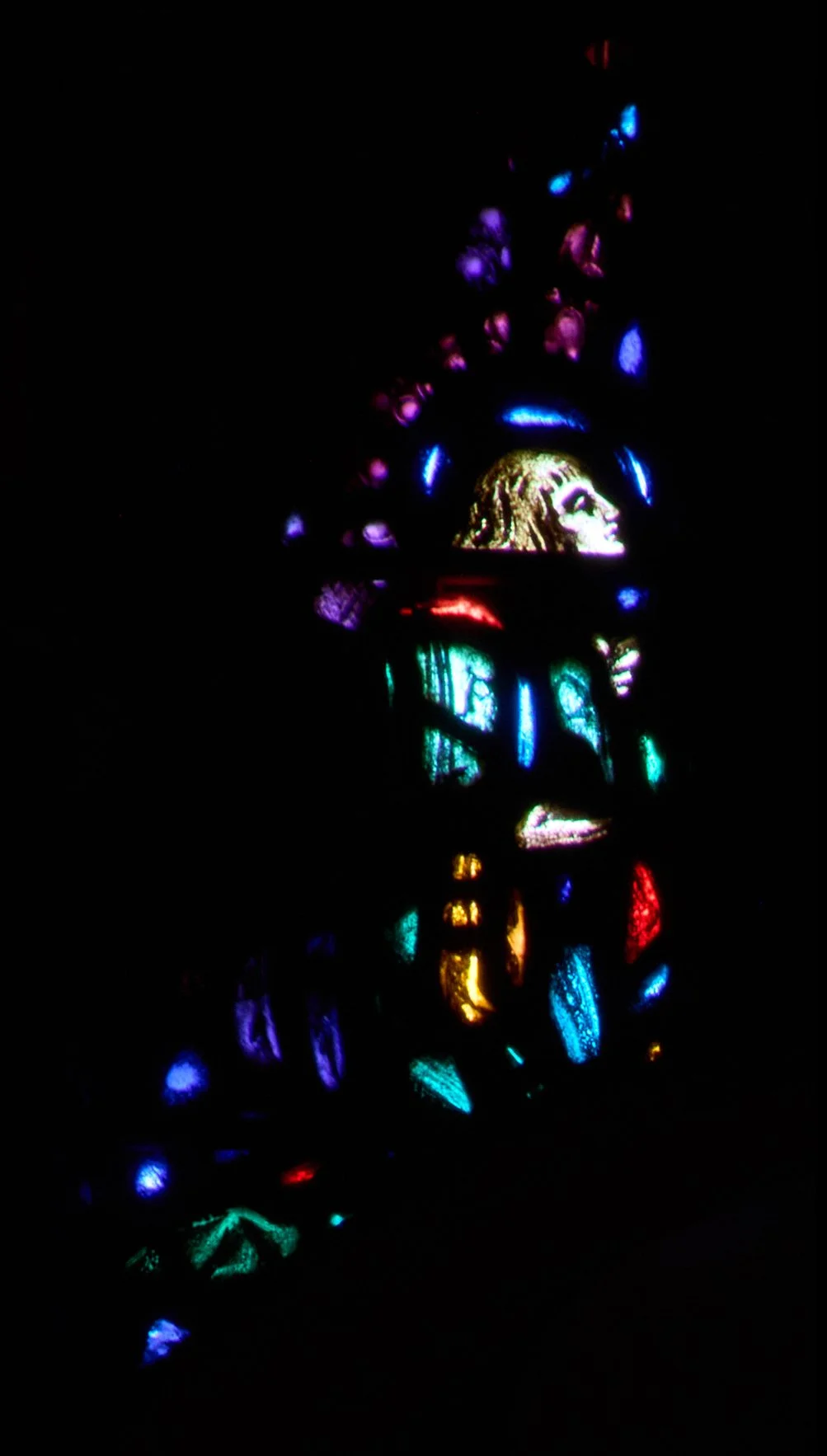
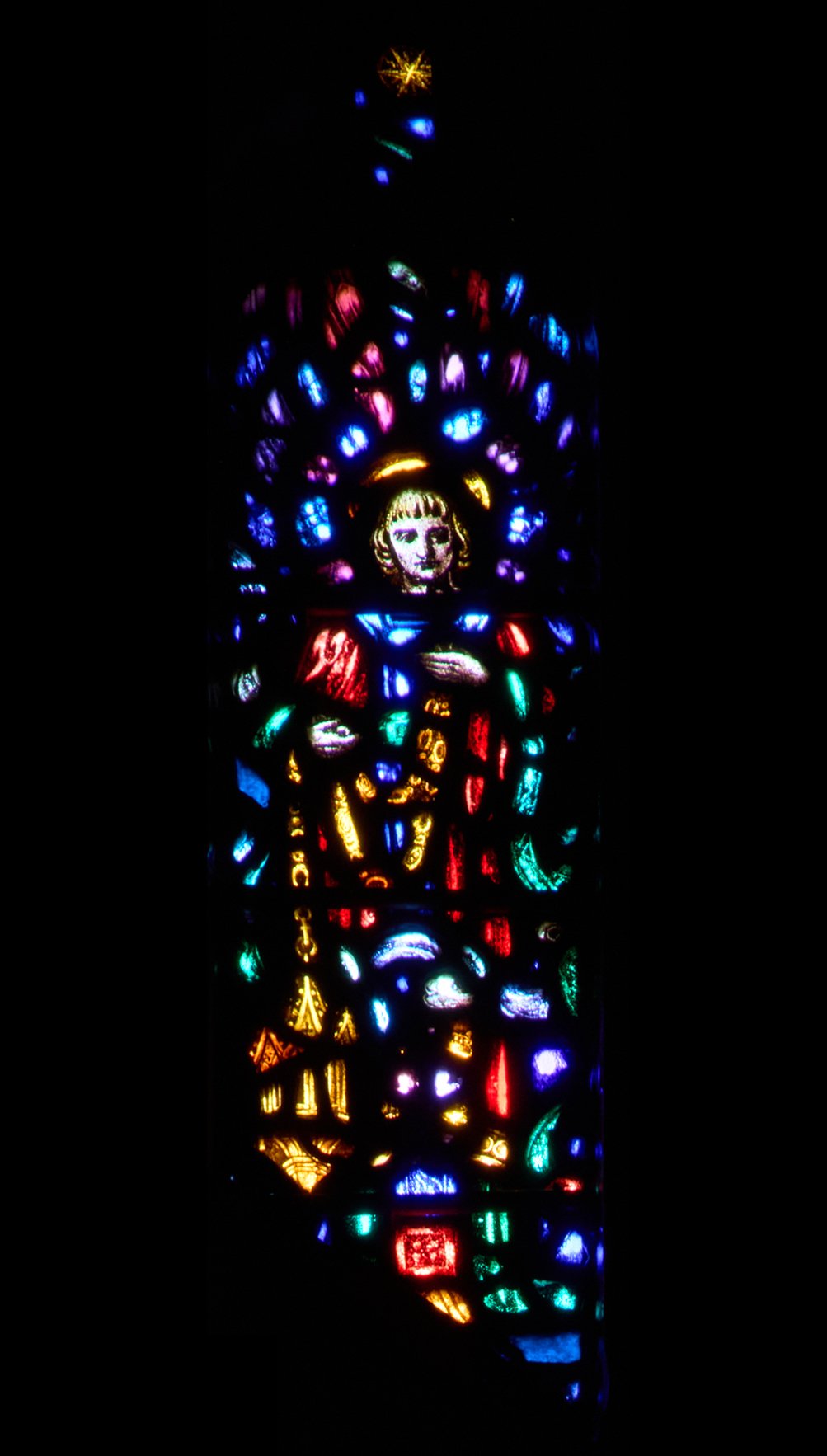
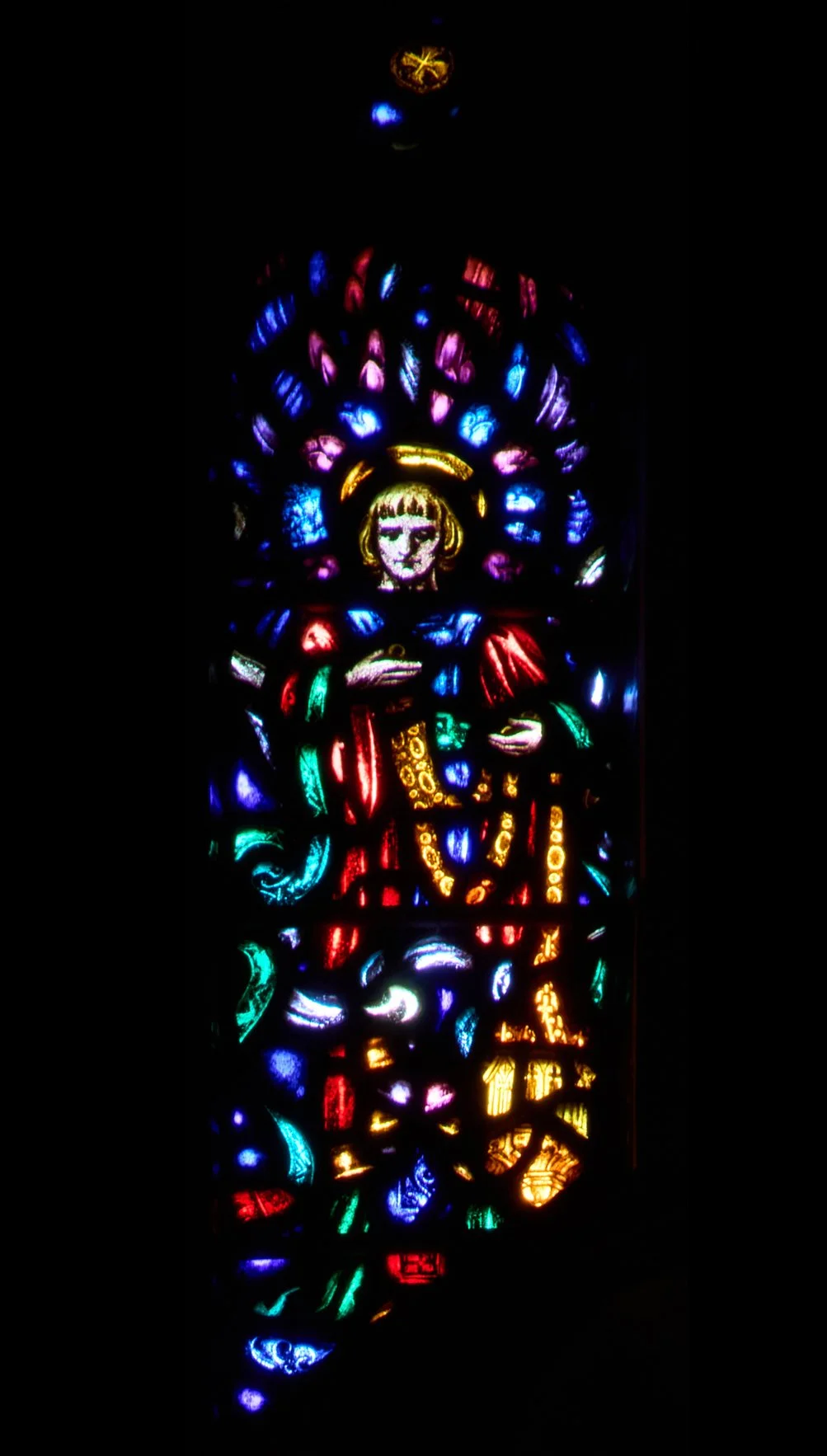
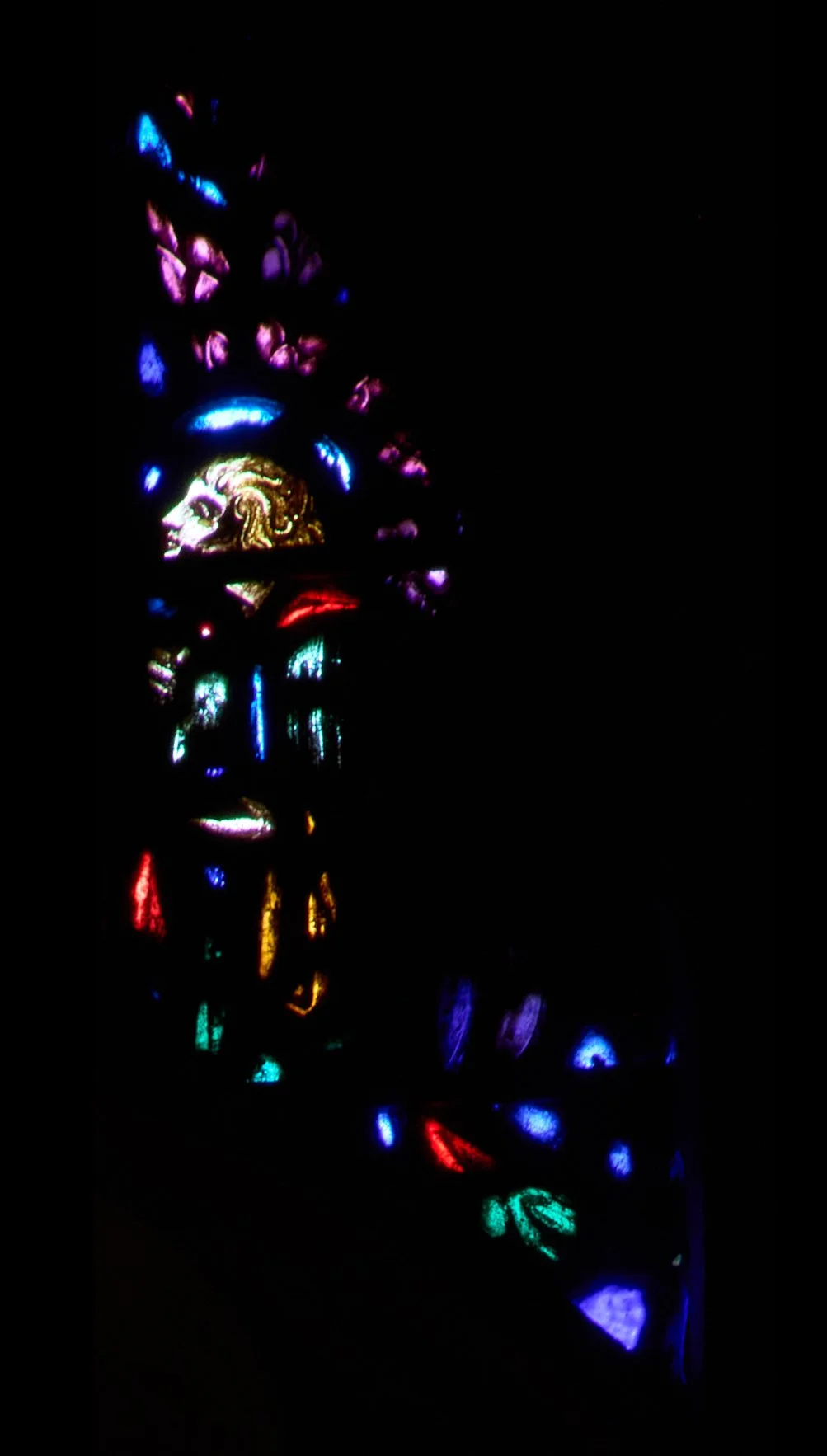
In the tracery above the window are two angels with golden censers of incense; to either side of them are men kneeling in worship of God. In Scripture, heartfelt, devout prayer is represented as incense in Heaven (Psalm 141:2, Revelation 5:8, 8:3–4). Burk may have included this detail as a nod to White’s observation that this imagery appears in a prophecy of the Gospel’s worldwide spread: “in every place incense shall be offered unto my Name” (Malachi 1:11). [4]
Interspersed among this window’s principal medallions are images of angels and specific saints. The angels, as God’s agents, represent Providence (paralleling the carved angels atop the Chapel ceiling’s buttresses). The Gospel Writers, Saints Matthew, Mark, Luke, and John, embody the faithfulness of the Early Church in recording and spreading Jesus’s teachings and example. The medieval English saints featured, some of whom are also seen in the Benjamin Franklin Window of Freedom Through the Word, contributed greatly to the growth of Christianity in England and on the European continent.
White is also commemorated with a recessed stone seat or sedile located directly underneath this window. The sedile recognizes his role as George Washington’s pastor during his Presidential administration, a small but important part of White’s 57 years as a minister in Philadelphia.
Ordained a priest in the Church of England in 1770, White had to swear allegiance to the crown. As was the case with all Church of England clergy in America, the outbreak of the American Revolution therefore posed a challenge of conscience. White, however, supported the Patriot cause because he believed, in his words, in “the inherent right of the community to resist and effectually to exclude unconstitutional and oppressive claims.” [5] He served as Chaplain of the Continental Congress from 1777 to 1789, then as a United States Senate Chaplain until 1800.
White played a key role in the development of the Episcopal Church in America. He was elected the first Bishop of the Diocese of Pennsylvania in 1786 and was later elected the first and fourth Presiding Bishop of the Episcopal Church in the United States. He supported greater inclusion of laypeople in church decision making bodies, supported missionaries to spiritually underserved parts of the United States, and spearheaded philanthropic efforts in Philadelphia, including a school for black and American Indian children. He ordained both the first, Absalom Jones, and the third, William Levington, African-Americans to be ordained in the Episcopal Church.
The Chapel building also features a Bishop White Library, completed in the early 1930s. Above its fireplace is engraved a quotation from White regarding the wholesome effects of Sunday School. Outside the Library is a bronze statue of a seated Bishop White by noted sculptor Alexander Stirling Calder.
NKH
Motifs Throughout
Blue Octagons and Red Squares: The windows’ field is of blue octagons with red squares interspersed, providing a predominantly blue backdrop.
Blue Rose/Fleur-de-Lis Lozenges: On either side of each panel in this window is a red vertical stripe with blue diamond shapes. This diamond shape, known as a “lozenge,” is common in heraldry. Each contains either a rose or a single fleur-de-lis in blue. This design helps to maintain the blue color scheme of the window even as the red band provides a contrasting outline.
AG
Stained Glass Design
Each of the windows in Washington Memorial Chapel have “medallions” depicting scenes or stories. In between those major medallions are smaller “intermedallions” which represent a theme or motif.
Within the tracery (intricate stonework window atop a stained glass window) are sections called daggers (dagger shaped), kites (diamond shaped) and panels (larger sections).
The slider below shows each medallion within the window.
-
![St. Peter Preaching at Jerusalem]()
01 St. Peter Preaching at Jerusalem
Saint Peter, the Apostle to the Jews, stands in the center of a Jerusalem crowd at the first Christian Pentecost.
-
![St. Paul Preaching at Antioch]()
02 St. Paul Preaching at Antioch
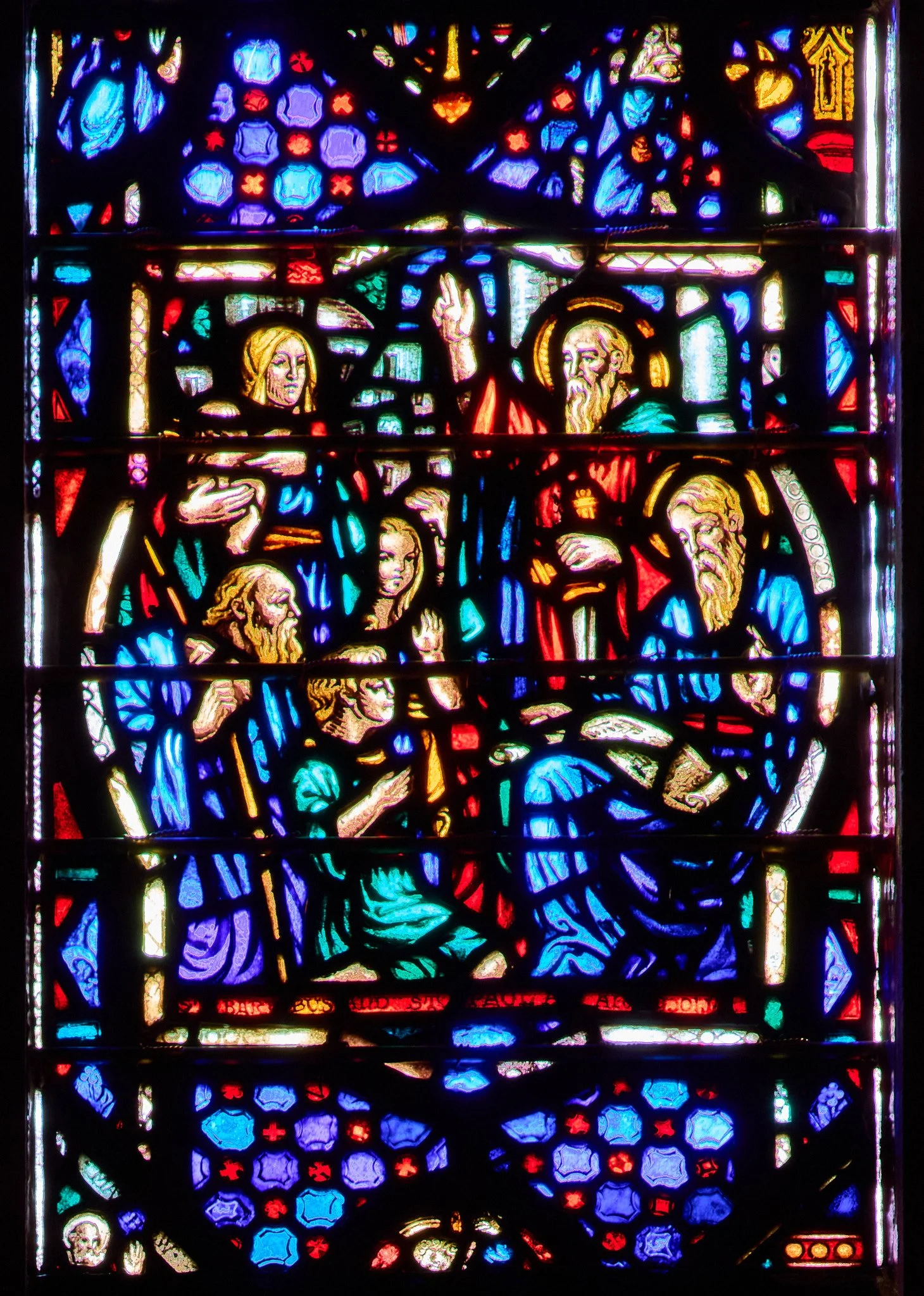
Two haloed figures, St. Paul and St. Barnabas, stand at the right of this scene, St. Paul with his hand raised in the gesture of preaching, and St. Barnabas beside him holding a book or scroll, as if reading or referencing scripture. Gathered around them are several listeners, some holding children; their raised hands and turned faces convey attention to the two apostles proclaiming the Gospel together.
-
![St. Paul Before Nero]()
03 St. Paul Before Nero
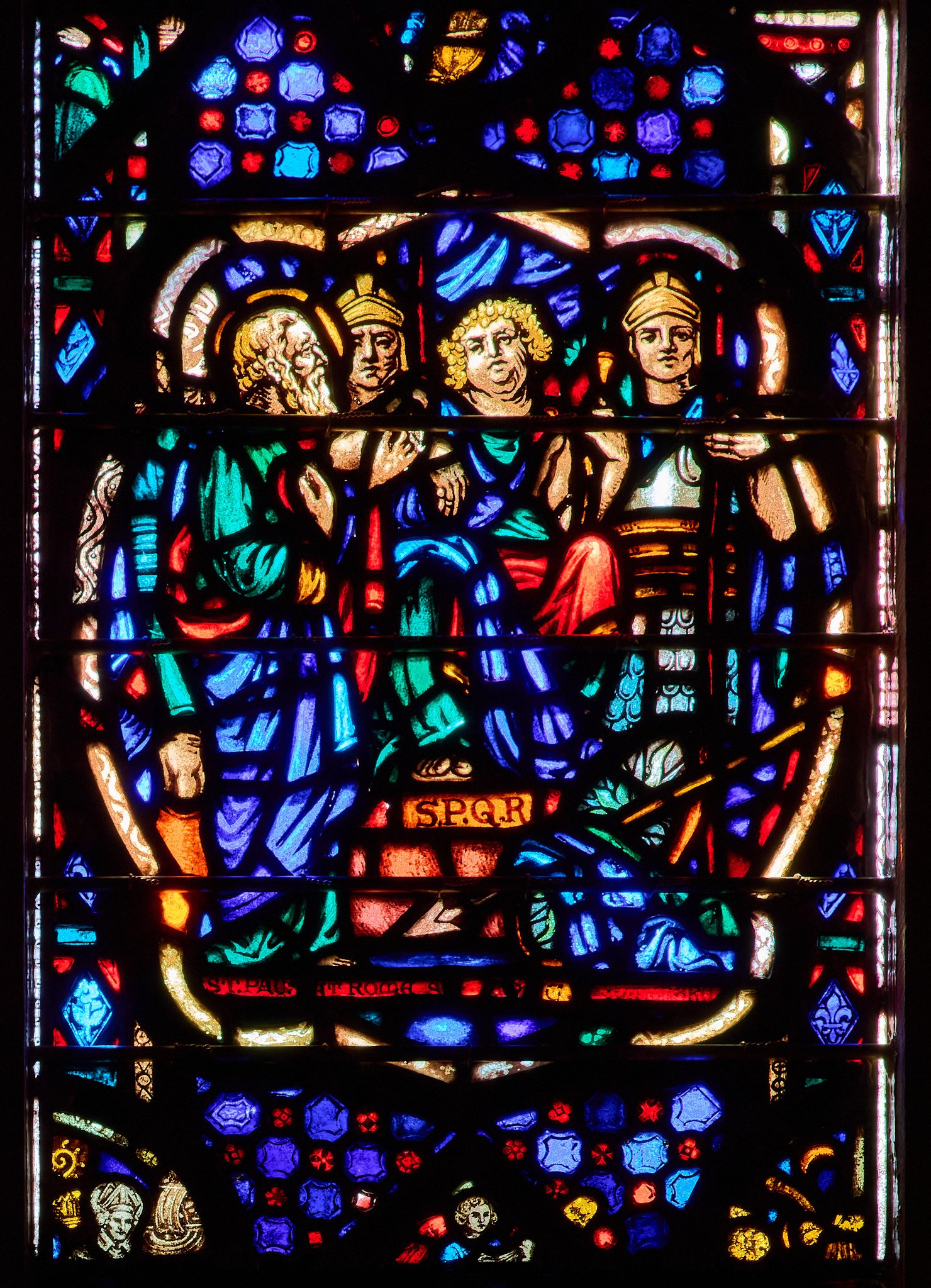
St. Paul, the bearded figure pictured in the left foreground, stands before the Roman emperor Nero. Nero is the central figure sitting upon his judgment seat, behind him are two Centurions standing guard. Stamped under the throne are the letters, “ SPQR, “ standing for “ Senatus Populusque Romanus, ” which translates to “ The Senate and the Roman People.”
-
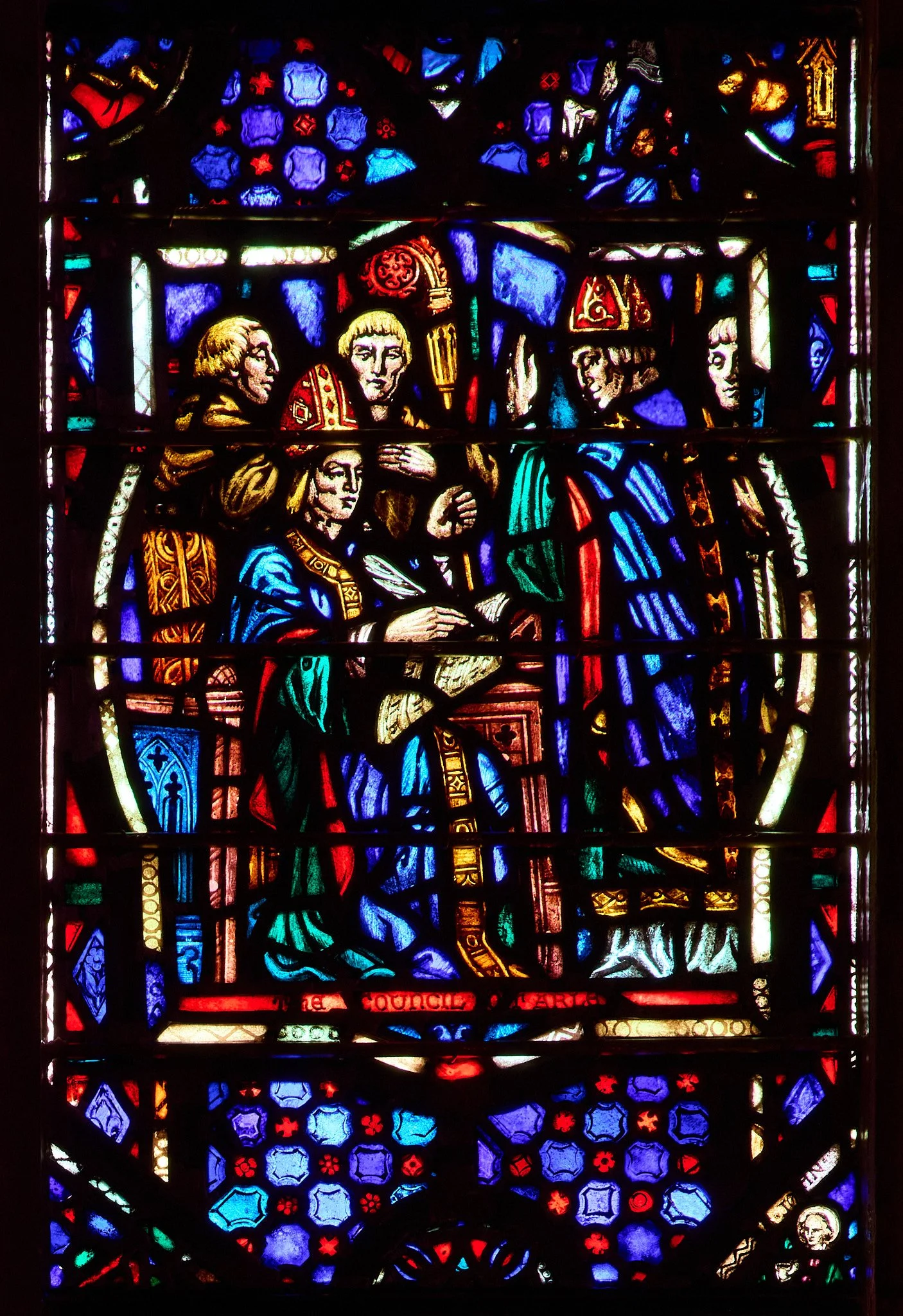
![The Council of Arles, 314 A.D.]()
04 The Council of Arles, 314 A.D.
Three bishops from Britain attending the Council of Arles, Eborius of York, Restitutus of London, and Adelphius of Lincoln/Colchester stand before either Emperor Constantine I, who convened the Council, or Bishop Marinus of Arles who chaired the Council.
-
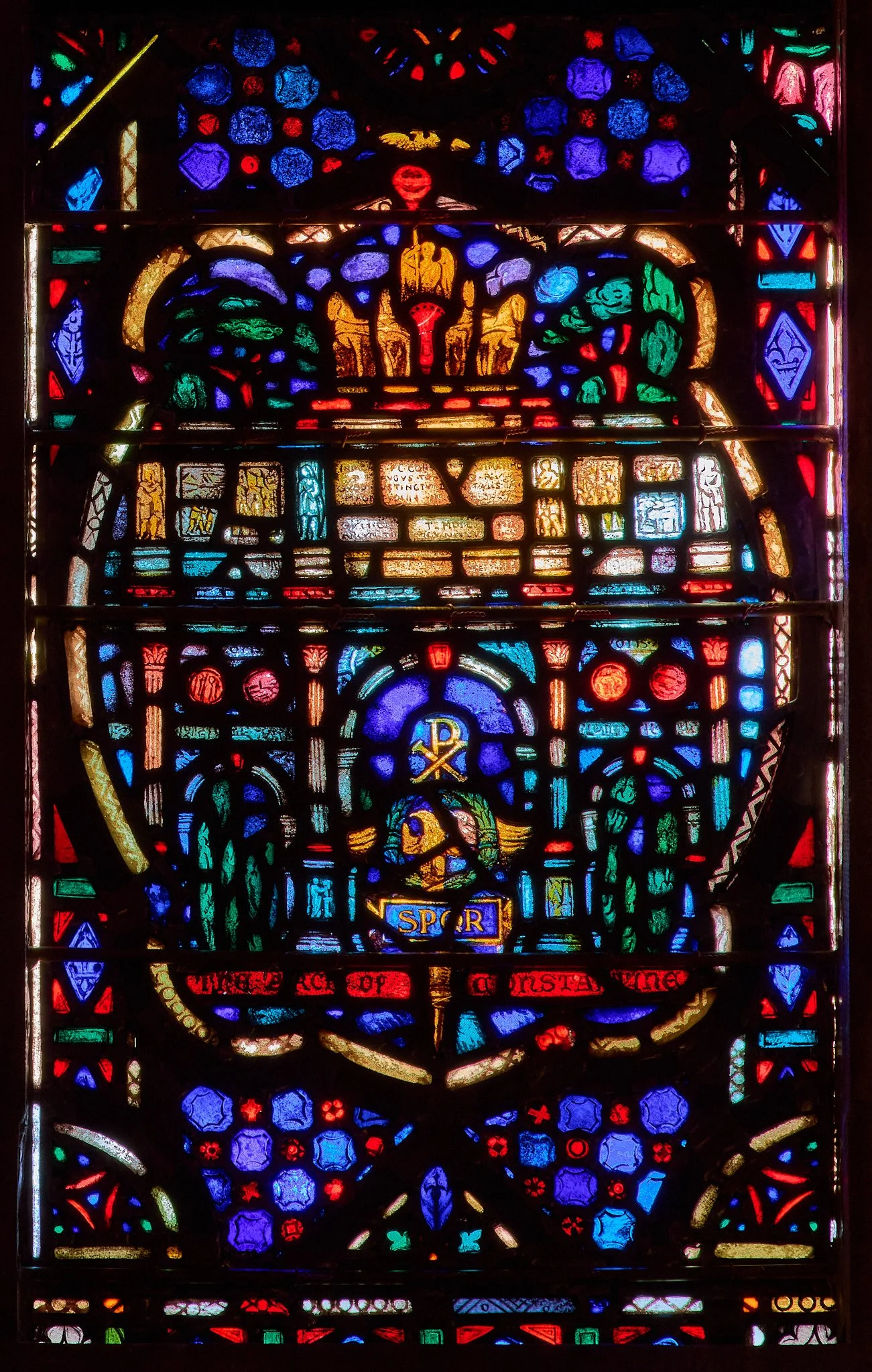
![The Arch of Constantine]()
05 The Arch of Constantine
The medallion shows the Arch of Constantine. It consists of three arched passageways, one on either side of a large central arch. Four columns in relief bracket the arches and on the top is a winged figure in a chariot drawn by four horses. In the central arch are the Greek letters X (chi) and P (rho), the first two letters of the Greek word Christos (Χριστός). Below them are the letters S P Q R, the abbreviation of the Latin, Senatus Populusque Romanus, The Roman Senate and People. Between the two groups of letters are an eagle and a wreath, possibly of oak leaves. The wreath, if made of oak leaves, is a corona civica or civic crown, awarded to Romans who saved the lives of fellow citizens. Together, the Greek and Latin words symbolize the supplanting of pagan Rome by Christianity under the Emperor Constantine, and the wreath may symbolize the saving of the Roman people by Christianity.
-
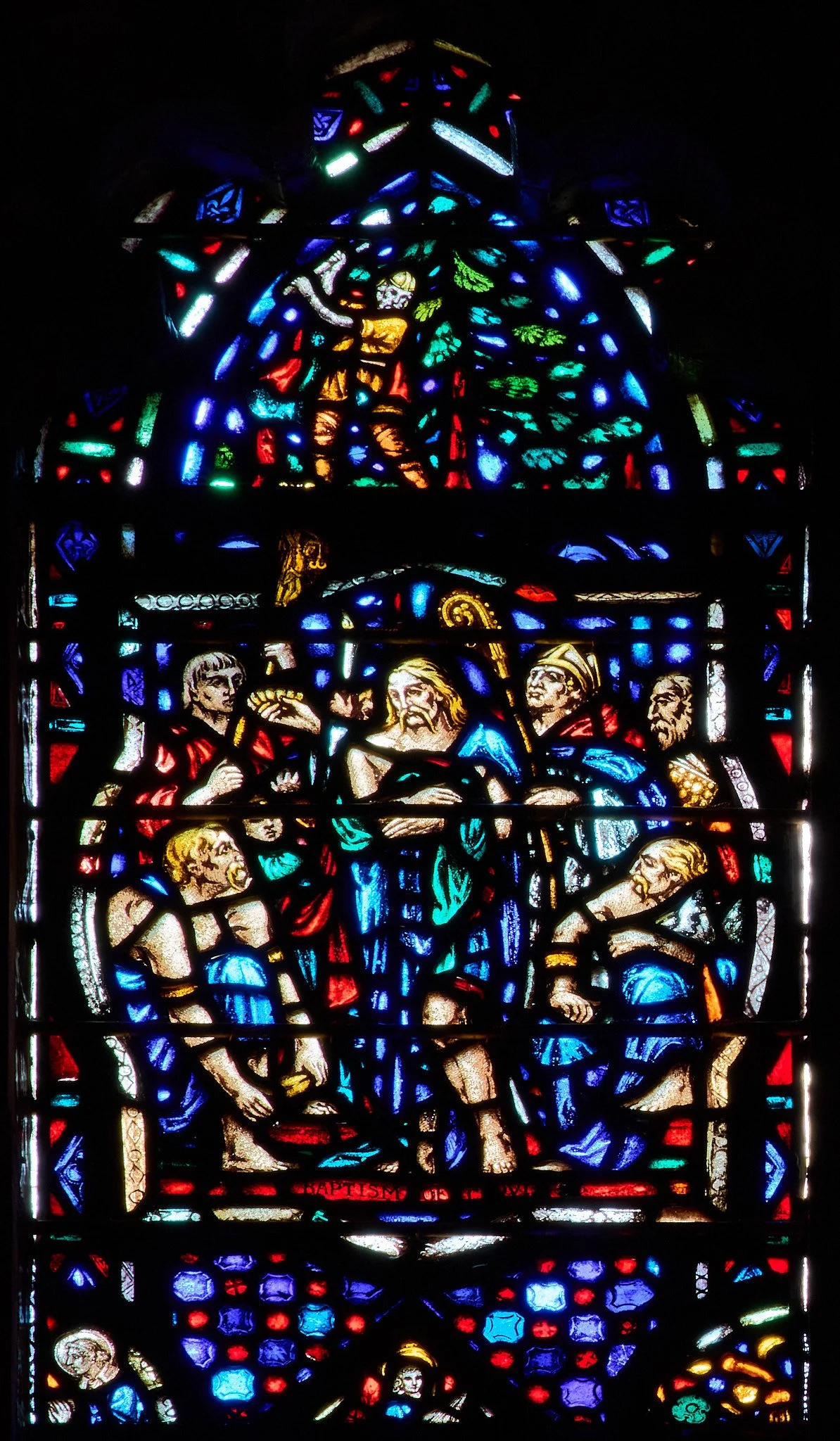
![The Baptism of Clovis]()
06 The Baptism of Clovis
The medallion shows Clovis being baptized into the Catholic Church by Saint Remigius, the Bishop of Reims. Clovis is in the middle of the scene and Saint Remigius stands immediately next to him. The others in the scene are waiting to be baptized.
-
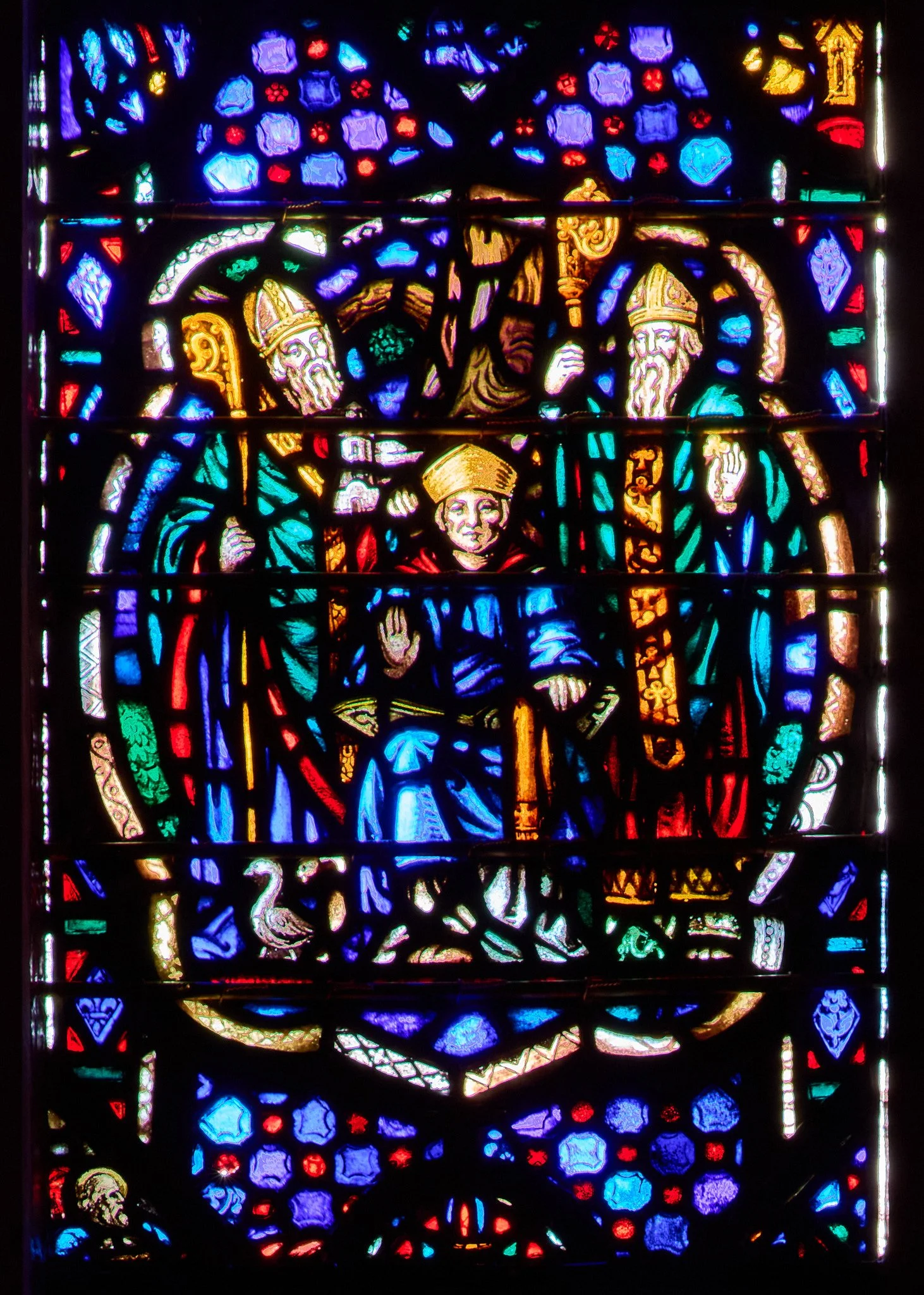
![Three Saints of the English Church]()
07 Three Saints of the English Church
The medallion shows the three saints of the English Church: St. Columba on the left, holding a crozier in his right hand and a small church in his left, has a dove depicted under his feet. In the center a seated St. Augustine, holds a book in his lap. On the right, St. Patrick also holds a crozier in his right hand, a shamrock in his left, and has a snake at his feet.
-
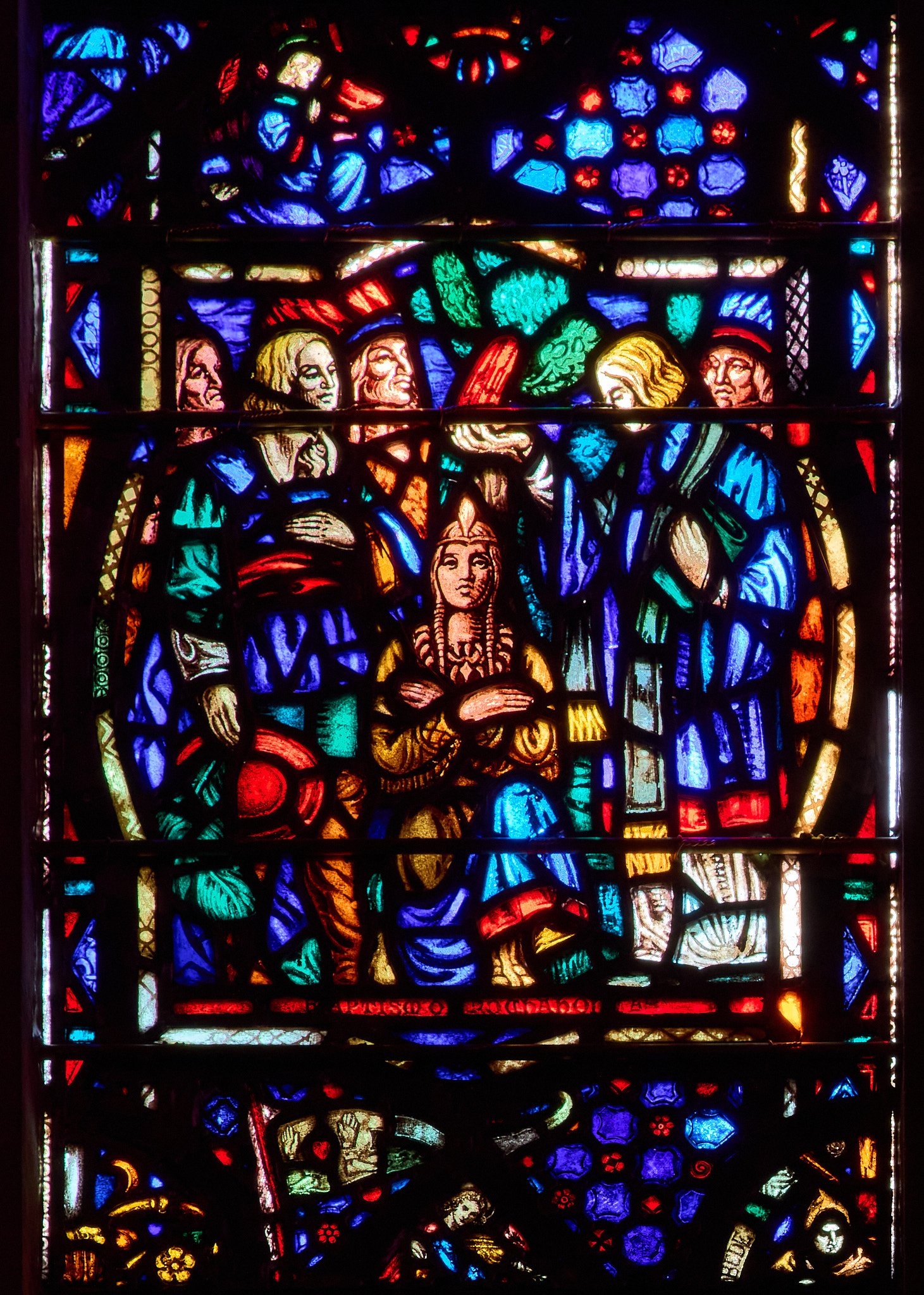
![The Baptism of Pocahontas]()
08 The Baptism of Pocahontas
Pocahontas kneels as she is baptized by the Reverend Alexander Whitaker. Her future husband, John Rolfe, stands behind her right shoulder, with another Englishman behind him (presumably Sir Thomas Dale). Two Powhatan men stand in the background (presumably Pocahontas’s brother Nantequaus and uncle Opachisco).
-
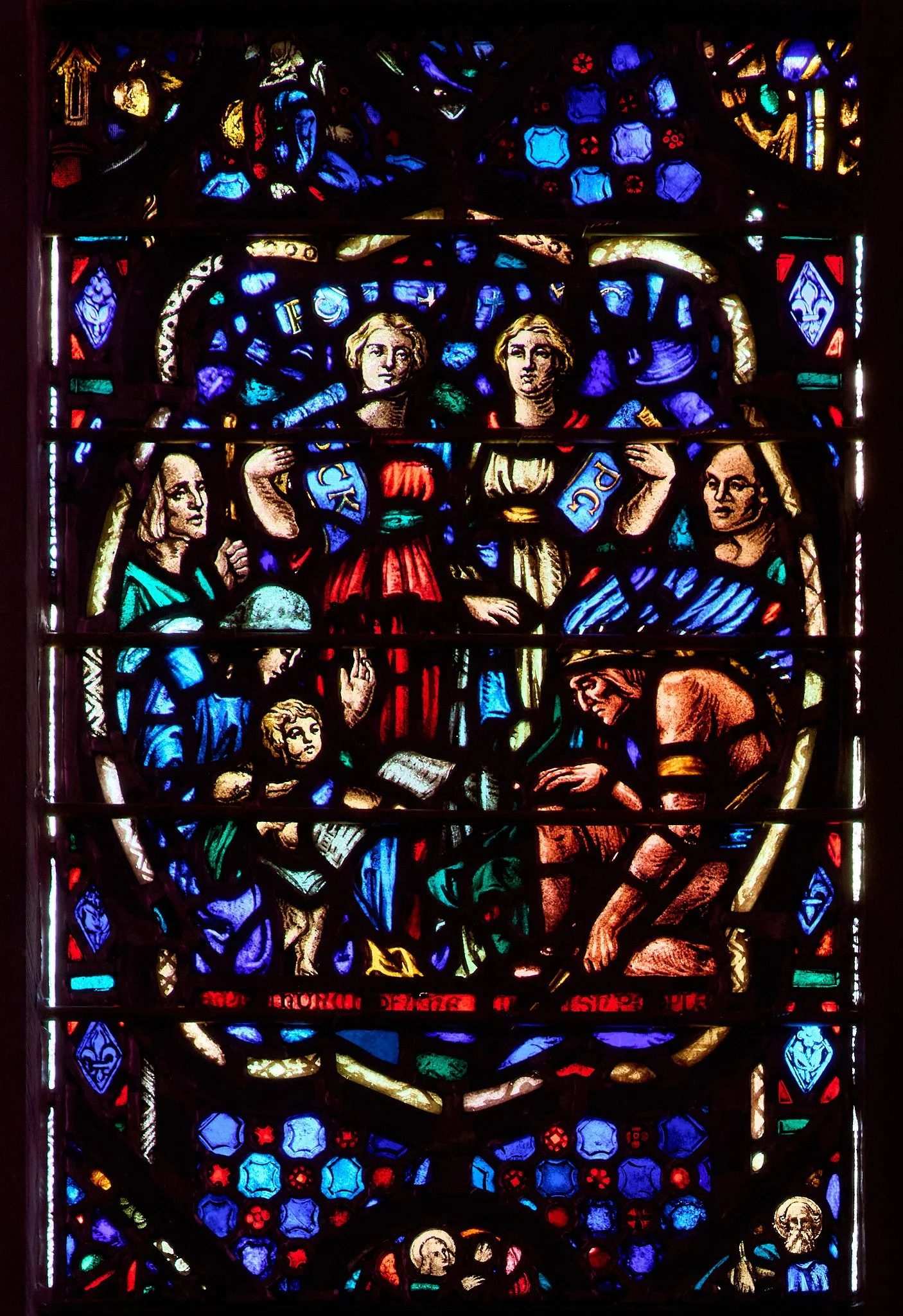
![The English Church in America]()
09 The English Church in America
Two women, arm-in-arm, stand in the center. One bears a scroll with the letters SPCK (the Society for Promoting Christian Knowledge), and the other bears a scroll with the letters SPG (the Society for the Propagation of the Gospel). A Native American kneels towards the one bearing the SPG scroll receiving instruction in the Gospel, while another looks on in the background. A man and woman kneel towards the woman with the SPCK scroll, while a child in the foreground holds a book and is being taught to read.
-
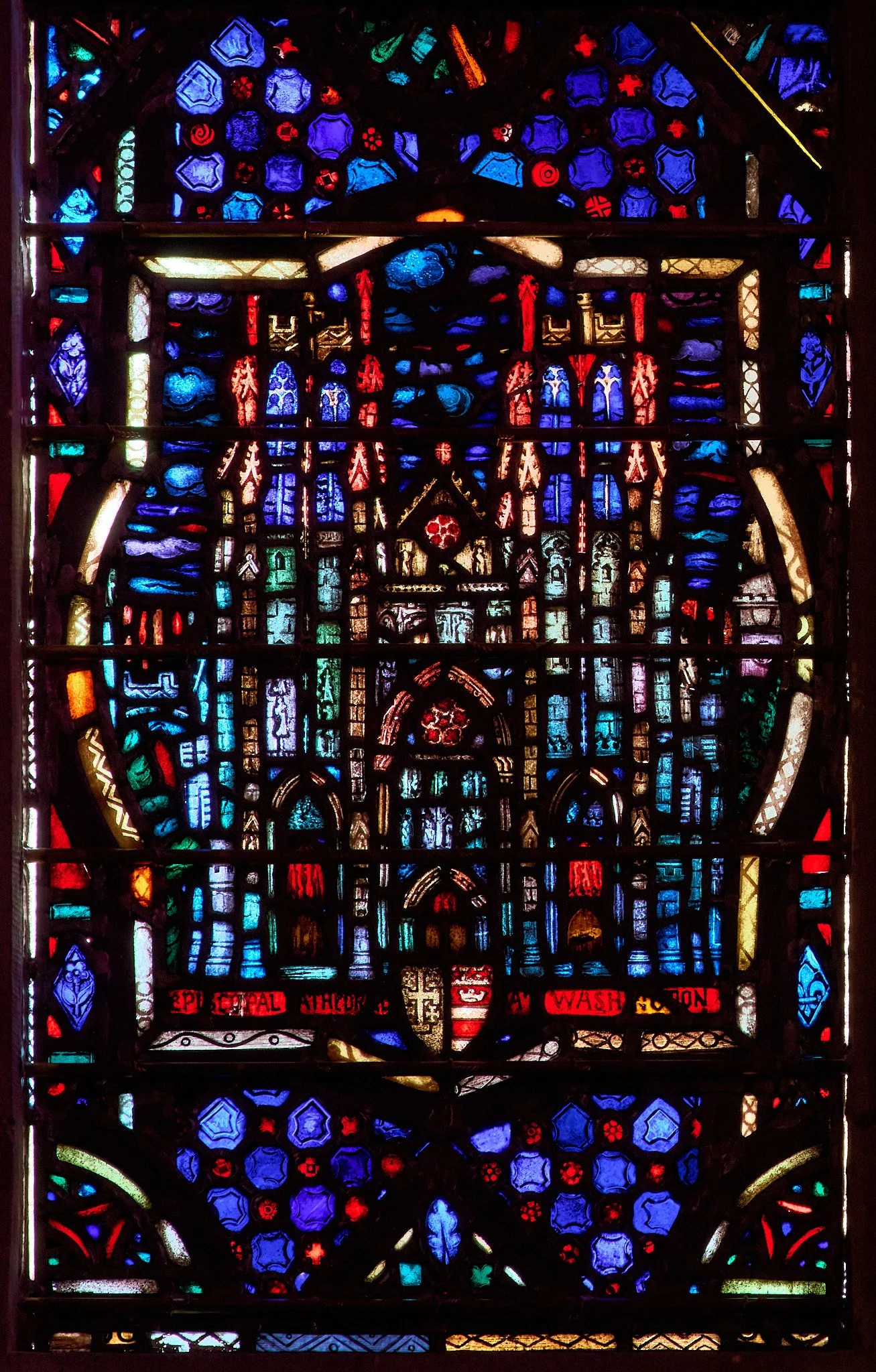
![The Facade of the Cathedral of St. Peter and St. Paul, Washington, D.C.]()
10 The Facade of the Cathedral of St. Peter and St. Paul, Washington, D.C.
The medallion shows the West Front of the National Cathedral, as designed by George F. Bodley and Henry Vaughan in 1907, with the first coat of arms of the Episcopal Diocese of Washington. The arms included those of Jerusalem and those of George Washington.
-
![Tracery Glass 1 (Dagger) Worshipper]()
Tracery Glass 1 (Dagger) Worshipper
-
![Tracery Glass 2 (Panel) Angel]()
Tracery Glass 2 (Panel) Angel
-
![Tracery Glass 3 (Panel) Angel]()
Tracery Glass 3 (Panel) Angel
-
![Tracery Glass 4 (Dagger) Worshipper]()
Tracery Glass 4 (Dagger) Worshipper
1 Saint Peter Preaching at Jerusalem
Medallion 1: Saint Peter Preaching at Jerusalem
Location: Right lancet, top
Description:
Saint Peter, the Apostle to the Jews, stands in the center of a Jerusalem crowd at the first Christian Pentecost.
Background:
The Reverend W. Herbert Burk described this scene as the first preaching of the Gospel or "the first Christian sermon." The subsequent baptism of "about three thousand souls" became, in Burk's words, "the first facts of the Christian ministry." The Holy Spirit had miraculously transformed Saint Peter in Jerusalem from a lonely, frightened denier of his discipleship into a fearless public confessor of Christ in fulfillment of Christ's prophecy that Peter would be the rock upon which the Church would be built. This scene represents the first implementation by the disciples of the Great Commission.
Following his resurrection, Jesus shared lessons, meals, and his physical presence with the disciples for forty days restoring their hope and faith. Near the end of this period, Jesus delivered the Great Commission, commanding the disciples to spread the gospel and make disciples of all nations through baptism and Christian instruction.
Crowds gathered in Jerusalem fifty days after Christ's Resurrection for the annual Jewish festival of Shavuot. Jews celebrated Shavuot, the Feast of Weeks, on the fiftieth (Greek: pentekoste) day after Passover. Shavuot honored the grain harvest and later commemorated the giving of the Torah and the issuance of the Ten Commandments on Mount Sinai.
The disciples, present among the Shavuot crowds, hesitated to proceed in fulfilling Christ's Great Commission. "And suddenly from heaven there came a sound like the rush of a violent wind… Divided tongues, as of fire, appeared among them, and a tongue rested on each of them (Acts 2:2-3, NRSV)." Filled with the Holy Spirit and unafraid of Roman or religious authorities, the disciples spoke to devout Jews from every nation in their native languages sharing messages about God's deeds.
As the crowd stood amazed, some accused the disciples of drunkenness from new wine. Peter contradicted the accusers, raising his voice to remind the crowd of the prophet Joel's predictions and cited the Holy Spirit as the explanation for the disciples' ability to speak in tongues. Peter asked the crowd to recall the list of Biblical prophecies fulfilled in the life, death, and resurrection of Jesus Christ, and said Israel should know with certainty that Jesus, whom the lawless had crucified, had been made both Lord and Messiah by God.
"Now when they heard this, they were cut to the heart and said to Peter and to the other apostles, 'Brothers, what should we do?' Peter said to them, 'Repent, and be baptized every one of you in the name of Jesus Christ so that your sins may be forgiven; and you will receive the gift of the Holy Spirit. For the promise is for you, for your children, and for all who are far away, everyone whom the Lord our God calls to him.'… So those who welcomed his message were baptized, and that day about three thousand persons were added… And day by day the Lord added to their number those who were being saved (Acts 2:37–40, 41-42, 47)."
An empowered and cohesive Christian community grew from the newly baptized in a repeating pattern that formed the foundation of the Christian Church. Pentecost, considered the "birth of the Church," took on new significance for Christians while retaining its historical connection to the Old Testament as the word of Jesus Christ spread across Israel and then the world.
DCS
Intermedallion [Surrounding Saint Peter Preaching at Jerusalem]
- Scene: Top scenic panel: A haloed knight on a ship flying both English and Papal flags, with a shield bearing the English royal coat of arms in the foreground. NH White banner states "onward ever," a rallying cry for knights of the Crusades. AG
- St. Hilda of Whitby: Quadrant in bottom left: St. Hilda founded the Abbey of Whitby, which was also dedicated to St. Peter. AG
- Cross: Bottom triangle: A Gold Latin cross surrounded with red, a symbol of Christ's and sacrifice. AG
- Unidentified Gold Item: Quadrant in bottom right: This piece coincides with the gold building or object in the quadrant below. Together, these gold items may symbolize the building of Christian worship spaces as Christianity spread throughout the world. AG
2 St. Paul Preaching at Antioch
Medallion 2: St. Paul Preaching at Antioch
Location: Right lancet, second from top
Description:
Two haloed figures, St. Paul and St. Barnabas, stand at the right of this scene, St. Paul with his hand raised in the gesture of preaching, and St. Barnabas beside him holding a book or scroll, as if reading or referencing scripture. Gathered around them are several listeners, some holding children; their raised hands and turned faces convey attention to the two apostles proclaiming the Gospel together.
Background:
The Bishop William White Window traces the theme "The Church's Conquest of the World," illustrated by its dedicatory verse, Mark 16:15, Christ's command to "go into all the world, and preach the Gospel to every creature." The window's ten medallions form a visual sermon on that command, tracking the spread of Christianity outward from Jerusalem through the Roman Empire, into barbarian Europe, across the English Church, and finally into America.
St. Paul and St. Barnabas's ministry at Antioch is the second link in this chain, following directly from St. Peter's preaching at Jerusalem. It was in Antioch of Syria that the two first taught for a full year among a growing and diverse congregation, and it was there that believers were first called Christians according to Acts 11:26. However, this medallion specifically references their journey to Antioch of Pisidia, where St. Paul delivered the sermon recorded at length in Acts 13:14-52. Addressed to the Israelites and Gentiles, St. Paul traces Israel's history from the Exodus through King David, then presents Jesus as the fulfillment of God's promise to raise up a savior from David's line, preaching that through Jesus, forgiveness of sins is offered in a way the Law of Moses could never provide. The sermon draws a large crowd but provokes jealousy among some of the synagogue's Jewish leaders, who contradict and revile St. Paul's message. In answer, St. Paul and St. Barnabas deliver the declaration this medallion primarily commemorates: "It was necessary that the word of God should first be spoken to you. But since you thrust it aside and judge yourselves unworthy of eternal life, behold, we turn to the Gentiles" (Acts 13:46). The Gentiles in the city rejoice, and Luke records that "the word of the Lord spread throughout the whole region" (Acts 13:49), marking the Gospel's first great expansion beyond its original Jewish audience and setting the pattern for what the rest of the window depicts moving forward.
As The Reverend W. Herbert Burk wrote about this event, "The year spent by these two men in that great city on the Orontes was one of the most notable in the world for it marked the transition of the Christian church from the Jewish atmosphere of Jerusalem to a great center of Gentile life and influence."
MM
Intermedallion [Surrounding St. Paul Preaching at Antioch]
- St. Hilda of Whitby: Quadrant in top left: The lower body of St. Hilda from the quadrant above, who founded the Abbey of Whitby, which was also dedicated to St. Peter.
- Cross: Bottom triangle: A Gold Latin cross continued from the triangle above , a symbol of Christ's and sacrifice.
- Unidentified Saint: This saint prays at the base of the gold cross in the quadrants to the left of him.
- Unidentified Gold Item: This piece coincides with the gold building or object in the quadrant above. Together, these gold items may symbolize the building of Christian worship spaces as Christianity spread throughout the world.
- St. Matthew: Bottom left triangle: St. Matthew is depicted as an older man with his left hand raised. This image continues in the triangle directly below.
- Angel: Bottom demilune: Angel wielding item over head, into gold object in demilune directly below. This image may recall Acts 13: , which tells the story of the Holy Spirit calling for Paul and Barnabas to leave Antioch and begin their missionary journey.
- Washington Coat of Arms: Bottom right triangle: Top portion of Washington's Coat of Arms, showing three white circles on a field of red.
AG
3 St. Paul Before Nero
Medallion 3: St. Paul Before Nero
Location: Right lancet, third from top
Description:
St. Paul, the bearded figure pictured in the left foreground, stands before the Roman emperor Nero. Nero is the central figure sitting upon his judgment seat, behind him are two Centurions standing guard. Stamped under the throne are the letters, " SPQR, " standing for " Senatus Populusque Romanus, " which translates to " The Senate and the Roman People."
Background:
St. Paul, known as the Apostle to the Gentiles, represents the spread of Christianity from the Jews in the Roman province of Palestine to the Gentiles (pagans) throughout the Roman world. St. Paul was the most traveled of the early Christian apostles, carrying out four missionary journeys during his lifetime. He was born Saul, circa 4 B.C., in the Roman province of Cilicia, (Modern-day Turkey), in the town of Tarsus; he was therefore both a Jew and a Roman citizen. Tradition holds that his family was of some wealth, and although he was trained as a tentmaker, he also was taught Greek. Saul was a member of the Jewish religious sect known as the Pharisees. He studied Jewish faith under the tutelage of Gamaliel, a famous Jewish scholar and rabbi, in Jerusalem. He was deeply religious and well schooled in the Torah and Judaic law and traditions. In his early life, he was a tireless and vociferous persecutor of Christians and the early Christian Church. In his travels he visited synagogues urging their congregations to expel Christians from their midsts.
Saul’s dramatic conversion to Christianity while traveling on the road to Damascus is well known to Christians and told in Acts 9:1-9. From this moment on he was known as Paul and became one of the greatest Christian missionaries and religious leaders in history. He became a zealous advocate of Christ’s divinity and teachings. He traveled throughout Judea, Cilicia, Asia Minor, Macedonia, Greece, and Caesarea preaching the Good News of Christ’s life, death, resurrection, and promise of salvation and redemption. Along the way he formed Christian communities in the Gentile world of the Roman Empire - forming Christian Churches.
He and his fellow apostles were frequently harassed, arrested, and imprisoned during these proselytizing journeys, yet they encouraged the fledgling churches to persist and spread the Good News to Jew and gentile alike. St. Paul's epistles to these churches, there are thirteen, form a large part of the New Testament. Eventually, on return to Jerusalem, St. Paul was brought before two Roman governors, Felix and Festus, on several charges, including treason against the Empire. Being a Roman citizen, Paul asked for trial before Emperor Caesar in Rome. For his safety, he was transported to Caesarea pending his transport to Rome.
This scene, St. Paul standing trial before the Roman emperor Nero, likely occurred between 60 to 64 A.D. in Rome. The details are recounted at the end of the New Testament book the Acts of the Apostles. Tradition holds that St. Paul was acquitted and went on to travel as far as Spain on another missionary sojourn before returning to Rome. It is believed he was rearrested, imprisoned, and martyred by beheading during Nero's campaign of Christian persecution that occurred after the massive fire that destroyed much of Rome. Ultimately, despite Roman efforts to contain and eliminate the spread of Christianity throughout their empire, the churches St. Paul planted, grew, thrived, and spread the Gospel to the far reaches of the Roman world and beyond.
DRS
Intermedallion [Surrounding St. Paul Before Nero]
- St. Matthew: Top left triangle: St. Matthew is depicted as an older man with his left hand raised. This image is continued from the triangle directly above.
- Angel: Center demilune: Angel wielding item over head, into gold object in demilune directly below. This image may recall Acts 13: , which tells the story of the Holy Spirit calling for Paul and Barnabas to leave Antioch and begin their missionary journey.
- Washington Coat of Arms: Top right triangle: Lower portion of Washington's Coat of Arms, showing the red and white fields of the flag.
- St. Wilfrid: Quadrant in bottom left: St. Wilfred attended the Synod of Whitby and argued that church traditions should follow the teachings of Peter and Paul, particularly the use of the Roman calendar date to calculate the date of Easter. The image continues in the quadrant directly below this image.
- Angel Reading Book: Bottom triangle: Divine wisdom and sacred knowledge may be represented by an angel reading, with a particular focus on reflection and quiet contemplation.
- Unidentified Gold Item: Quadrant in bottom right: This piece coincides with the gold building or object in the quadrant below. Together, these gold items may symbolize the building of Christian worship spaces as Christianity spread throughout the world.
AG
4 Council of Arles, 314 A.D.
Medallion 4: Council of Arles, 314 A.D.
Location: Right lancet, fourth from top
Description:
Three bishops from Britain attending the Council of Arles, Eborius of York, Restitutus of London, and Adelphius of Lincoln/Colchester stand before either Emperor Constantine I, who convened the Council, or Bishop Marinus of Arles who chaired the Council.
Background:
The Council of Arles, convened by Constantine I on August 1, 314 AD, in Arles in Southern Gaul (modern day France) was an historic event. It was the first deliberative assembly of Christian Bishops in the Western Roman Empire. It was historic because: 1. It was the first time a Christian faction asked a secular leader to help resolve an ecclesiastical dispute. 2. It was the first of several bold moves by Constantine to organize the early Christian church and use councils to promulgate church law that would apply to all participating Christian churches.
In the pre-Christian era the Roman empire was ruled by various emperors and there were a variety of religions throughout the empire ranging from traditional Roman polytheism to mystic sects, Judaism, and rapidly growing Christianity. Constantine I, Emperor of the Western Roman empire, had converted to Christianity and issued the Edict of Milan in 313 AD which legalized Christianity in the Roman Empire. He convened the Council of Arles to resolve the dispute within the church caused by Donatists, a faction who were unhappy with the ordination of a Bishop.
The Donatists had alleged that in 311 Caecilian was improperly elected Bishop of Carthage by officiating bishops, and they wanted Caecilian deposed. An appeal to a tribunal in Rome ruled against them and the Donatists demanded a more impartial hearing. Constantine agreed to their demand and the result was the first inter-provincial council held August 1, 314 AD, at Arles in southern France. The host bishop, Marinus of Arles, chaired the meeting and at least thirty-three bishops were present—including three from Britain. The council not only upheld the previous validation of Caecilian's election, it took the opportunity to make a variety of pronouncements on church practices—discipline, prerogatives, and limitations of various clergy, essentially the first promulgation of ecclesiastical law (operating policy). It reported the establishment of twenty-two canons (rules) to Pope Sylvester who had remained in Rome.
The Reverend Burk's interest in the Council of Arles was not centered on the ecclesiastical implications, but rather he pronounced, "...our purpose is to trace the wide growth of the Christian Church. There is no better evidence of the westward faring of the Gospel than the Council of Arles, held in the year 314 in the city in southern France which gave its name to the council…. The Church had reached the western limits of the world and our three bishops proclaim the growth of the Kingdom."
KRD
Intermedallion [Surrounding Council of Arles, 314 A.D.]
- St. Wilfrid: Quadrant in top left: Bottom half of St. Wilfrid quadrant from above.
- Angel: Top right middle: This is the bottom half of the angel from the triangle located directly above.
- Unidentified Gold Item: This piece coincides with the gold building or object in the quadrant above. Together, these gold items may symbolize the building of Christian worship spaces as Christianity spread throughout the world.
- St. John: Bottom right triangle: St. John holds a cup, and possibly a snake, recalling the legend of St. John blessing a cup of poisoned wine and a snake crawling out, drawing out the poison.
AG
5 The Arch of Constantine
Medallion 5: The Arch of Constantine
Location: Right lancet, bottom
Description:
The medallion shows the Arch of Constantine. It consists of three arched passageways, one on either side of a large central arch. Four columns in relief bracket the arches and on the top is a winged figure in a chariot drawn by four horses. In the central arch are the Greek letters X (chi) and P (rho), the first two letters of the Greek word Christos (Χριστός). Below them are the letters S P Q R, the abbreviation of the Latin, Senatus Populusque Romanus, The Roman Senate and People. Between the two groups of letters are an eagle and a wreath, possibly of oak leaves. The wreath, if made of oak leaves, is a corona civica or civic crown, awarded to Romans who saved the lives of fellow citizens. Together, the Greek and Latin words symbolize the supplanting of pagan Rome by Christianity under the Emperor Constantine, and the wreath may symbolize the saving of the Roman people by Christianity.
Background:
The Roman emperor Constantine, known as Constantine the Great, ruled from 306 AD to 337 AD, and was the first Roman emperor to convert to Christianity. The Reverend W. Herbert Burk notes as a point of interest that Constantine was proclaimed emperor at York in Britain and that the Bishop of York was present at the Council of Arles in 314 AD. It was not until 312 AD, however, that Constantine defeated another pretender to the imperial crown, Maxentius, at the Battle of Milrain Bridge and became the undisputed emperor. The Arch of Constantine in Rome is a triumphal arch commemorating Constantine's victory and was dedicated by the Roman Senate in 315 AD.
In 313 AD Constantine issued what is known as the Edict of Milan which legalized Christianity and ceased persecution of Christians. He convened the First Council of Nicaea in 325 AD which produced the Nicene Creed, the definitive statement of Christian belief. At about the same time, he ordered the building of the Church of the Holy Sepulchre in Jerusalem. Constantine himself, however, did not convert to Christianity until he was on his deathbed in 337 AD.
Regardless of its origins, the arch's association with Constantine, the first Christian emperor of the Roman empire, is the reason for its inclusion in the Bishop White Window - The Church's Conquest of the World. As a symbol of Constantine the Great, it represents the pivotal moment in history when the Christian church emerged as the successor to the pagan Roman empire shaping modern Western civilization. Burk wrote that ". . . the Arch has been selected as the symbol of the Conqueror, not Constantine the Great, but Christ the King of Kings and Lord of Lords, the Saviour of the World."
GPP
Intermedallion [Surrounding The Arch of Constantine]
- St. John: Top right triangle: This is the representation of St. John, continued from the triangle above. AG
AG
6 The Baptism of Clovis
Medallion 6: The Baptism of Clovis
Location: Left lancet, top
Description:
The medallion shows Clovis being baptized into the Catholic Church by Saint Remigius, the Bishop of Reims. Clovis is in the middle of the scene and Saint Remigius stands immediately next to him. The others in the scene are waiting to be baptized.
Background:
A single baptism helped change the course of European history. When Clovis, king of the Franks, accepted Christianity, he set in motion events that would shape the future of France, the Catholic Church, and the spread of Christianity across western Europe.
Sometime between 496 AD and 508 AD, Clovis, the pagan king of the Franks, was baptized into the Catholic Church. At that time, most of the Germanic tribes that were not pagan had converted to Arianism, a heresy condemned by the Council of Nicaea in 325 AD. Clovis's conversion to Nicaean Christianity, that is, Catholicism, set the stage for Christianity becoming the dominant faith in Western Europe, supported by powerful rulers.
Clovis ruled in the late fifth and early sixth centuries. He united several Frankish groups under his leadership and expanded his power across much of what had been Roman Gaul. Because of his military victories and political skill, his kingdom became the foundation for the future kingdom of France. In that sense, Clovis is often remembered as the first major ruler in the line that would eventually lead to France as a nation.
His conversion was strongly influenced by his wife Clotilde, a Burgundian princess who was already a devout Christian. She had urged Clovis to accept the Christian faith for many years, and she played a major role in encouraging his conversion. According to tradition, Clovis was also prompted to convert during a battle with the Alemanni, another Germanic tribe that had migrated in the preceding centuries into what is now Germany. When his forces were in danger of losing, he prayed to Christ, promising to be baptized if Christ granted him victory. The Franks won the battle, Clovis brought the Alemanni under his rule, and he fulfilled his promise by being baptized at Reims by Bishop Remigius (St. Remi).
Clovis's conversion was significant because it joined the Frankish kingdom to the Catholic Church. By choosing a Christian baptism, Clovis aligned himself with the bishops and Christian communities of Roman Gaul, giving the Church a strong political ally. This decision strengthened Christianity in the region and helped distinguish the Franks from neighboring peoples.
This event also helped shape the political and cultural future of Europe. The Frankish kingdom became one of the most important Christian powers in the early Middle Ages, and its alliance with the Catholic Church laid foundations for later French history. Over time, bishops, monasteries, churches, and Christian customs spread more deeply through Frankish lands, making Christianity a central part of culture and governance. The baptism of Clovis can therefore be seen as a key step in the Christianization of western Europe.
The Reverend W. Herbert Burk's choice of the Baptism of Clovis was a message of thanks as well as history. By highlighting the spread of Christianity in France, he honored the nation that had supported America in the Revolutionary War and linked France's Christian past to its help in America's fight for independence.
FPS
Intermedallion [Surrounding The Baptism of Clovis]
- St. Boniface: Top scenic panel: St. Boniface cuts down Thor's Oak to prove the power of Christianity over paganism. AG
- Saint Cuthbert: A monk, bishop, and hermit in the north of England, St. Cuthbert's missionary work helped establish Christianity across Northumbria. NH and AG
- Angel Reading Book: Bottom triangle: Divine wisdom and sacred knowledge may be represented by an angel reading, with a particular focus on reflection and quiet contemplation. AG
- Unidentified Object: Bottom right quadrant: This piece coincides with the gold building or object in the quadrant below. Together, these gold items may symbolize the building of Christian worship spaces as Christianity spread throughout the world. AG
7 Three Saints of the English Church
Medallion 7: Three Saints of the English Church
Location: Left lancet, second from the top
Description:
The medallion shows the three saints of the English Church: St. Columba on the left, holding a crozier in his right hand and a small church in his left, has a dove depicted under his feet. In the center a seated St. Augustine, holds a book in his lap. On the right, St. Patrick also holds a crozier in his right hand, a shamrock in his left, and has a snake at his feet.
Background:
Continuing the theme of “The Church’s Conquest of the World,” this medallion depicts what The Reverend W. Herbert Burk dubbed “the master-builders” of the Church in the British Isles.
St. Columba, a product of the Irish Church, served as a missionary and brought Christianity to Scotland in the sixth Century. The dove is associated with his name in both Irish (“colm”) and Latin (“columba”), recalling his legacy of learning, teaching, and sharing the Word of God beyond Ireland. Perhaps symbolized by the small church he holds, St. Columba founded several churches across Scotland, and his monastery at Iona became a school for missionaries.
St. Patrick wields a symbol of the blessed trinity, the shamrock, having brought Christianity to Ireland in the fifth Century. He stands upon a serpent, similar to medieval depictions of St. George standing over the dragon, both serving as emancipators, liberating followers from sin and temptation by following Christ.
Carrying the gospels, as indicated by the text on his lap, St. Augustine arrived in Kent, England in 597 A.D. Here, he converted King Ethelbert to Christianity and established Canterbury as the center of his missionary endeavors. The open text on his lap evokes the lessons of the Gospels that he taught in Canterbury and beyond.
Much as these saints delivered Christianity to a new land, the foundation of America was based on the predominantly English and Protestant values of her founders who sought to foster these distinctly Christian values in a new land. As Burk wrote, “The religion of England, both that of the established Church and that of those which had separated from it, was fostered upon these shores and made its large contribution to the building of the church in this new land.”
AG
Intermedallion [Surrounding Three Saints of the English Church]
- St. Mark: Bottom left triangle: Based on the other identified Four Evangelists, this may be St. Mark whose Gospel was written for a Gentile audience.
- Angel Reading Book: Bottom triangle: Continued from the triangle above, divine wisdom and sacred knowledge may be represented by an angel reading.
- Unidentified Object: Top right quadrant: This piece coincides with the gold building or object in the quadrant above. Together, these gold items may symbolize the building of Christian worship spaces as Christianity spread throughout the world.
AG
8 The Baptism of Pocahontas
Medallion 8: The Baptism of Pocahontas
Location: Left lancet, third from the top
Description:
Pocahontas kneels as she is baptized by the Reverend Alexander Whitaker. Her future husband, John Rolfe, stands behind her right shoulder, with another Englishman behind him (presumably Sir Thomas Dale). Two Powhatan men stand in the background (presumably Pocahontas's brother Nantequaus and uncle Opachisco).
Background:
"Were it but the gaining of this one soul," wrote Virginia deputy governor Sir Thomas Dale of Pocahontas, "I will think my time, toil, and present stay well spent." [1] The Powhatan princess's 1614 Christian conversion—followed by marriage to an Englishman and a peace treaty with her tribe—was much more than a hostage situation turned love story.
The Reverend W. Herbert Burk designed this scene, which also appears in the United States Capitol rotunda, as the window's climax, representing "evangelization to the American Indian" as part of Christ's Providential "dealings" with America through the witness of the English church. [2]
King James I's 1606 charter endorsed the Virginia Colony's intent to spread Christianity "to such people, as yet live in darkness." [3] In 1610, Virginia leaders reiterated their top priorities: "to preach, and baptize…and by propagation of that Gospel, to recover out of the arms of the Devil, a number of poor and miserable souls, wrapped up unto death, in almost invincible ignorance." [4]
Though economically motivated, many English colonizers also took Jesus's Great Commission seriously. [5] Captain John Smith, a pivotal Jamestown leader famous for enforcing 2 Thessalonians 3:10 ("...the man who will not work shall not eat."), argued that colonization fit into a Providential plan. He urged his countrymen to risk everything "to plant the gospel we so much profess," noting that without missionaries their own pagan ancestors would have remained "as miserable as the most barbarous Salvage [sic]." [6]
After Smith's return to England in 1609, the colony nearly collapsed. Order was restored from 1611 to 1619 by Sir Thomas Dale. His ironfisted legal code began by pledging ultimate allegiance to God and calling the settlement a "sacred cause." He cracked down on theft, laziness, immorality, and crimes against natives. Every colonist was required to give their testimony to a pastor and receive catechesis if needed. His final requirement was a twice-daily 15-minute-long prayer in the guardhouse of every fort, concluding with a passionate plea for successful witnessing to indigenous peoples (see endnote for excerpts). [7]
The first convert of these efforts prior to the arrival of organized missions (see Medallion 9: The English Church in America) was the colony's young friend Pocahontas. She is well-known for having intervened with her father, Chief Wahunsenacawh of the Powhatan, to save the life of Captain Smith, and also for having brought provisions to the starving settlers. [8] After this, however, she was taken hostage by the colonists during tense diplomatic negotiations. During that time she was mentored by "the Apostle of Virginia," Reverend Alexander Whitaker, and had many spiritual conversations with Dale. At the same time, Pocahontas and notable colonist John Rolfe fell in love, and he also witnessed to her. [9]
Pocahontas asked to be baptized and took the Christian name of Rebecca. [10] She married Rolfe, had a son named Thomas, and they traveled to London on a successful public relations tour for Virginia. [11] Historian E. M. Rose has identified strong "circumstantial evidence" that while there Rebecca met Squanto, a Christian convert from a related tribe, who would later save the Pilgrims from starvation. [12]
As the Rolfe family was about to return for Jamestown, Rebecca died from a sudden illness. Captain Smith recorded that her final expressions of faith brought "joy to the beholders, to hear and see her make so religious and godly an end." [13]
NKH
[2] W. Herbert Burk, “The Chapel Windows,” Washington Chapel Chronicle 7, no. 1 (April 1915): 2.
[3] King James I, “First Charter of Virginia,” (1606).
[4] [“Almost invincible ignorance” is a sympathetic characterization alluding to the idea that for someone who is unable to learn the full truth, violations of God’s law might not count as sin. The qualifier “almost” is added because of Scriptures such as Romans 1:20.] The sentence continues after a semicolon: “…to endeavor the fulfilling and accomplishment of the number of the elect, which shall be gathered from out all corners of the earth; and to add our mite to the treasury of Heaven, that as we pray for the coming of the kingdom of glory, so to express in our actions, the same desire, if God have pleased, to use so weak instruments, to the ripening and consummation thereof.” [Original spelling of quote altered for readability.] Council for Virginia, A True and Sincere Declaration of the Purpose and Ends of the Plantation begun in Virginia, of the Degrees which it Hath Received; and Means by Which it Hath Beene Advanced: And the Resolution and Conclusion of his Majesties Council of that Colony, for the Constant and Patient Prosecution Thereof, Until by the Mercies of God it Shall Retribute a Fruitful Harvest to the Kingdome of Heaven, and this Common-Wealth (London: I. Stepneth, 1610), 2-3.
[5] For further examples, see Russell M. Lawson, “Anglicans on the Frontier: The Great Commission and the Exploration and Colonization of North America,” Anglican and Episcopal History 87, no. 2 (June 2018): 180–204.
[6] The modern English word “savage” was often spelled “salvage” in early modern English because it is derived from the Latin silvaticus, literally “forest-dwelling.” John Smith, Advertisements for the Unexperienced Planters of New England or Anywhere: Or, The Pathway to Erect a Plantation (1631, repr.; Boston: William Veazie, 1865), 21-2.
[7] The spelling has been modernized in the following quote, and some inconsistent capitalization corrected. “And seeing[,] Lord[, that] the highest end of our plantation here, is to set up the standard, and display the banner of Jesus Christ, even here where Satan’s throne is[;] Lord, let our labor be blessed in laboring the conversion of the heathen. And because thou usest not to work such mighty works by unholy means, Lord sanctify our spirits….let us be as Angels of God sent to this people…give us patience, wisdom and constancy to go on through all difficulties and temptations, till this blessed work be accomplished…That when the heathen do know thee to be their God, and Jesus Christ to be their salvation, they may say, blessed be the King and Prince of England, and blessed be the English nation, and blessed forever be the most high God, possessor of heaven and earth, that sent them amongst us….Amen.” Thomas Dale, Laws for The Colony in Virginea Britannia: Lawes Divine, Morall and Martiall, &c. (London: Walter Burre, 1612), Virtual Jamestown.
[8] Based on various ethnographic data, the general scholarly consensus is that Smith was not truly about to be killed by the Powhatan when Pocahontas shielded him, but that Smith sincerely believed that he had been saved from death; supposedly, he misunderstood a tribal adoption ritual that involved mock execution. The English perception at the time was more significant than whether this was or was not a real execution attempt.
[9] Rolfe was a pioneer in tobacco cultivation, contributing greatly to the colony’s success.
[10] While some historians argue that Pocahontas was baptized by The Reverend Richard Buck, minister at Jamestown, there is no evidence for this other than the assumption that the baptism would have taken place at Jamestown rather than Henrico. There is also no direct evidence that it was at Henrico, either, but this seems more probable given Whitaker’s role in Pocahontas’s spiritual journey.
[11] Pocahontas’s famous descendants include General Robert E. Lee, First Ladies Edith Wilson and Nancy Reagan, and President William Henry Harrison.
Intermedallion [Surrounding The Baptism of Pocahontas]
- St. Mark: Top left triangle: These are the blue robes belonging to St. Mark, found in the triangle directly above.
- Angel: Top left quadrant: Divine wisdom and sacred knowledge may be represented by an angel reading, with a particular focus on reflection and quiet contemplation. Unidentified Object: Bottom left quadrant: This piece coincides with the gold building or object in the quadrant below. Together, these gold items may symbolize the building of Christian worship spaces as Christianity spread throughout the world.
- Heraldic Banner of Five Wounds: Bottom: Banner depicting disembodied hands and feet with a red heart at the center, representing the wounds of Christ.
- Angel: Top left quadrant: Divine wisdom and sacred knowledge may be represented by an angel reading, with a particular focus on reflection and quiet contemplation.
- St. Bede the Venerable: Quadrant in bottom left: Known as the "Father of English History," his most famous book, "The Ecclesiastical History of the English People," details the history of England and the arrival of Christianity.
AG
9 The English Church in America
Medallion 9: The English Church in America
Location: Left lancet, fourth from the top
Description:
Two women, arm-in-arm, stand in the center. One bears a scroll with the letters SPCK (the Society for Promoting Christian Knowledge), and the other bears a scroll with the letters SPG (the Society for the Propagation of the Gospel). A Native American kneels towards the one bearing the SPG scroll receiving instruction in the Gospel, while another looks on in the background. A man and woman kneel towards the woman with the SPCK scroll, while a child in the foreground holds a book and is being taught to read.
Background:
This window pays allegorical homage to the Society for Promoting Christian Knowledge (SPCK) and Society for the Propagation of the Gospel in Foreign Parts (SPG), founded in 1698 and 1701 respectively by The Reverend Thomas Bray (1656/8-1730). Bray, the son of poor farmers, recognized that clergy who took calls overseas or in remote areas were often too poor to afford books. Appointed by the Bishop of London to organize the Church of England in Maryland in 1698, he established the SPCK as an organization to supply overseas parishes with books and educational materials, a mission which soon expanded to serve the Church in England and Wales.
Upon his return from Maryland, Bray reported that Anglicanism in the Colonies was disorganized and lacked vitality, and led the initiative to establish the SPG, both to minister to Christian colonists and overseas travelers, and to Christianize the peoples of the world. The original motto of the SPG, Transiens Adiuva Nos, from Paul's vision in Acts 16:9, translates to "Come over and help us;" this had been the first motto of the Massachusetts Bay Colony, used between 1629 and 1689. Particularly during the reign of Queen Anne, the SPG established and supported many of the colonial parishes of the Episcopal Church, sending several hundred university-educated clergy to the American Colonies before the organization and its priests were expelled at the outbreak of the Revolutionary War.
Today, both organizations continue to exist; the SPCK primarily publishes and distributes Christian literature, albeit no longer strictly for the Church of England, while the SPG survives as the United Society Partners in the Gospel, currently focusing on relief, development, and partnership across the Anglican Communion. SPG's involvement in Caribbean slavery, particularly in the operation of sugar plantations to fund Codrington College in Barbados, was criticized as early as 1783 and was ended with the abolition of slavery in the British Empire in 1833. Nonetheless, the activities of both of these organizations were instrumental in spreading Anglicanism throughout the American Colonies, and the Episcopal Church today benefits greatly from Bray's initiative.
JRW
Intermedallion [Surrounding The English Church in America]
- Unidentified Object: Top right quadrant: This piece coincides with the gold building or object in the quadrant above. Together, these gold items may symbolize the building of Christian worship spaces as Christianity spread throughout the world.
- Angel: Top left: This angel wields the Banner of Five Wounds, illustrating the sacred mission to uphold the lessons of Christ. St. Bede the Venerable: Top left quadrant: This is a continuation of the image of St. Bede from the quadrant directly above.
- Angel: Bottom demilune: This angel spreads its hands in welcome, inviting all to partake in Christianity's divine blessings.
- St. Luke: Bottom right triangle: Depicted as a bearded man with bare feet, St. Luke's writings in Acts and the Gospel of Luke provided the framework for the global expansion of Christianity.
AG
10 The Facade of the Cathedral of St. Peter and St. Paul, Washington D.C.
Medallion 10: The Facade of the Cathedral of St. Peter and St. Paul, Washington D.C.
Location: Left lancet, bottom
Description:
The medallion shows the West Front of the National Cathedral, as designed by George F. Bodley and Henry Vaughan in 1907, with the first coat of arms of the Episcopal Diocese of Washington. The arms included those of Jerusalem and those of George Washington.
Background:
The Reverend W. Herbert Burk wrote of this medallion, "Our picture looks to the future." As the facade of the National Cathedral then under construction, he wrote ". . . it is a symbol of the Church of Christ which is a growing organization, not a finished product."
Pierre l'Enfant included a "great church for national purposes" in his Plan for the City of Washington, to be a non-sectarian facility for "public prayers, thanksgivings, funeral orations… and a proper shelter for those heroes that fell in the cause of liberty" on the site where the Old Patent Office Building (now the National Portrait Gallery) now stands.
By the end of the nineteenth century, as the United States continued to industrialize and the Episcopal Church continued to grow, two separate trends collided: the cathedral movement, towards the erection of large, purpose-built churches to serve as the seat of the diocesan bishop; the second was the subdivision of the old, historical dioceses: the Diocese of Maryland was divided first in 1868 to create the Diocese of Easton (all of Maryland east of the Susquehanna River) and then in 1895 to move four counties along the Potomac River together with the District of Columbia into the Diocese of Washington.
The first bishop of the Diocese, The Rt. Rev. Henry Yates Satterlee, inherited the germ of a cathedral project just as the District of Columbia began to rapidly urbanize. Congress issued a charter for a "Protestant Episcopal Cathedral Foundation" in 1893. A site, atop Mount Saint Albans in the northwestern edge of the District, was purchased - the Bishop taking a $148,000 mortgage upon himself to ensure that the land would not be lost to secular development. Bodley and Vaughan were engaged to produce a design for a cathedral in the Gothic style, and construction began in 1907.
When this window was installed in 1918, only the apse of the Cathedral had been completed: Bodley and Vaughan's design would be substantially altered and expanded by Frohman, Robb, and Little, with the west facade being almost wholly reworked prior to its completion in 1990. Similarly, the arms of the Diocese of Washington were revised in 1946, after a 1907 complaint from heraldist Pierre de Chaignon la Rose that the original arms, as shown in the medallion, implied that Washington married a princess of the Kingdom of Jerusalem.
JRW
Overview Endnotes
© Text copyright of Washington Memorial Chapel and courtesy of the God's Glass Project.
© Photos copyright of Sam Cornwall, licensed exclusively to Washington Memorial Chapel and courtesy of the God's Glass Project.
Unauthorized sharing or distribution of text or images from this website is strictly prohibited without written permission from the copyright holders.