Marquis de Lafayette
The Window of Settlement
Stained Glass / View All Windows

INSCRIPTION
“To the Glory of God, in honor of John Paul Jones, Captain, U.S.N.
and in memory of
Richard Dale,
November 6, 1756 – February 26, 1826,
First Lieutenant of the
Bon Homme Richard,
Captain, U.S.N.
June 5, 1794,
Commodore, 1801.
This window is given
by his great-grandson
Edward C. Dale
1917”
“To The Glory of God
In honor of Lafayette
And in Grateful Tribute to Louis XVI
and the French People.
-Given by Daniel Baugh,
1917.”
“Ask, and it shall be given you;
seek, and ye shall find;
knock, and it shall be opened unto you.”
— Matthew 7:7
Original Installation: 1919
Repaired and restored through gift of:
The Huguenot Society of Pennsylvania in honor of our American and French heritage.
Rededication: 2018
Medallion Reading Order:
Left to right, top to bottom.
Overview
This window highlights various settler peoples in America: the Spanish, English, French, Dutch, Swedes, Germans and Scots-Irish.
Through the accompanying Scripture, The Reverend W. Herbert Burk draws a parallel between the valiant strivings of the settlers "upon whose lives the fabric of our modern nation rests" and the perseverance in prayer taught by Christ in the Sermon on the Mount.
The decorations between the scenes heavily emphasize national coats of arms, portraying that "each [settler nation] has left its hand-mark on America, and all have contributed to its strength and weakness." Other images between the scenes symbolize agriculture, diplomacy, and travel.
It is Burk's celebration of Gilbert du Motier, Marquis de Lafayette as a "lover of liberty" which connects the honoree to this window's secondary theme: the improbable triumph of liberty-loving England (rather than autocratic Spain) in the long contest for the New World.
Lafayette came from a long line of military men, but in 1775 he was an 18-year-old cavalry captain with zero combat experience. During dinner with the Duke of Gloucester ,George Ill's disaffected younger brother, he was deeply inspired by news of the American patriots' struggle for freedom. Nothing could dissuade the bold young Marquis from joining the fight, and in April 1777 he escaped France in disguise, against a royal order. [1]
Lafayette asked Congress' permission to serve without pay under General Washington and was commissioned as a major general. In his baptism by fire at the disastrous Battle of Brandywine, he immediately earned Washington's respect by voluntarily riding to the front line and leading an organized retreat despite being shot in the leg and having no official command position yet. [2] In addition to successful leadership in several key battles (including a decisive bayonet charge in the climactic Battle of Yorktown), Lafayette also helped win the war by returning to France to help secure the allied troops and warships that would turn the tide. [3]
A lesser-known episode in Lafayette's career of fighting for liberty was his campaign for religious freedom in his own country after the war. As he wrote to Washington in an encrypted letter, "102 [Protestants] in 12 [France] are under intolerable 80 [Despotism]." Although a Roman Catholic himself, Lafayette could not stand for the injustice being done to his countrymen and made risky moves behind the scenes to advance their cause. Thanks to his efforts, Louis XVI signed a new Edict of Toleration three years later. Lafayette celebrated by bringing a Protestant clergyman as a guest to Versailles. [4]
The climax of the Chapel's design planning coincided with America's entry into the First World War, adding further significance to the prominent theme of our friendship with France. Including Lafayette as a window honoree among American patriots is one of many Chapel elements commemorating the Franco-American alliance, together with the Flags of Old France, the blue-and-gold French Alliance Door (which connects to the Lafayette Room), Lafayette's bronze seal in the Porch of the Allies, the French Alliance Day medallion in the John Paul Jones Window. and the French Alliance Day relief sculpture inside the National Patriots Bell Towers. In December 2024, the Lafayette Trail organization placed a historical marker on the Chapel grounds recognizing Lafayette's participation in the Valley Forge encampment.
NKH
Motifs Throughout
Blue Lattice and Red Diamants: The window’s field is of blue latticework on a red-and-blue ground, with red diamants where the lattice staves intersect. The color is predominantly blue.
JRW
Stained Glass Design
Each of the windows in Washington Memorial Chapel have “medallions” depicting scenes or stories. In between those major medallions are smaller “intermedallions” which represent a theme or motif.
Within the tracery (intricate stonework window atop a stained glass window) are sections called daggers (dagger shaped), kites (diamond shaped) and panels (larger sections).
The slider below shows each medallion within the window.
-
![The Foundation of St. Augustine]()
01 The Foundation of St. Augustine
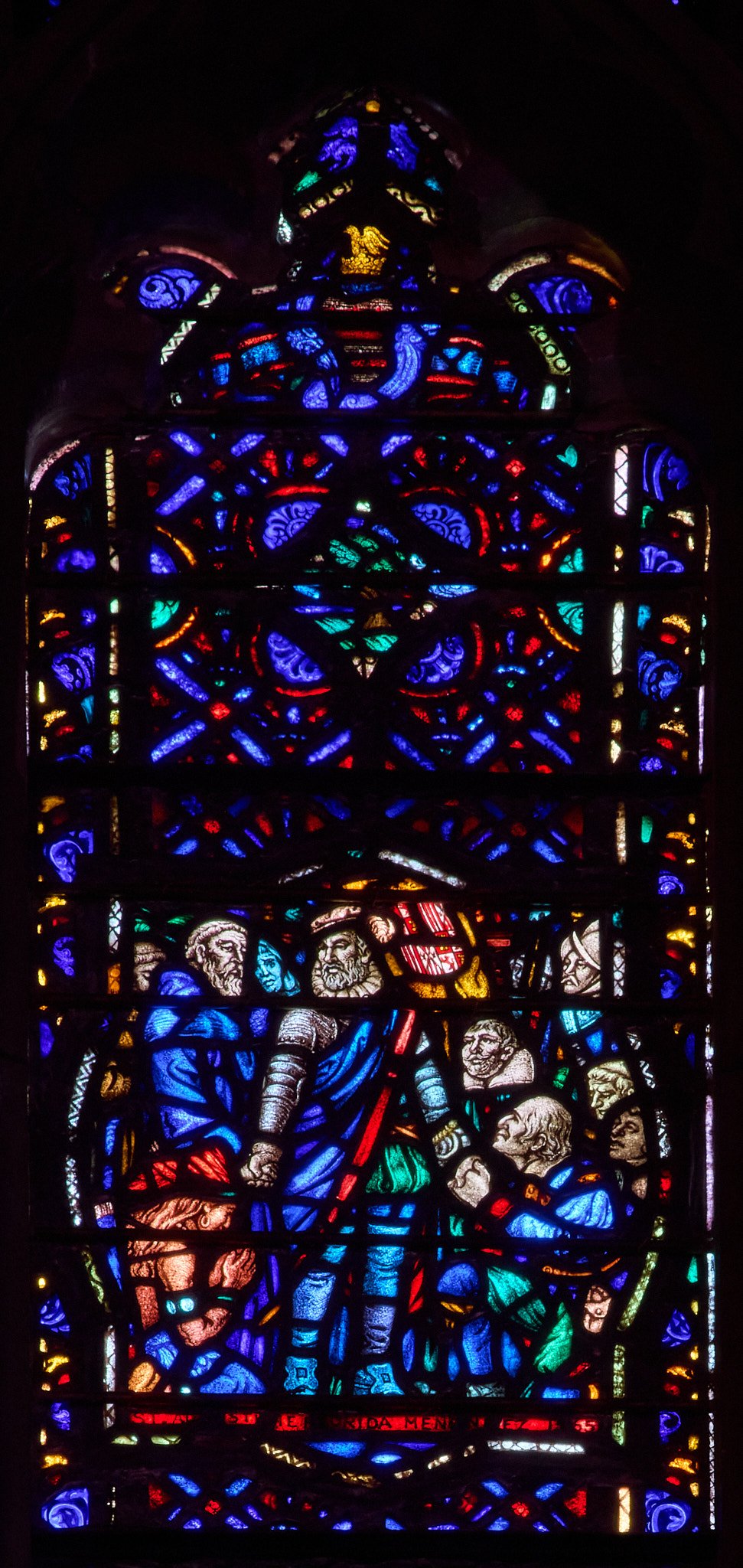
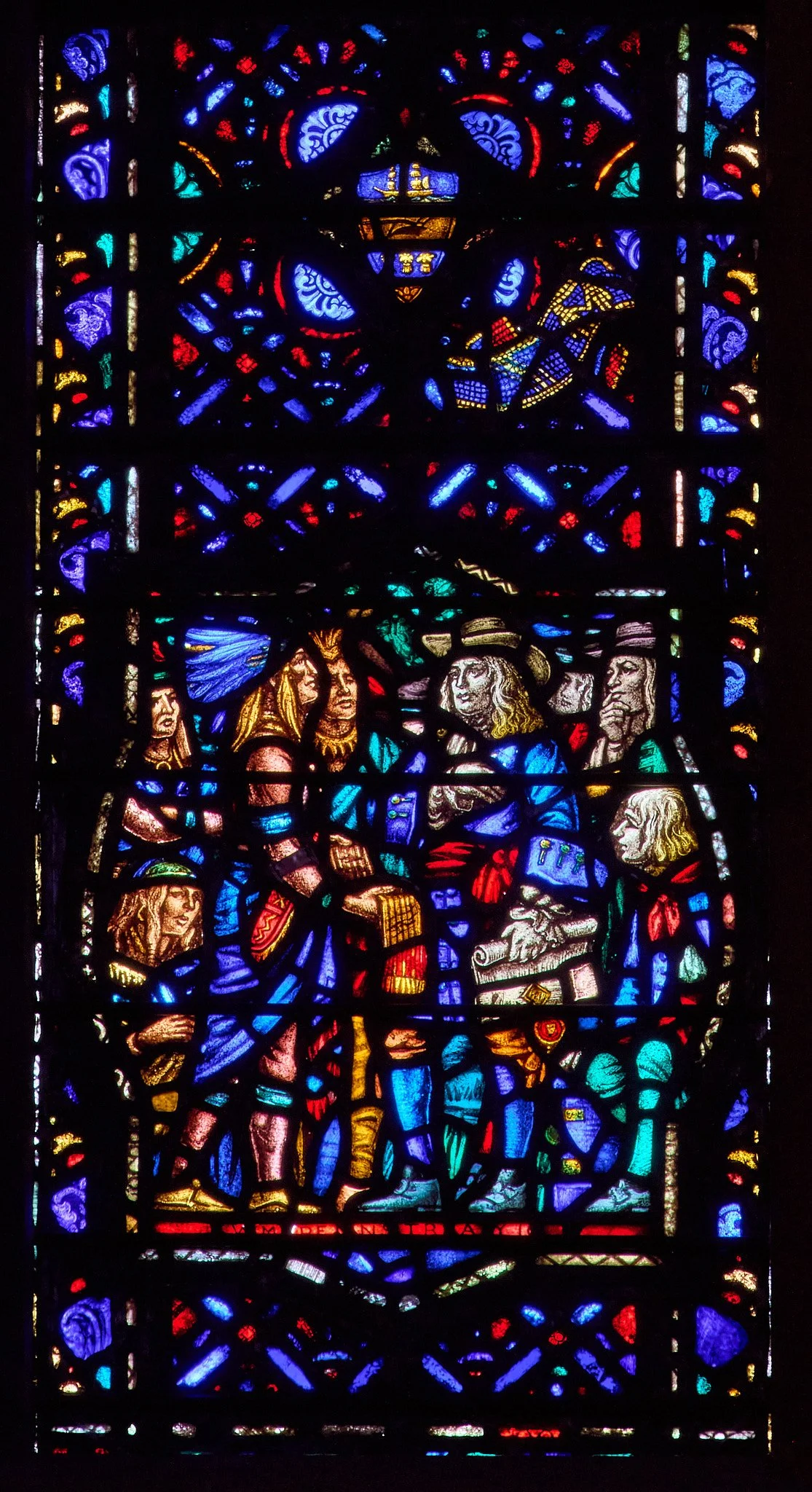
Pedro Menendez de Aviles, the founder in 1565 of St. Augustine, Florida is shown in the center under the banner of the Kingdom of Spain bidding farewell to Spanish monks, soldiers, Indian converts, and African slaves, prior to his return to Spain.
-
![The Settlement of Jamestown]()
02 The Settlement of Jamestown
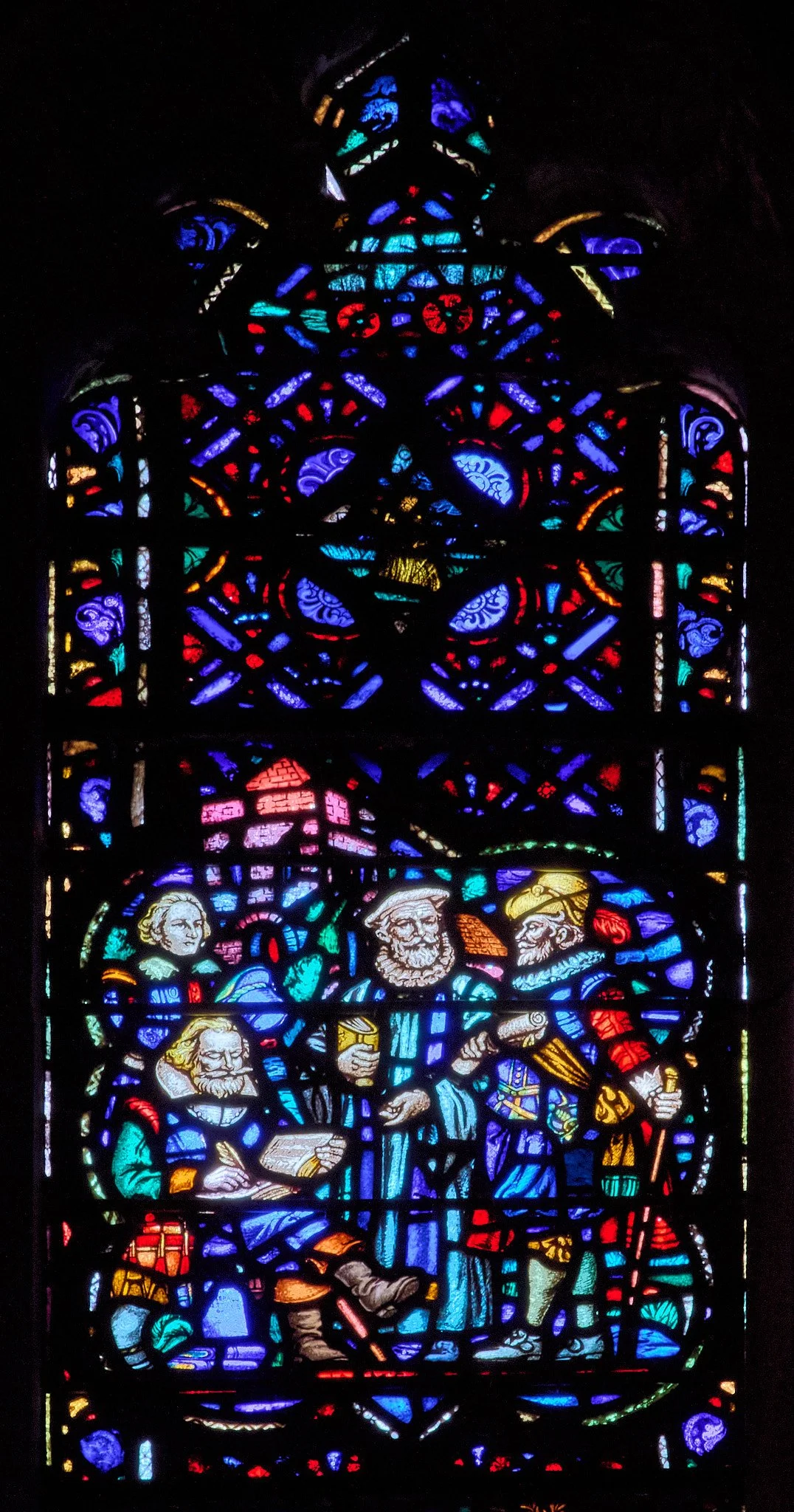
Edward-Maria Wingfield, the first elected president of the Jamestown colonists, is on the right of the medallion. He holds in his left hand the mace of office symbolizing his authority and in his right hand the commission appointing the first governing council in America. In the center is The Reverend Robert Hunt holding the English Bible under his right arm. On the left, Captain John Smith is seated and writing his early account, A True Relation of Such Occurrences and Accidents of Note as Hath Happened in Virginia. The figure standing behind Smith is supposed to be Captain Christopher Newport, though all other depictions of Newport show him with a beard. In the upper left is the brick tower of the Old Jamestown Church built around 1650 and still standing.
-
![The First Communion at Jamestown]()
03 The First Communion at Jamestown
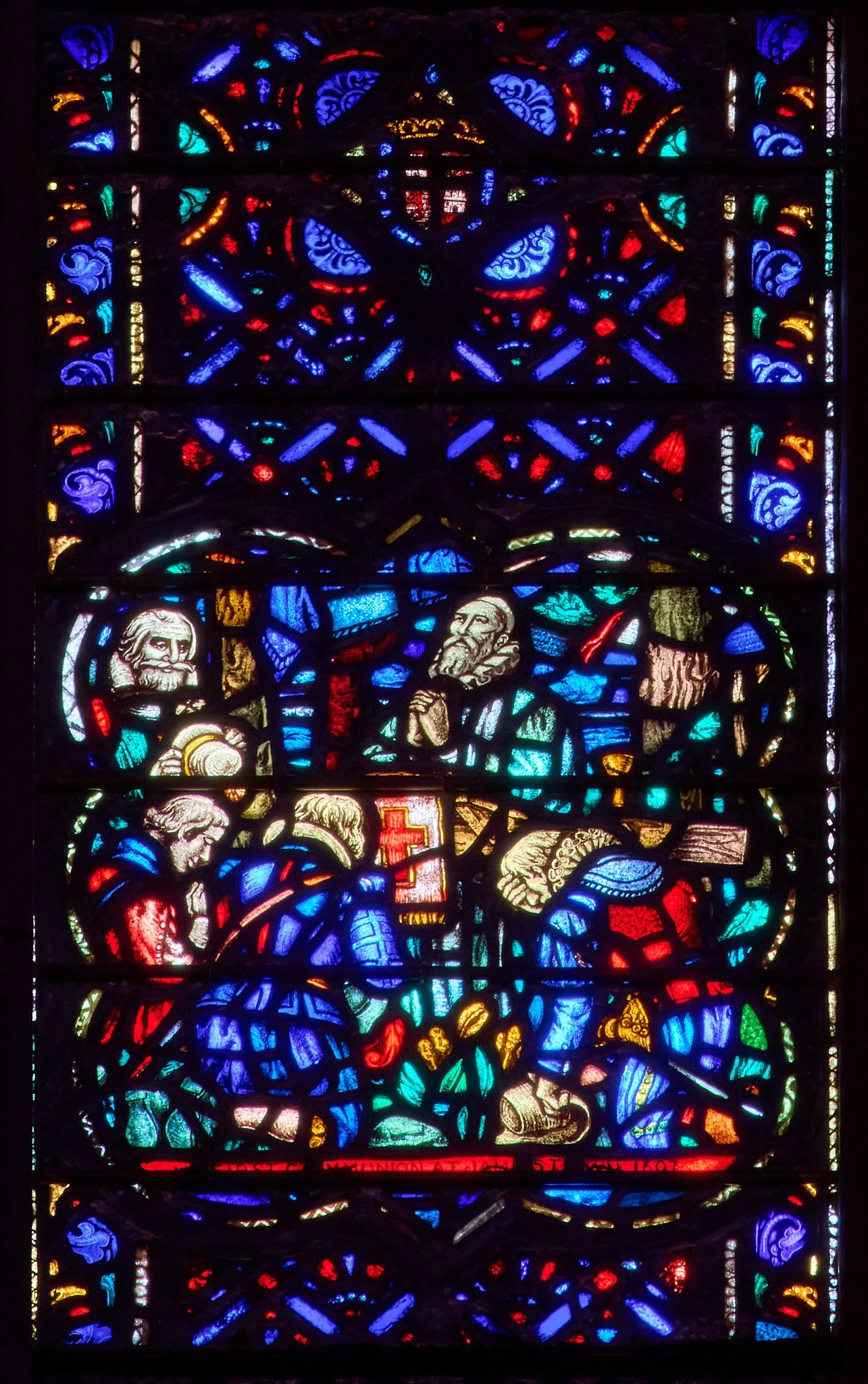
In this medallion we see a depiction of The Reverend Robert Hunt, first chaplain of the Jamestown colony, in the center with his hands clasped in prayer. Overhead a white sail protects the settlers from the weather as Hunt holds the first Anglican Communion at Jamestown on June 21, 1607. English soldier and explorer Captain John Smith, who helped stabilize Jamestown and ensure its survival, appears standing to the far left. In the forefront, three Jamestown settlers appear kneeling in prayer. On the altar on the right of the medallion is the chalice, in The Reverend W. Herbert Burk’s words, “the symbol of the Church’s sacramental life.”
-
![04 The First Deliberative Assembly]()
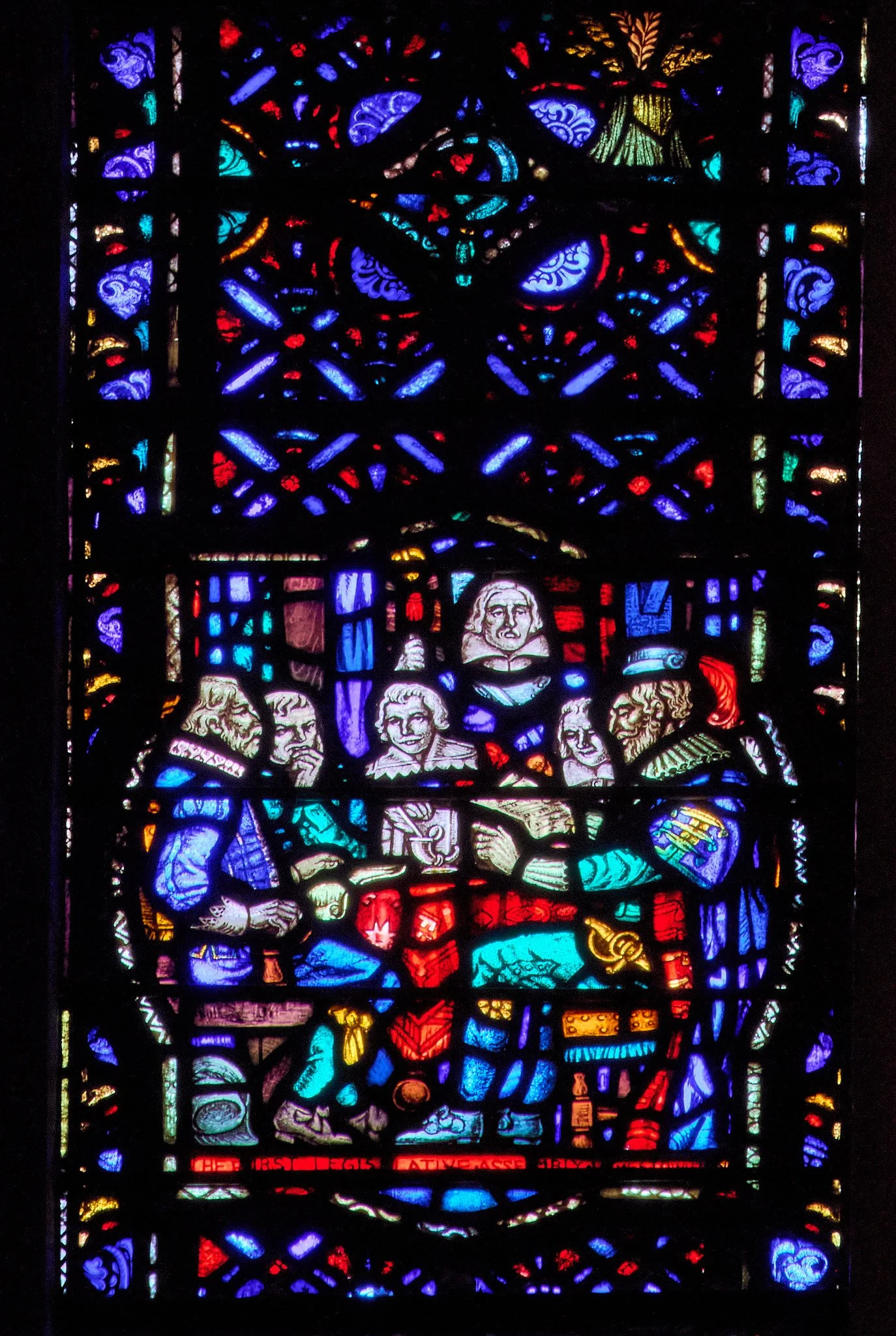
04 The First Deliberative Assembly
Sir George Yeardley, flanked by two pairs of men, is seated at a table draped in red cloth in the frame church at Jamestown. In the background, the Sergeant stands with a ceremonial halberd.
-
![05 The Signing of the Mayflower Compact]()
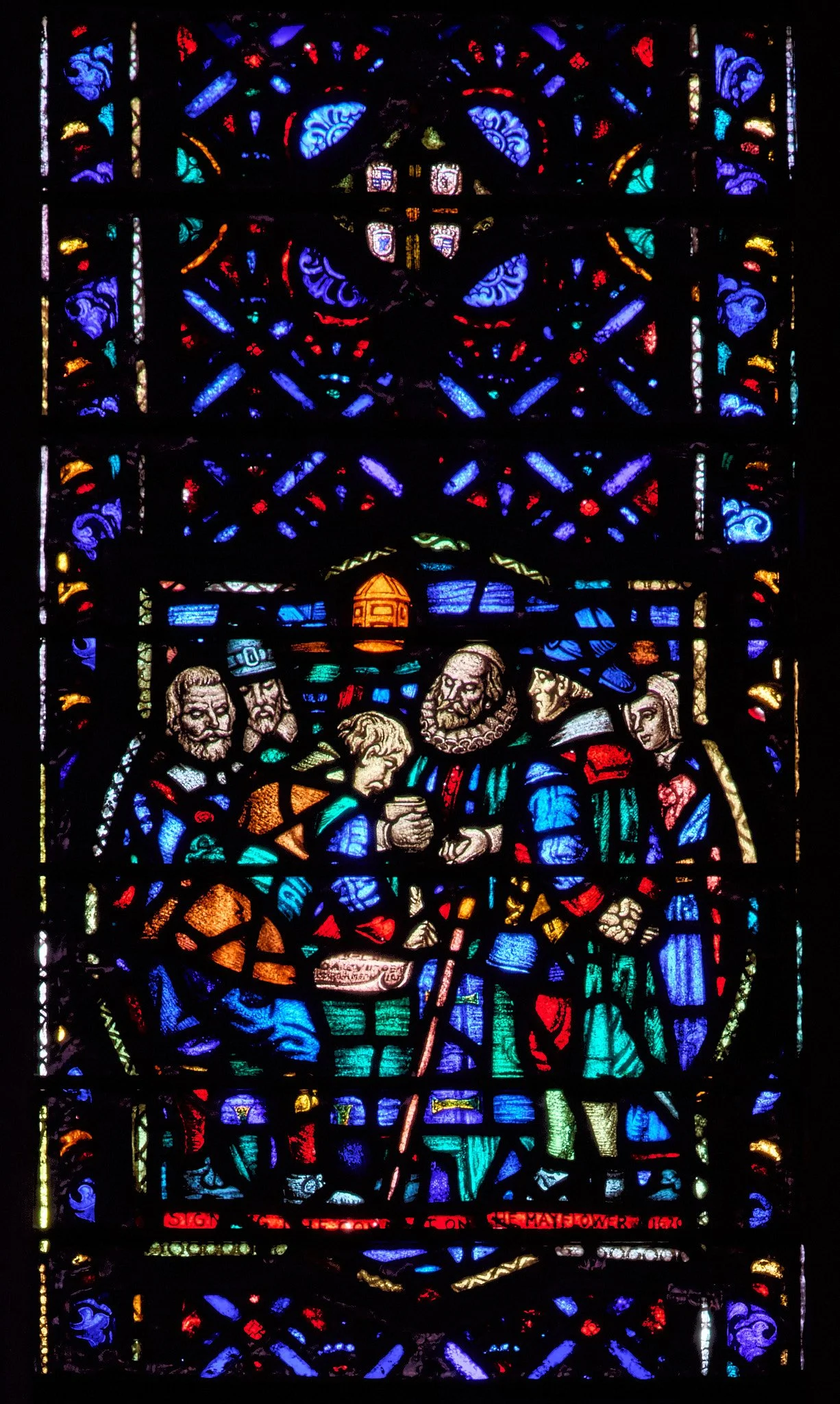
05 The Signing of the Mayflower Compact
The medallion shows the signing of the Mayflower Compact in the cabin of the Mayflower on November 11, 1620. The figure in the middle is John Carver, the first governor. The figure leaning over signing the compact is his successor, William Bradford. The figure on the far right is Priscilla Mullins, who represents the women of New England. Next to her is her future husband, John Alden. The figure on the far left is Captain Miles Standish, who was in charge of the first exploration party of sixteen men. Next to him is William Brewster, a ruling Elder.
-
![The Purchase of Manhattan]()
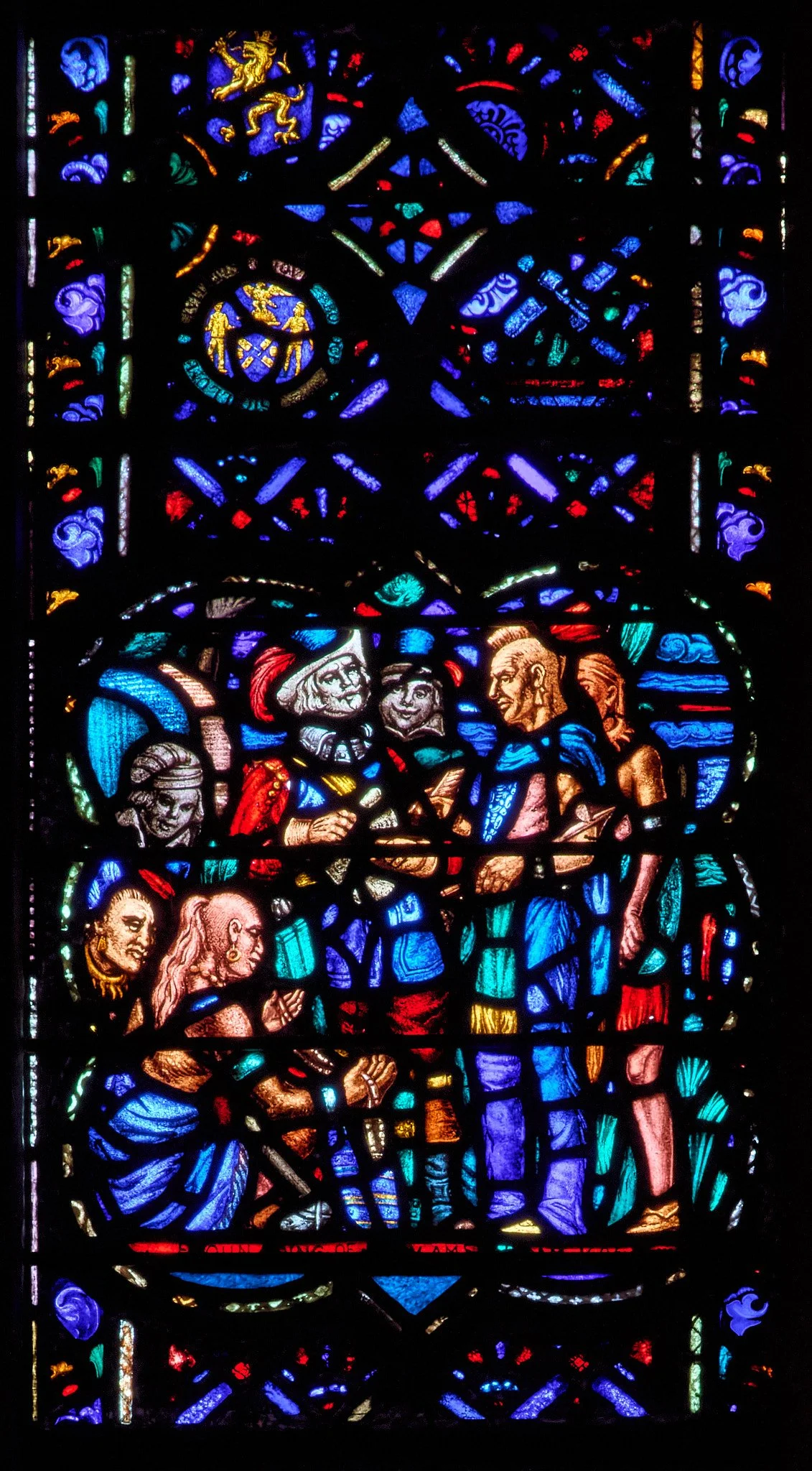
06 The Purchase of Manhattan
Peter Minuit transacts the purchase of Manhattan with a sachem (local leader) of the Lenape Indians. In the upper right are seen the waves of the ocean. To Minuit’s left and right are other Dutch settlers looking on. In the lower left a Lenape Indian examines a string of beads, part of the various goods used in the purchase. To the right of the sachem, another Lenape Indian observes with interest.
-
![The Landing of the Swedes]()
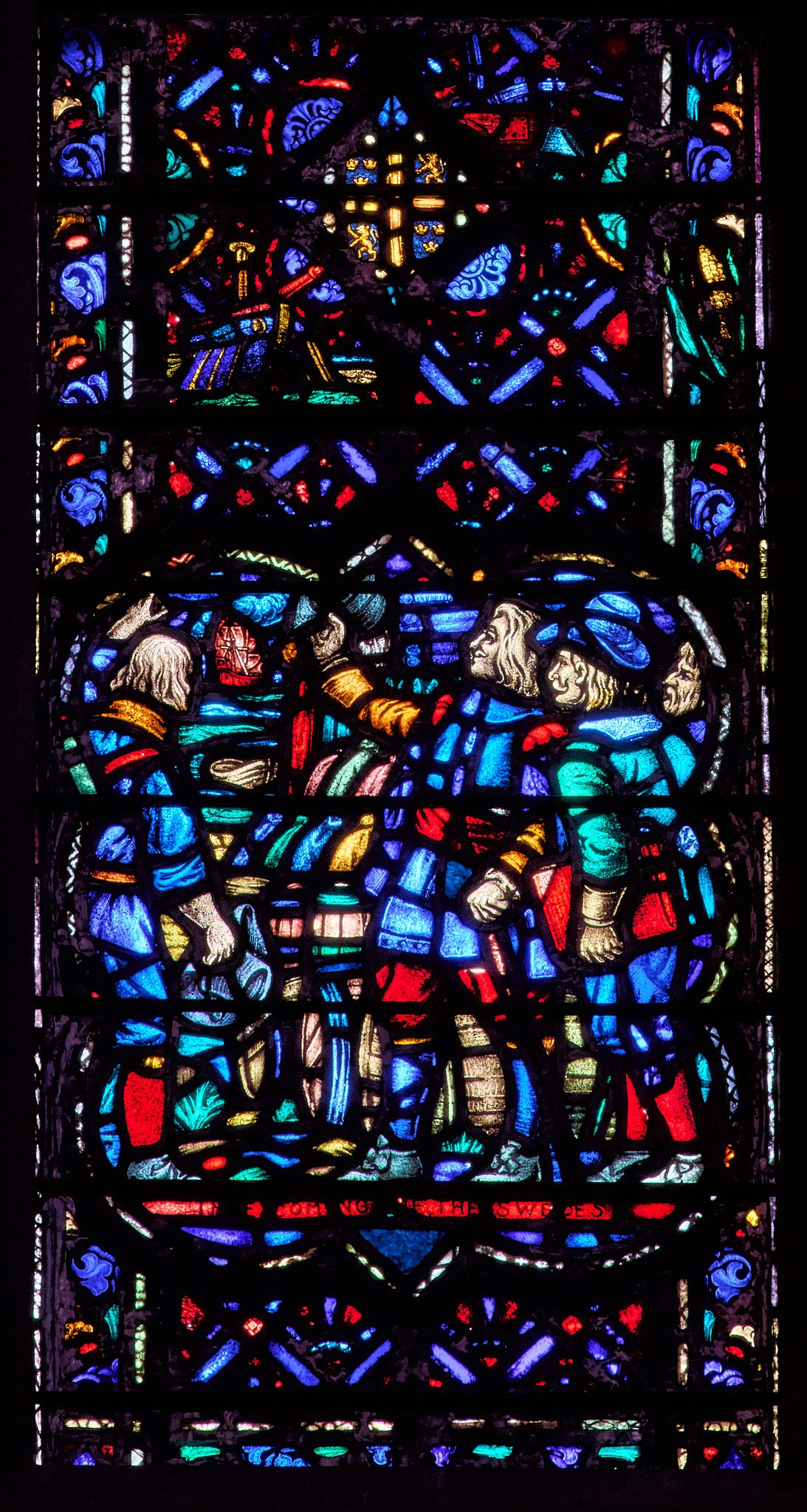
07 The Landing of the Swedes
This medallion shows the first Swedish settlers in America bidding farewell to the ships that had brought them to the Delaware Bay. In the center is Mans Kling, head of the expedition; waving his hat, and Hendrik Huyghen, the commissary of the settlement holding a book, probably of accounts. On either side are unidentified Swedish settlers. In the middle ground are barrels, probably containing tobacco or flour and what appear to be bundles of cloth of various colors or possibly furs.
-
![Penn’s Treaty with the Indians]()
08 Penn’s Treaty with the Indians
This medallion depicts William Penn (center right), proprietor of the Quaker colony of Pennsylvania, and a sachem or chief of the Leni Lenape tribe of Native Americans (center left) formalizing the Treaty. The sachem is handing Penn a belt of wampum. Penn is holding a scroll, presumably the treaty, from which dangles a red seal with the Penn coat of arms. On Penn’s side are his Quaker colleagues, while behind the sachem are other Leni Lenape.
-
![Pastorius Welcoming the German Immigrants]()
09 Pastorius Welcoming the German Immigrants
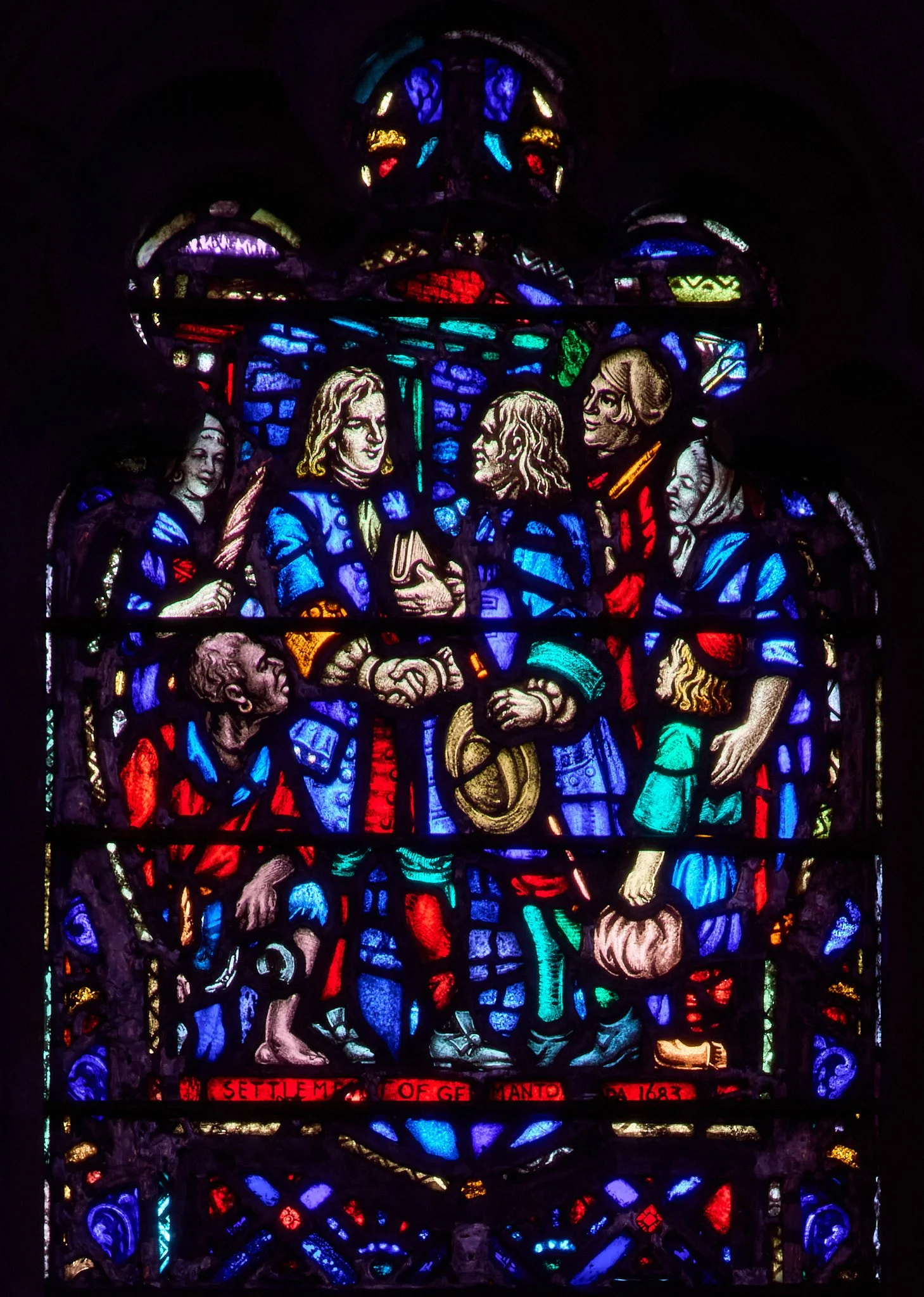
This medallion depicts Daniel Pastorius welcoming a family of German immigrants to the settlement of what was to become Germantown in Pennsylvania. Pastorius’s wife, holding a distaff, stands behind him. A freed African slave kneels in the left foreground, his shackles broken.
-
![Granting the Franchise to the French HuguenotsGranting the Franchise to the French Huguenots]()
10 Granting the Franchise to the French Huguenots
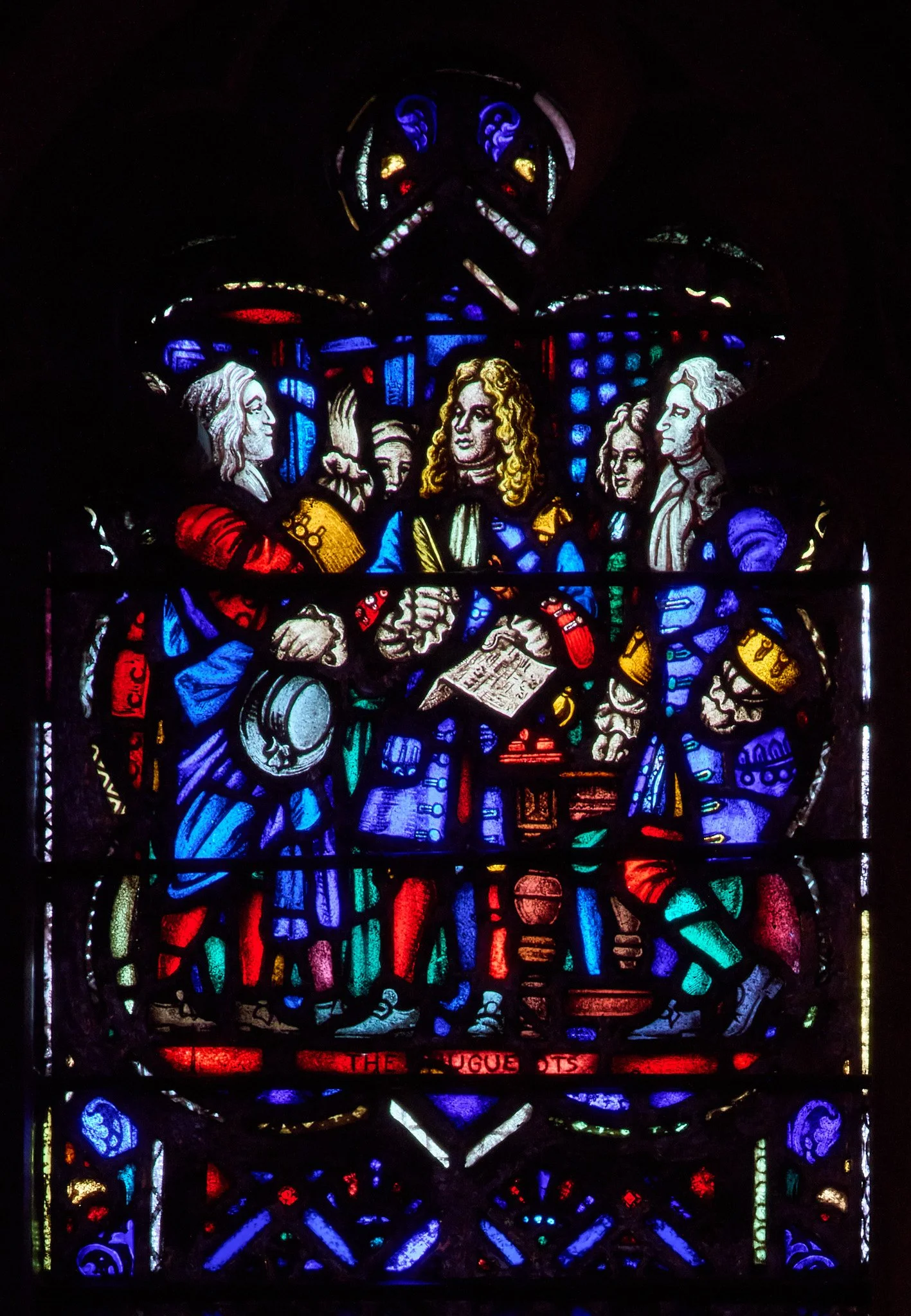
South Carolina Governor Joseph Blake stands in the center holding the statutory Act of Enforcement in his left hand and the quill to sign it in his right hand. On the right stand English leaders; on the left stands a Huguenot minister with his hand raised, prepared to take the oath of allegiance to the Crown of England. Behind him are members of his flock waiting to take the oath.
-
![The Scotch-Irish Settlement]()
11 The Scotch-Irish Settlement
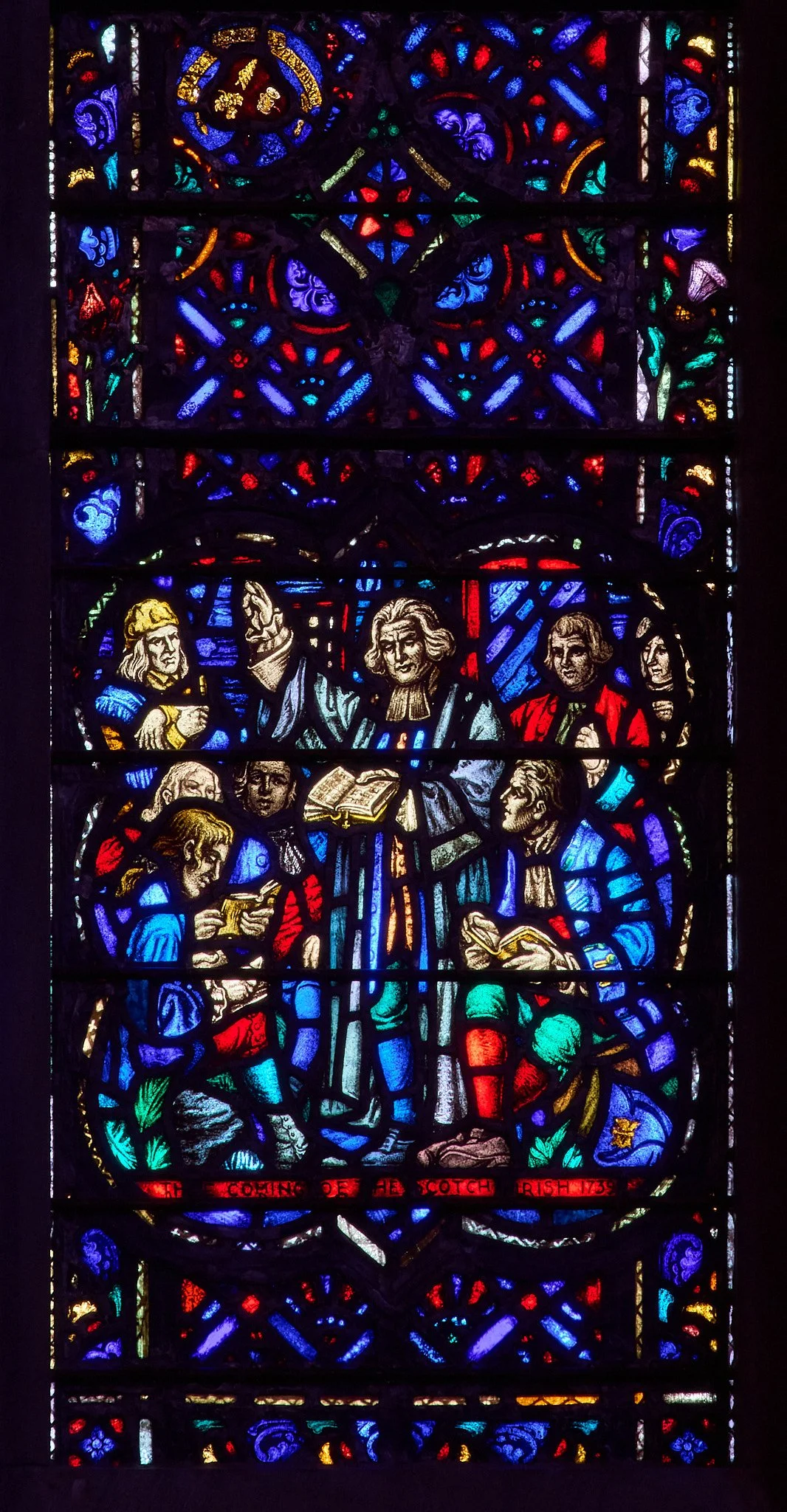
The Reverend William Tennent stands in front of the Log College (nineteen miles from Valley Forge) expounding the Bible to his seminary students. His son Gilbert Tennent stands on the right, behind The Reverend Tennent’s left shoulder, leaning on a rifle.
-
![12 Lord Ogelthorpe at Savannah]()
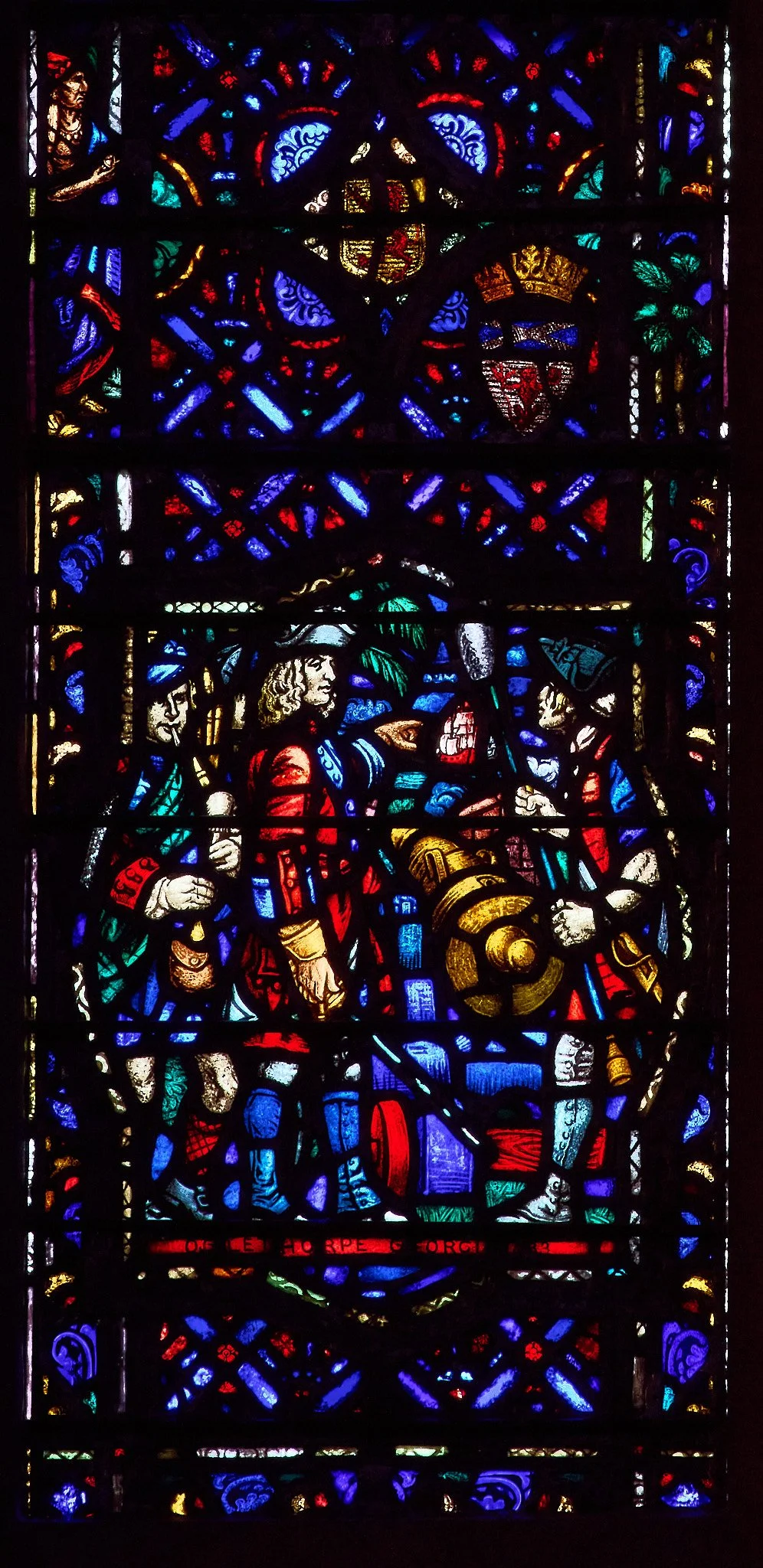
12 Lord Ogelthorpe at Savannah
Lord Oglethorpe stands by a cannon on the ramparts of Fort Frederica on 25 July 1745, a palm tree visible over his shoulder, pointing out the ships of the Spanish fleet retreating over the horizon. At right, an English artilleryman stands by with his sponge, waiting to swab the cannon; at left, a Scottish piper plays the bagpipes. The Native American figure in the intermedallion above and to the left is an idealized portrait of Tomochichi, a chief of the Yamacraw band and early ally of Oglethorpe.
-
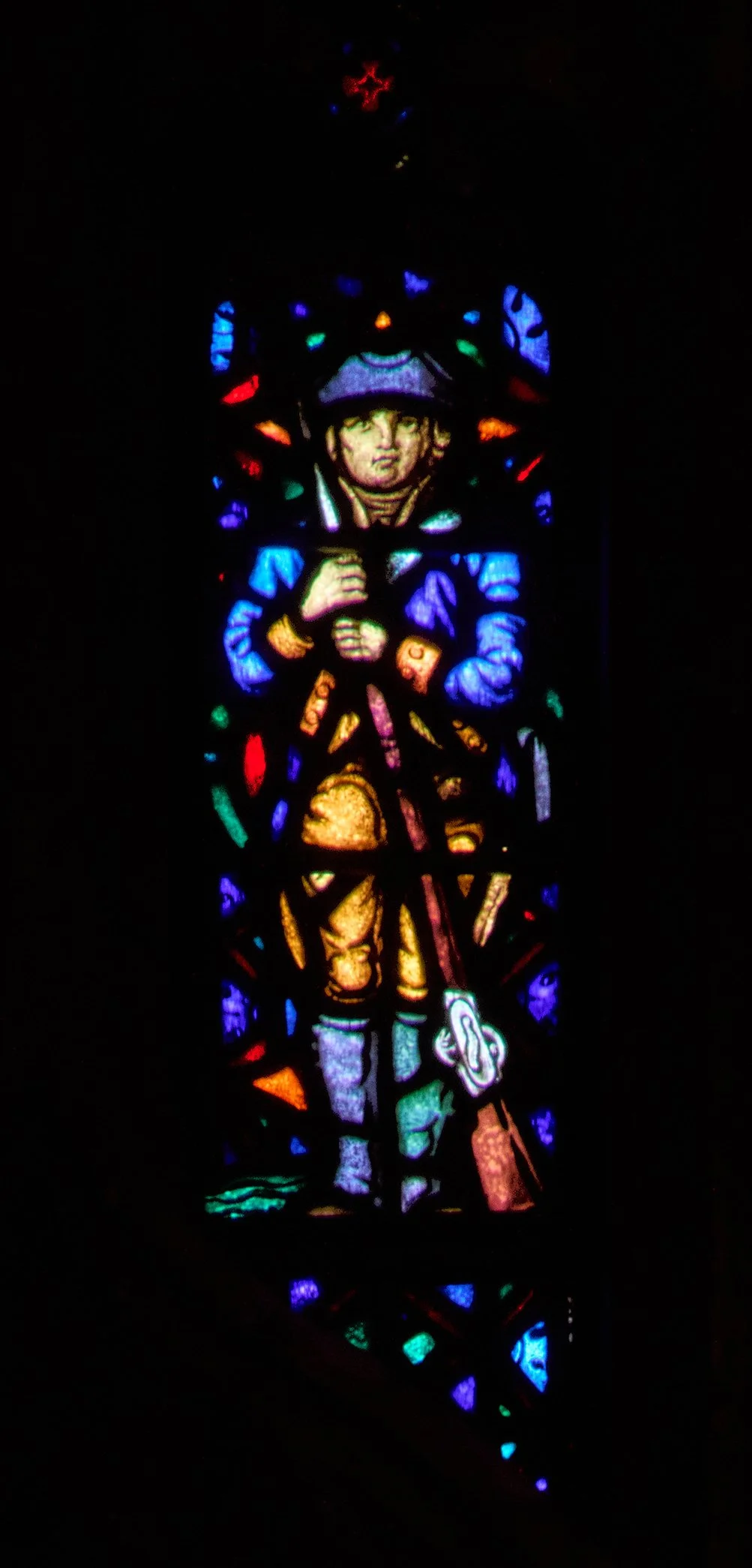
![Tracery Glass 1 (Panel) Continental Soldier]()
Tracery Glass 1 (Panel) Continental Soldier
Learn the significance of different Continental Army uniform facing and cuff colors throughout the chapel windows.
-
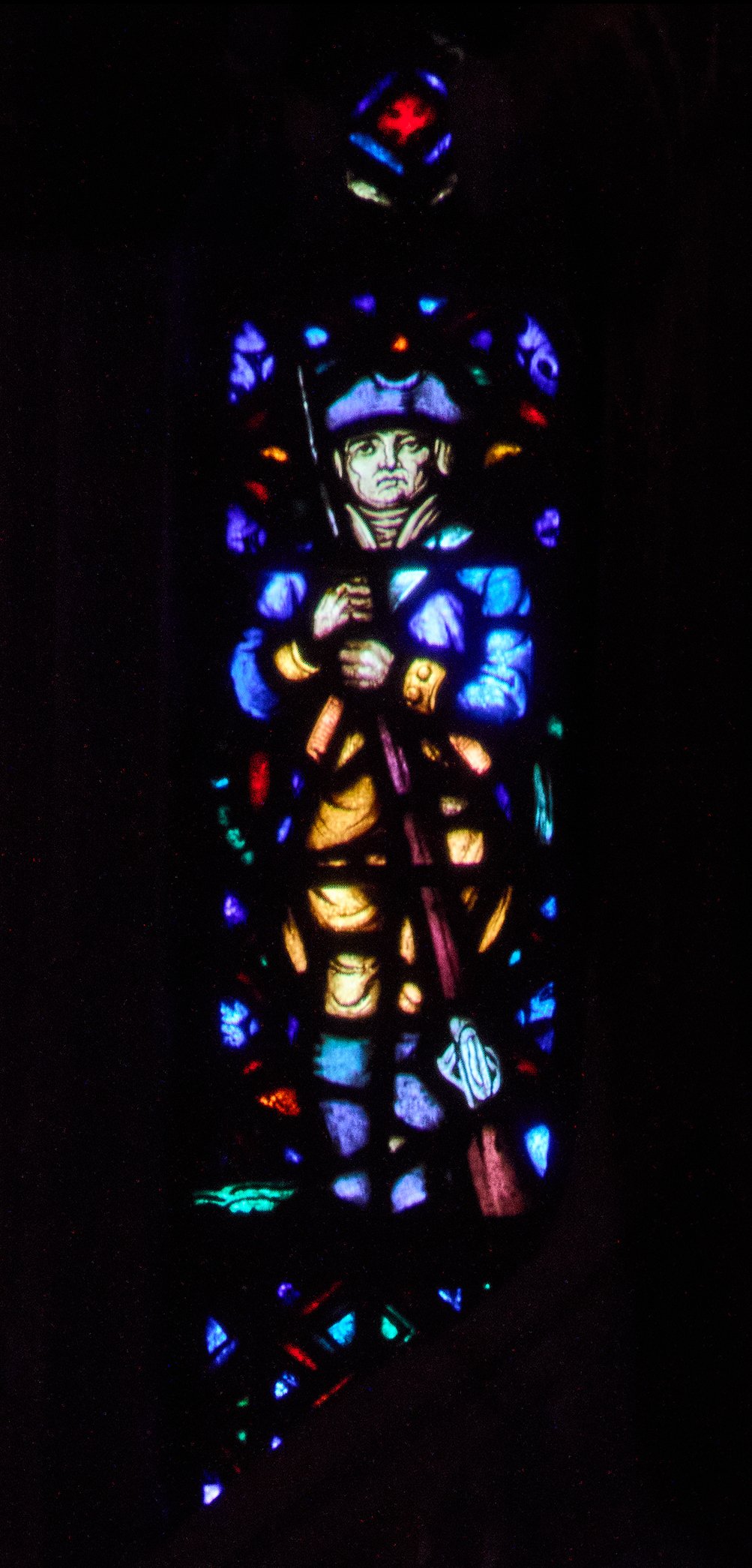
![Tracery Glass 2 (Panel) Continental Soldier]()
Tracery Glass 2 (Panel) Continental Soldier
Learn the significance of different Continental Army uniform facing and cuff colors throughout the chapel windows.
Detailed Medallion Text
1 The Founding of Saint Augustine
Medallion 1: The Founding of Saint Augustine
Location: Left lancet, top
Description:
Pedro Menendez de Aviles, the founder in 1565 of St. Augustine, Florida is shown in the center under the banner of the Kingdom of Spain bidding farewell to Spanish monks, soldiers, Indian converts, and African slaves, prior to his return to Spain.
Background:
The conflict "between the modern and medieval worlds . . . the struggle between democracy and autocracy, between Protestantism and Romanism." In these words The Reverend W. Herbert Burk described the theme of the Window of Settlement. For Burk, Protestant England represented the modern spirit of democracy while Catholic Spain represented medieval autocracy. This medallion reflects that struggle and marks the first European settlement in North America.
In the 16th century, the New World became an extension of the commercial, military, and religious rivalries of the European powers. France and England looked with envy on the riches of the Spanish empire in America and sought to plant their own colonies there. In 1564 amid growing tensions between Protestants and Catholics in France, Charles IX of France sent an expedition composed largely of Huguenots to the coast of Florida to establish a settlement, Fort Caroline.
The Spanish crown saw this French fort, near present day Jacksonville, as a threat to Spanish control of the area and to their trade between Mexico and Spain. It was on this trade, which included large quantities of gold and silver mined in the New World, that Spain's wealth and imperial power depended. King Philip II ordered Pedro Menendez de Aviles, a Spanish admiral who had just set up a convoy system to protect the trans-Atlantic trade, to found a Spanish settlement on the Florida coast. This he did in June 1565 on the site of what is now St. Augustine, Florida.
In September 1565 the French countered with an attempt, launched from Fort Caroline, to capture St. Augustine. The effort failed, and Menendez retaliated. On September 20th 1565 he captured Fort Caroline, executing nearly all his prisoners and hanging their bodies on trees with the inscription, "Not as Frenchmen, but as Lutherans." (They were Calvinists, not Lutherans, but Protestants all the same.) He then defeated a French relief force and massacred them as well. The Matanzas River in the area takes its name from these events; matanzas in Spanish means "massacres."
In 1568 a French expedition led by Chevalier Dominique de Gourgues attacked and captured the Spanish forts in the area. De Gourgues then hanged their garrisons on the same trees with his own inscription, "I do this not as unto Spaniards, nor as outcasts, but as traitors, thieves and murderers." Ultimately, the French gave up their efforts to settle that part of North America. St. Augustine and the other Spanish settlements remained under Spanish control, subject to occasional French and English raids and a 20 year period of British rule (1763-1783), until they were incorporated into the United States in 1821.
GPP
Intermedallion [Above The Founding of Saint Augustine]
- Top center: Washington's full coat of arms, including the crest: a black raven, (although in the window it is rendered in gold) issuing from a gold ducal coronet. This version with the Rococo-style shield shape is what he commissioned for his bookplate design in 1771.
- Center astroid: "The Old Senator." This sturdy oak tree is an iconic landmark in St. Augustine. Thought to predate the arrival of the Spanish, it may be over six hundred years old.
NKH
2 The Settlement of Jamestown
Medallion 2: The Settlement of Jamestown
Location: Right lancet, top
Description:
Edward-Maria Wingfield, the first elected president of the Jamestown colonists, is on the right of the medallion. He holds in his left hand the mace of office symbolizing his authority and in his right hand the commission appointing the first governing council in America. In the center is The Reverend Robert Hunt holding the English Bible under his right arm. On the left, Captain John Smith is seated and writing his early account, A True Relation of Such Occurrences and Accidents of Note as Hath Happened in Virginia. The figure standing behind Smith is supposed to be Captain Christopher Newport, though all other depictions of Newport show him with a beard. In the upper left is the brick tower of the Old Jamestown Church built around 1650 and still standing.
Background:
The Settlement of Jamestown emphasizes the first English settlement in North America and the arrival of both the English (Protestant) Bible and the beginnings of democracy here. It is meant to complement medallion 1, The Founding of Saint Augustine, which illustrates the first European settlement in North America, the struggle for empire in the New World, and the conflict between Protestantism and Catholicism.
As noted in medallion 11 in the Nathanael Greene Window of Discovery, England's colonization of North America owed much to the writings and influence of Richard Hakluyt Jr, an English cleric and geographer of the late 16th and early 17th centuries. His work stimulated English interest in the exploration and settlement of North America. In the 1580's Queen Elizabeth I granted Sir Walter Raleigh a royal patent to explore Virginia - all North America north of the Spanish possessions in Florida. The outbreak of the Anglo-Spanish War of 1585-1604 and the death of Elizabeth I put these plans on hold until 1606. In that year the new king of England, James I, issued a charter establishing the Virginia Company, a commercial venture ("joint stock company") aimed at establishing English settlements in North America and seeking gold and silver. The Virginia Company of London was given rights to establish colonies between what is now Long Island and North Carolina. Edward-Maria Wingfield and Hakluyt were two of the four incorporators (directors) of this company. Laying the basis for American protests 170 years later the charter stated that:
all and everie the parsons being our subjects which shall dwell and inhabit within everie or anie of the saide severall Colonies and plantacions and everie or anie of theire children . . . shall have and enjoy all liberties, franchises and immunities as if they had been abiding and borne within this our realme of England.
In December 1606, 108 settlers, mostly gentlemen and adventurers, set off in three ships, Susan Constant, Discovery, and Godspeed, under the command of Captain Christopher Newport, to establish a colony in the New World. They made landfall in May 1607 at a place they named Cape Henry and established "James Cittie" or "James Towne," named in honor of King James, on what is now Jamestown Island on the James River.
Sealed orders, not to be opened until the expedition arrived in "Virginia," established the colony's governing council of six men among whom were Newport, Smith, and Wingfield. The members then elected Wingfield president. This proto-democracy governed the colony, albeit with a period of martial law, until the establishment of the Virginia House of Burgesses in 1619. The Rev. Hunt, who had been named chaplain of the colony by Hakluyt, conducted Anglican services until his death in 1608.
GPP
Intermedallion [Above The Settlement of Jamestown]
- Top center: A Conestoga wagon. This iconic vehicle of American settlement was a freight hauler designed in the early 1700s by German settlers on the Conestoga River in Lancaster County, Pennsylvania. Before railroads, Americans relied on these spacious wagons to transport goods. The wagon's ingenious "boat" shape helped keep cargo from sliding around when traversing hilly terrain, while the distinctive canvas cover protected against rain. Beginning in the 1840s, a lighter version of these trusty transports known as the "prairie schooner" was the conveyance of choice for those settling further westward.
- Center astroid: A pastoral scene featuring a person reaping wheat in the foreground of a building.
NKH
3 The First Communion at Jamestown
Medallion 3: The First Communion at Jamestown
Location: Left lancet, second from the top
Description:
In this medallion we see a depiction of The Reverend Robert Hunt, first chaplain of the Jamestown colony, in the center with his hands clasped in prayer. Overhead a white sail protects the settlers from the weather as Hunt holds the first Anglican Communion at Jamestown on June 21, 1607. English soldier and explorer Captain John Smith, who helped stabilize Jamestown and ensure its survival, appears standing to the far left. In the forefront, three Jamestown settlers appear kneeling in prayer. On the altar on the right of the medallion is the chalice, in The Reverend W. Herbert Burk's words, "the symbol of the Church's sacramental life."
Background:
In 1606, Richard Hakluyt, geographer, Archdeacon of Westminster Abbey, and one of the directors of the Virginia Company of London, appointed Hunt as chaplain of the Jamestown colony. Hunt had been the Vicar of Heathfield, County of Sussex, England, and with settlers from Old Heathfield, East Sussex, departed England for Virginia in December 1606. On April 29, 1607, Hunt led the settlers in public prayer as they planted a cross at Cape Henry, named for the Prince of Wales.
In his chronicle of the settlement, Captain John Smith described Hunt as, "our honest, religious and courageous divine; "a peacemaker who "reconciled the mischiefs of the ignorant spirits of the settlers." Smith reported that on " . . . June 21, third Sunday after Trinity, under the shadow of an old sail, Robert Hunt celebrated the Sacrament of the Lord's Supper. It is impossible to rate too highly the character and work of the aforesaid Hunt, Chaplain of the Colony." Smith noted further that ". . . wee had daily Common Prayer morning and evening, every Sunday two sermons and every three months the holy communion till our Minister died: but our prayers daily, with an homily on Sundaies, we continued two or three years after, till more Preachers came."
Burk highlighted the scene of the first Anglican Communion at Jamestown and remarked on Captain Smith's description of the religious observances of the colonists because, he stated, "In these homely words is told the story of the first planting of the English Church in America, a planting from which was to spring in time a rich harvest of noble Christian men and women, founders of the great republic and leaders in the life and thought of America."
R. S. Thomas, historiographer of the Southern Virginia Diocese of the Episcopal Church, characterized the event as a "glorious scene (that) ought to be immortalized in glorious verse or on speaking canvas." Instead, Burk chose the illuminating medium of stained glass to preserve this momentous scene.
DCS
Intermedallion [Above The First Communion at Jamestown]
- Center astroid: Arms of Castile quartered with Leon. This was the coat of arms of the main Spanish kingdom (Castile-Leon) and echoes the Spanish Foundation of St. Augustine above. The monumental marriage alliance of Queen Isabella I of Castile-Leon with King Ferdinand III of Aragon was a Providential turning point that led to a unified Christian Spain willing and able to sponsor Columbus's exploration of the New World.
NKH
4 The First Deliberative Assembly
Medallion 4: The First Deliberative Assembly
Location: Right lancet, second from the top
Description:
Sir George Yeardley, flanked by two pairs of men, is seated at a table draped in red cloth in the frame church at Jamestown. In the background, the Sergeant stands with a ceremonial halberd.
Background:
The medallion represents the first meeting of the first deliberative assembly in America, the "General Assembly" of the Virginia Colony. What was to become the House of Burgesses of Virginia met for the first time in Jamestown on July 30, 1619. Convened by George Yeardley, the Governor of the Virginia Colony, the Assembly met in the third church, whose foundations are visible in the reconstructed Jamestown Memorial Church. Following the precedent of the House of Commons, which itself met in the former St. Stephen's Chapel in the Palace of Westminster, the Burgesses sat "in choir," facing one another.
The Reverend W. Herbert Burk chose this event, the convening of the first popular legislative assembly held in America, because in his words and with perhaps pardonable exaggeration, " …it marks the beginning of a new era in the history of man.... It laid the foundations of our Republic on the rights of man and made democracy the ideal for the governments of the earth."
George Yeardley (1587-1627) had served in the Colony from 1610 until 1617, ultimately becoming deputy governor. He returned to England in that year, and following the death of Lord de la Warr, Yeardley was knighted and appointed Lord Governor of Virginia.
Prior to his departure for Virginia, on November 16, 1618, the governors of the Virginia Company of London promulgated the "Instructions to George Yeardley," often referred to as the Great Charter, a document which was intended to regularize and reform the government of the colony of Virginia. In response to near starvation among the colonists, continuing hostilities with the native tribes and internal frictions, the colony had been under martial law since 1609. In addition, the colony was not proving to be a profitable business venture, though the introduction of tobacco in 1613-14 had begun to show promise. A change in the system was clearly necessary.
The "Instructions" make no mention of a "General Assembly" or indeed any form of government. Rather, they establish the principle of land ownership in order both to encourage settlement and to separate Company revenues from private revenues. They also organize the land into four "boroughs" and seven "plantations" with self-government authority. Once these boroughs and plantations were established, each elected two representatives thereafter called burgesses [1]. They were then called to attend a "general assembly," held under the supervision of the Governor and the Governor's Council, which was composed of Virginia Company of London appointees.
This first meeting had to be curtailed a day early due to an outbreak of malaria. However, as a representative body, it would persist until the Revolution, raising up from its ranks Richard Henry Lee, who moved "that these united colonies are, and of right ought to be, free and independent states," George Mason, the author of the Bill of Rights; Thomas Jefferson, the author of the Declaration of Independence, and George Washington.
JRW
[1] From the Germanic "burgher," a resident of a town, or a freeman (ie: not an indentured servant, serf, or slave.)
Intermedallion [Above The First Deliberative Assembly]
- Center astroid: A sickle. Used for harvesting grain, it is probably included to complement the accompanying intermedallion showing a sheaf of wheat.
GSP - Upper right: Garb (or Wheatsheaf). This symbol of a successful harvest may represent the defeat of starvation through Captain John Smith's "He who does not work shall not eat" (2 Thessalonians 3:10) policy.
NKH
5 The Signing of the Mayflower Compact
Medallion 5: The Signing of the Mayflower Compact
Location: Left lancet, third from the top
Description:
The medallion shows the signing of the Mayflower Compact in the cabin of the Mayflower on November 11, 1620. The figure in the middle is John Carver, the first governor. The figure leaning over signing the compact is his successor, William Bradford. The figure on the far right is Priscilla Mullins, who represents the women of New England. Next to her is her future husband, John Alden. The figure on the far left is Captain Miles Standish, who was in charge of the first exploration party of sixteen men. Next to him is William Brewster, a ruling Elder.
Background:
The Mayflower Compact, signed aboard ship before the colonists landed in New England, was more important for the future United States than the landing itself. The Compact, a simple agreement of less than 200 words established:
"a civil Body Politick . . . [to] enact, constitute and frame such just and equal Laws, Ordinances, Acts, Constitutions and Officers . . . as shall be thought most meet and convenient for the general Good of the Colony"
The Reverend W. Herbert Burk described the document, signed by forty-one adult male passengers, as "the seed-corn of the Declaration of Independence and the Constitution of the United States." Although Priscilla Mullens did not sign, Burk included her to represent, as he phrased it, "the women of New England."
The Mayflower set sail from Plymouth, England in September 1620 bearing 120 English colonists. Some had emigrated in 1607-08 to the Netherlands and had settled in Leiden. Others were from congregations in England. These colonists were known as Separatists, Protestants who could not reconcile themselves to the beliefs and practices of the Church of England and chose to separate from it. They were distinct from another Protestant group, the Puritans, who wanted to "purify" the established Church of England by eliminating what they saw as too many Roman Catholic elements in the worship. The Puritans would later settle the Massachusetts Bay Colony.
The Mayflower had originally intended to disembark the colonists farther south to settle along the Hudson River and preempt Dutch claims to the area. Rough seas and dwindling supplies for the crew for the return voyage forced the Mayflower to stop and disembark the colonists in Cape Cod Bay. The colonists needed a "charter" from the Virginia Company to settle in the area claimed by England, but Cape Cod was outside the jurisdiction of the charter the colonists had obtained. They were therefore outside the law. To keep order and unity among them, they agreed to establish a form of government that would make laws governing their colony.
The Mayflower Compact was the first self-government agreement in what would later become the United States. It helped the Plymouth Colony survive and paved the way for democracy and future American governments. The Mayflower Compact was about unity, cooperation, and creating a fair government--all important ideas for building a new society from scratch.
FPS
Intermedallion [Above The Signing of the Mayflower Compact]
- Center astroid: Arms of the Colony of Virginia. Although this decoration refers primarily to the Jamestown scenes above, the Mayflower Compact was, as described here, necessitated by the "Pilgrim Fathers" landing outside the bounds of Virginia. This complicated coat of arms represents the English King and his rule over England (and France, in name only), Scotland, and Ireland. It was later modified in 1619 to present Virginia as a fifth, equal crown realm.
NKH
6 The Purchase of Manhattan
Medallion 6: The Purchase of Manhattan
Location: Right lancet, third from the top
Description:
Peter Minuit transacts the purchase of Manhattan with a sachem (local leader) of the Lenape Indians. In the upper right are seen the waves of the ocean. To Minuit's left and right are other Dutch settlers looking on. In the lower left a Lenape Indian examines a string of beads, part of the various goods used in the purchase. To the right of the sachem, another Lenape Indian observes with interest.
Background:
As the overall theme of the Lafayette window is the settlement of America by the nations of Europe, this medallion highlights the role of the Dutch in that settlement effort. The Republic of the Seven United Netherlands, the land of the Dutch, was a powerful force in the 1600's. Between 1614 and 1664 the Dutch established important settlements in the area of New York and Pennsylvania which they called New Netherlands with Manhattan as a center. As part of this settlement process, the Republic chartered the Dutch West Indies Company and gave it trade monopoly in the Dutch West Indies as well as jurisdiction in North American and other territories.
In 1626 Peter Minuit, a merchant and politician, was appointed director of the New Netherlands by the Dutch West Indies Company. Minuit governed by a measure of democracy in his politics but is best known for arranging the purchase of Manhattan from the Lenape Indians. The "purchase" was reported to the Dutch West Indies Company in 1626 by a letter from a Dutch merchant, Peter Schagen, who stated Minuit arranged the transaction for "60 guilders worth of trade." The description is significant because rather than paying in guilders, Minuit used trade goods which were highly valued by the Indians: cloth, tools, beads and trinkets, and cooking utensils. In the 19th century, historian John Romeyn Brodhead converted the 60 guilders to US$24 giving rise to the often used statement that Minuit purchased Manhattan for "$24 worth of beads."
In 1632 the Dutch West Indies Company recalled Minuit to Europe and dismissed him from his position as director, possibly because he was aiding patroons (proprietors of large estates granted by the Dutch West Indies Company) engaging in trade activities not in the interests of the Dutch West Indies Company. Minuit remained active, however, in settling North America. In 1637 he began collaborating with the Swedish government and its goal of establishing a colony in the New World. In 1638 Minuit and his ships, Fogel Grip and Kalmar Nyckel, landed along the Delaware River at what is now Wilmington, Delaware, establishing the first Swedish colony in America.
KRD
Intermedallion [Above The Purchase of Manhattan]
- Upper left: Arms of the Dutch West Indies Company (Azure, a lion rampant crowned or holding in his dexter paw a sword). This is a modified version of the Dutch Republic coat of arms. The lion was a 1579 symbol of the unification of the Dutch provinces. The crown represents Dutch sovereignty, and the sword represents willingness to defend it.
- Lower left: Seal of the City of New York. This emblem has changed little since its adoption in 1686. It is composed of a windmill with a barrel (of flour) on either side, an eagle above, and a colonial sailor and an American Indian on either side of the barrels. (The very small rendition in the window does not include the tiny beavers). It is surrounded by the Latin phrase SIGILLIVM CIVITATIS NOVI EBORACI ("Seal of the City of New York"). This rendition is probably based on the 1915 version, which was adopted after extensive study of the various iterations of the seal.
NKH
7 The Landing of the Swedes
Medallion 7: The Landing of the Swedes
Location: Left lancet, third from the top
Description:
This medallion shows the first Swedish settlers in America bidding farewell to the ships that had brought them to the Delaware Bay. In the center is Mans Kling, head of the expedition; waving his hat, and Hendrik Huyghen, the commissary of the settlement holding a book, probably of accounts. On either side are unidentified Swedish settlers. In the middle ground are barrels, probably containing tobacco or flour and what appear to be bundles of cloth of various colors or possibly furs.
Background:
From the early to the mid 17th century Sweden under King Gustavus Adolphus (Gustav II Adolf) had become a major political power in Northern Europe. Surveying his kingdom's geopolitical position, the king developed an interest in exploring America as a site for colonization, trade, and commerce, and in 1626 the Company of New Sweden was founded for this purpose. King Gustav II died on the battlefield in 1632, but in 1637 the Company launched the first expedition to America. Led by Peter Minuet, former Governor of the New Netherland settlement, and sponsored by various Dutch and Swedish investors, two ships, the Kalmar Nyckel (Key of Kalmar) and Fogel Grip (Flying Griffen) were outfitted and launched from Gothenburg bound for the New World.
They arrived in the Delaware Bay in the spring of 1638, landed near the confluence of the South (Delaware) River and Minquis (subsequently named the Christina) River, and began building a fort (Fort Christina named after Sweden's young Queen Christina), wharf, and trading post. Over the coming decades, eleven more flotillas made the hazardous trek from Sweden to America, bringing Swedes, Finns, Dutch, and German immigrants to current day Delaware. Most of these settlers brought their Lutheranism, egalitarianism, and rugged individualism with them. Swedes settled as far south as New Castle, Delaware, as far north as Trenton, New Jersey and west and east from the Delaware estuary.
The Swedish settlers quickly engaged with Lenape tribal chiefs and signed treaties for land acquisition and trade. Having no metallurgy of their own, the Lenape valued and traded for tools such as axes, hoes, and cooking pots in exchange for tobacco and corn desired by the colonists. Swedish colonists peacefully co-existed with their Lenape neighbors, sharing in hunting and fishing expeditions and exchanging farming techniques and seeds. As the colony of New Sweden expanded, relations with the Dutch became hostile, resulting in the surrender of Fort Christina and the colony to a Dutch army led by Peter Styvesant in 1655.
The legacy of the Swedish emigration to New Sweden remains to this day in the Delaware Valley, primarily in church buildings and architectural history. Numerous historic "Old Swedes' Churches" still stand today, including: Holy Trinity Church in Wilmington, Delaware, Gloria Dei in Philadelphia, and Trinity Episcopal in Swedesboro, New Jersey. Interestingly, the best known Swedish cultural artifact in America is not even recognized as Swedish - the classic Log Cabin. Having lived in Nordic evergreen forests in their native Scandinavia, the settlers in New Sweden built traditional log cabins familiar from their homeland once in the New world. These traditional structures became ubiquitous across the frontiers of America to such an extent that their Swedish origin became lost over time until they were considered an iconic symbol of America itself. It is perhaps fitting to recall that log huts provided the fledgling Continental army with shelter during its arduous winter encampment here at Valley Forge in 1777-78.
DRS
Intermedallion [Above The Landing of the Swedes]
- Center astroid: Arms of Sweden (Azure, quartered by a cross or with outbent arms; first and fourth, three open crowns Or placed two above one; second and third three sinisterbendwise streams Argent, a lion crowned with an open crown Or armed Gules).
JRW - Lower left: This is very likely the warship Vasa under construction. This contemporaneous grand project of ascendant Sweden (launched in 1628; New Sweden was founded in 1638) aptly symbolizes the tragic shortness of the Swedish stormaktstiden (Age of Greatness). The Vasa, a beautifully-crafted vessel, was poorly designed and top-heavy. It capsized less than a mile from where it was launched on its maiden voyage.
NKH - Lower right: Ear of Corn. Maize was a key crop of the native peoples (mainly the Lenape) whom the Swedish settlers encountered. Unlike many other European settlements, these colonists happened upon agriculture-based indigenous communities. The small colony at Fort Christina survived at first through trading for this "Indian Corn" and other foodstuffs. These relatively peaceful partnerships survived the collapse of Swedish colonization, and some Swedes intermarried with the Lenape.
NKH
8 Penn's Treaty with the Indians
Medallion 8: Penn's Treaty with the Indians
Location: Right lancet, fourth from the top
Description:
This medallion depicts William Penn (center right), proprietor of the Quaker colony of Pennsylvania, and a sachem or chief of the Leni Lenape tribe of Native Americans (center left) formalizing the Treaty. The sachem is handing Penn a belt of wampum. Penn is holding a scroll, presumably the treaty, from which dangles a red seal with the Penn coat of arms. On Penn's side are his Quaker colleagues, while behind the sachem are other Leni Lenape.
Background:
Painter Benjamin West portrayed the event depicted in this medallion as having happened on June 23, 1683 at the "Great Elm"at Shackamaxon in his painting, "The Great Treaty." Though the date and location were never recorded in primary source documents, diplomatic records indicate that the "spirit of a treaty" characterized the relations between Penn and the Leni Lenape rather than the specifics of an official treaty. In 1857, one of Penn's great-grandsons , William, donated a wampum belt showing two figures holding hands, symbolizing friendship and peace, to the Historical Society of Pennsylvania. Reportedly, William Penn received the belt from Leni Lenape in 1683 at the time of the treaty. Later, the Philadelphia History Museum acquired the belt. The Leni Lenape (named the Delaware Tribe by the English) used wampum belts, made of shells and beads, as currency, memory aids, and to mark the creation of treaties.
The Reverend W. Herbert Burk chose this image of an unverified event to represent religious and racial tolerance in Pennsylvania. Scholars described Willam Penn as the first great hero of American Liberty for having founded Pennsylvania as an experiment in tolerance for Protestants, Catholics, Jews, and Quakers persecuted in late 17th century Europe.
The establishment of Penn's political and religious sanctuary in Pennsylvania protected Freedom of Conscience. Penn's written Pennsylvania constitution limited the power of government, provided a humane penal code, and offered the fundamental liberties of equal rights for women and disparate religious groups.
Penn's purchase of Native American land demonstrated his rare, amicable relationship with Native Americans. Penn safely traveled unarmed among Native Americans in testament to the mutual respect of their relationship.
DCS
Intermedallion [Above Penn's Treaty with the Indians]
- Center astroid: Arms of the Commonwealth of Pennsylvania. Designed by Quaker Caleb Lownes (a significant prison reform advocate and also an iron merchant who sold nail-rod to Thomas Jefferson for the construction of Monticello), this three-part coat of arms is still in use today and is the centerpiece of the state's flag. The ship on the ocean represents thriving trans-Atlantic commerce out of Philadelphia's port. The plow represents agriculture and the hard work behind it. The three sheaves of wheat represent Pennsylvania's fertile fields, prosperous farming, and non-tangible riches such as great thoughts and deeds.
NKH - Lower right: Wampum belt from the Treaty of Shackamaxon
JRW
9 The German Immigration
Medallion 9: The German Immigration
Location: Left lancet, fifth from the top
Description:
This medallion depicts Daniel Pastorius welcoming a family of German immigrants to the settlement of what was to become Germantown in Pennsylvania. Pastorius's wife, holding a distaff, stands behind him. A freed African slave kneels in the left foreground, his shackles broken.
Background:
William Penn, in his efforts to secure settlers for his New World colony (Pennsylvania), traveled throughout Holland and Germany enticing people to emigrate on the basis of religious freedom and economic opportunity denied them in their native lands. Many of this first wave of German settlers were Lutheran, Mennonite, Amish, and Quaker. Over the first half of the 18th century, thousands of German immigrants sailed to Philadelphia, settling in the city and its surrounding northern and western counties.
The first German settlers arrived in Philadelphia as early as 1683. They came from Crefeld, located in the Rhineland of southwest Germany, and were Mennonites. Most notable among these early settlers was Francis Daniel Pastorius, a lawyer, writer, philosopher, linguist, public official, and an abolitionist. In 1683 Pastorius became an agent for the Frankfurt Land Company and led an expedition of settlers to Philadelphia. Having purchased 15,000 acres of land to the northwest of the city from William Penn, Pastorius laid out his plan for Germantown, the first permanent German settlement in America. He served as the town's first mayor and justice of the peace. Pastorius went on to serve in the Pennsylvania Assembly in 1687.
Having converted from Lutheranism to Quakerism after meeting William Penn years earlier, Pastorius joined the Germantown Friends Meeting. In 1688 he authored a proposal to outlaw slavery in the colony. This letter was later accepted at the annual Philadelphia Quaker Meeting in Philadelphia and became the first formal religious document in America advocating the abolition of slavery.
The German settlers were important contributors to the founding of America. Henry Muhlenberg, a Lutheran clergyman, played a key role in the founding of the Lutheran church in America. His son, Peter Muhlenberg, also a Lutheran pastor, was a colonel in the Continental Army. And, of course, the Baron Friedrich Ludolf Gerhard Augustin von Steuben, came to Valley Forge in 1777 to help Washington transform the battered Continental Army into a capable, well trained fighting force. Major General Von Steuben was the author of the first US Army training manual, the "Blue Book," and led a division of the Continental Army at the battle of Yorktown in 1781. He settled in New York after the war, where he died in 1794. Von Steuben is honored at Washington Memorial Chapel by a memorial bay in the Porch of the Allies and his name is etched on the front of the President's pew, the first pew immediately in front of the pulpit. Additionally, he appears in our Chapel's George Washington and Patriotism windows in medallions titled respectively, "Washington Creates the American Army" and "Oath of Allegiance."
DRS
Intermedallion [Above The German Immigration]
- Tracery: Angel Wings. These are likely a reference to God's Providence in the depicted events.
NKH
10 Granting the Franchise to the French Huguenots
Medallion 10: Granting the Franchise to the French Huguenots
Location: Right lancet, fifth from the top
Description:
South Carolina Governor Joseph Blake stands in the center holding the statutory Act of Enforcement in his left hand and the quill to sign it in his right hand. On the right stand English leaders; on the left stands a Huguenot minister with his hand raised, prepared to take the oath of allegiance to the Crown of England. Behind him are members of his flock waiting to take the oath.
Background:
The French Huguenots were Calvinist Reformers who began fleeing religious persecution in France before and after the revocation by Louis XIV of the Edict of Nantes which had granted religious and civil rights to Protestants. They arrived in South Carolina in the 1680's encouraged by the promise of religious freedom and land. Perhaps not unexpectedly, their immigration was challenged by political and social strife.
In 1663 King Charles II had granted a royal charter for the province of Carolina to eight English nobles, the Lords Proprietors. The charter gave the Lords Proprietors rights to settle, govern, and profit from the province. The Proprietors encouraged the immigration of the French Huguenots, believing that their merchants and craftsmen would increase the profitability of the settlements. However, the contributions of these new immigrants were quickly thwarted.
The early governing documents of South Carolina limited political and civil rights to members of the Church of England, the Anglican Church, thus excluding the Huguenots. Moreover, the English colonists distrusted the Huguenots due to their customs and continued use of the French language. The Huguenots chafed under the lack of religious and civil rights and the lack of acceptance by the English colonists. They lobbied hard to secure the same rights as natural-born Englishmen. The Lord Proprietors encouraged a succession of governors in the Carolina province to have a liberal policy of accommodation of civil rights for the Huguenots. The English colonists were vehemently opposed, however, and a succession of governors and the provincial Grand Council were unable to resolve the factional conflicts.
Joseph Blake was appointed governor in 1696 when Governor John Archdale returned to England. Blake, himself a non-Anglican Protestant, aligned with the pro-naturalization movement of the Proprietors. In 1697 he signed the 1697 Naturalization Act which had three key provisions:
- It granted Huguenots the right to vote, hold office, and confer property to heirs.
- It secured "Liberty of Conscience to all Protestants" which enabled the Huguenots to practice their Calvinist faith freely.
- In exchange for the above, Huguenots were required to publicly swear an oath of allegiance to the English monarch.
The Reverend W. Herbert Burk viewed this key political act as important in aiding European countries in settling America, a view that was indeed accurate in the long term. Gaining the civil rights of natural-born subjects enabled the Huguenots to participate in the political process. That and their economic and business success contributed to their growing acceptance. Despite this progress, the Church Act of 1706 made the Anglican Church the official church of South Carolina and required Huguenot churches to become Anglican. A mix of political and social considerations, as well as coercion, gradually motivated the Huguenots to adapt the English colonists' ways and assimilate with their neighbors.
Prominent Americans of the American Revolution of Huguenot descent include Henry Laurens, second president of the Second Continental Congress; his son John Laurens, an aide-de-camp to George Washington; Paul Revere; John Jay, first Chief Justice of the Supreme Court and author of some of the Federalist essays; and Elias Boudinot, president of the Second Continental Congress and President of the Confederation after the Revolution.
KRD
Intermedallion [Above Granting the Franchise to the French Huguenots]
- Tracery: Angel Wings. These are likely a reference to God's Providence in the depicted events.
NKH
11 The Coming of the Scotch-Irish 1739
Medallion 11: The Coming of the Scotch-Irish 1739
Location: Left lancet, bottom
Description:
The Reverend William Tennent stands in front of the Log College (nineteen miles from Valley Forge) expounding the Bible to his seminary students. His son Gilbert Tennent stands on the right, behind The Reverend Tennent's left shoulder, leaning on a rifle.
Background:
President Theodore Roosevelt described the "sturdy" and "God-fearing" Scots-Irish (or "Scotch-Irish") settlers as "enterprising and intelligent, fond of the strong excitement inherent in the adventurous frontier life." [1] According to John Fiske—a historian whose work The Reverend W. Herbert Burk consulted—the arrival of these people "affected all the colonies south of Pennsylvania most profoundly." [2] The Scots-Irish comprised only around 5% of the population at the time of the Revolution, yet contributed eight Declaration signers, three Constitution framers, and future President Andrew Jackson (who fought in the war despite being only thirteen years old). The title of this scene alludes to the significant Scots-Irish settlement of Virginia's Shenandoah Valley, while the image of William Tennent's Log College in Pennsylvania— America's first Presbyterian seminary—represents broader contributions to the country's character.
The ancestors of the Scots-Irish settlers in America were pious Scots who colonized Northern Ireland beginning in 1606. The English wanted to transform this strongly Roman Catholic region into a loyalist zone now that they had brutally crushed a Spanish-backed uprising there. The result, however, was an equally independent-minded Presbyterian region; persecutions by the English and wars with their Irish neighbors only intensified this identity. The Scots-Irish were thus forged in conflict and shaped by Calvinist morality and political theory; viewing liberty not "as the absence of restraint but as a state of order repressing brute propensity," and being willing to defy even the king on matters of conscience. [3]
Amid economic distress and ongoing discrimination in 1717, many Scots-Irish were attracted by William Penn's advertisements for a land of prosperity and religious freedom. William Tennent (1673-1746), a Puritan minister serving in the Anglican Church in Northern Ireland, became one of many clergy spearheading the first major wave of Scots-Irish immigration. Swiftly joining the Presbyterians upon arrival, Tennent went on to found the Log College in 1727 in Neshaminy (less than twenty miles from where the Washington Memorial Chapel now stands). Here, Tennent provided intensive training in theology and ancient languages to a dedicated band of young men, some of whom lodged in his nearby home or in the attic of the school. This humble cabin in the wilderness north of Philadelphia was the fourth institution of higher learning in America—preceded only by William & Mary, Harvard, and Yale. [4]
Gilbert Tennent and other Log College alumni—endorsed by famous evangelist George Whitefield as "the burning and shining lights of this part of America"—founded the College of New Jersey (later Princeton University) in 1741 to further the Great Awakening. [5] They recruited like-minded Scots clergyman John Witherspoon (later the only clergyman to sign the Declaration of Independence) as the college's president in 1768, and he continued in this role until his death twenty-six years later. Witherspoon built upon the Tennent legacy of zealously evangelical higher education as he directly mentored future President James Madison, along with a Vice President (Aaron Burr), three Supreme Court Justices, fifty-three members of Congress, and one hundred and fourteen ministers. [6]
Another example of the Log College's profound ripple effect on American life is the formative influence that the Rev. Samuel Davies—taught by Tennent's student Samuel Blair—had on a young Patrick Henry (who was also of Scots-Irish heritage). As "the Trumpet of the Revolution," Henry echoed both the rhetoric and the political teachings of Davies, whom he described as "the greatest orator" he had ever heard. [7]
NKH
[2] John Fiske, Old Virginia and Her Neighbours, vol. 2 (Boston: Houghton, Mifflin, 1897), 390.
[6] See Jeffry H. Morrison, John Witherspoon and the Founding of the American Republic: Catholicism in American Culture (Notre Dame, IN: University of Notre Dame Press, 2003) for more information on this "forgotten Founder."
Intermedallion [Above The Coming of the Scotch-Irish 1739]
- Upper left: The Seal of Germantown, Pennsylvania. Thought to have been designed by Pastorius himself, this emblem features a trefoil (three-leaf clover). Each leaf contains a symbol for the settlement's very successful main economic activities, as outlined in the seal's Latin motto "Vinum, Linum et Textrinum": a grape vine for viticulture, a flax blossom for linen fiber production and flaxseed export, and a weaver's spool for textile manufacturing.
- Lower right: Thistle of Scotland. The thistle, a plain but beautiful bloom with a very prickly stalk, is the national flower of Scotland. According to legend, Viking invaders attempting a surprise attack by night yelped as they stepped on thistles, waking up their Scottish targets. It is a symbol of vigilance, resilience, and independence; attributes displayed by the Scots-Irish settlers.
NKH
12 Lord Oglethorpe At Savannah
Medallion 12: Lord Oglethorpe At Savannah
Location: Right lancet, bottom
Description:
Lord Oglethorpe stands by a cannon on the ramparts of Fort Frederica on 25 July 1745, a palm tree visible over his shoulder, pointing out the ships of the Spanish fleet retreating over the horizon. At right, an English artilleryman stands by with his sponge, waiting to swab the cannon; at left, a Scottish piper plays the bagpipes. The Native American figure in the intermedallion above and to the left is an idealized portrait of Tomochichi, a chief of the Yamacraw band and early ally of Oglethorpe.
Background:
The Reverend W. Herbert Burk chose to depict the Settlement of Savannah, representing the Colony of Georgia, as an example of the causes that "stood for some human hope or ideal" motivating the settlement of the American colonies. In Burk's words, "philanthropic purpose" and "Christian ideals" were the motivations. Georgia was, "a haven for the hapless debtor." Appalled by the conditions of England's debtors prisons which he had investigated in 1729 as a Member of Parliament, James Edward Oglethorpe (1696-1785) decided to found a colony in America for the "unemployed and the unemployable." Influenced by the political philosopher and English essayist James Harrington (1611-1677), Oglethorpe envisioned a colony of small farms operated by "the worthy poor."
Capitalizing on Parliament's concern over the Spanish presence in Florida, Oglethorpe proposed to locate this new colony south of South Carolina as a "buffer zone" to guard the border between the northern colonies and Spanish Florida. In 1732 the King granted a charter for the formation of a colony to be run as a corporation by twenty trustees. Unlike the other colonies, there was no provision for a representative assembly. Alcohol was forbidden since it would lead to idleness, and slavery was outlawed. In order to perpetuate an economy based on family farming, instead of the creation of massive plantations as in more northerly colonies, Oglethorpe limited the size of land grants to fifty acres.
Oglethorpe resolved to lead the expedition to settle Georgia himself. Oglethorpe's party, on the ship Anne, reached Charleston, South Carolina in early January 1733, and thereafter sailed south to the Savannah River. Oglethorpe first established the city of Savannah on a bluff previously occupied by the Yamacraw band of Native Americans. He received a favorable welcome from Tomochichi, chief of the Yamacraw, with whom he maintained cordial relations. Settlers from Salzburg, Moravia, and Scotland, as well as Jewish communities in England soon arrived, seeking free exercise of their own faiths.
After 1736 tensions with the Kingdom of Spain mounted, and war came in 1739. Following an unsuccessful attack by Oglethorpe on the Spanish settlement of St. Augustine, the Spanish attacked Fort Frederica on St. Simons Island, which Oglethorpe had built to defend the colony. With a far smaller force, Oglethorpe was able to drive off the Spaniards.
Oglethorpe left Georgia for the final time in 1743. In his absence, the trustees found themselves unable to manage the "Georgia Experiment" as originally envisioned. Slavery was legalized in 1749, followed shortly thereafter by hard liquor. The colonists themselves were dissatisfied with their lack of a voice in government, and in 1751 the trustees allowed the colonists to elect delegates to discuss their concerns and petition the trustees. Georgia reverted to the King and became a royal colony in 1755 with a Commons House of Assembly to which citizens could elect representatives to pass laws.
JRW
Intermedallion [Above Lord Oglethorpe At Savannah]
- Left edge: Chief Tomochichi of the Yamacraw Band. This wise local chief was crucial for Oglethorpe's success. Recognizing that the best interests of his people overlapped with the goals of the Georgia settlers, Tomochichi formed a close alliance with Oglethorpe and acted as a diplomatic bridge to the Lower Creek Confederacy. Tomochichi made an outstanding impression on England during his 1734 visit. He was friendly toward missionaries such as John Wesley and was consistently favorable towards offers of Christian education for his people.
- Center astroid: Lion rampant of Scotland (Blazon: Or, a lion rampant gules within a double royal tressure, flory counter-flory). This red lion has been the symbol of Scotland since at least the twelfth century. This is a reference to the Scottish settlers in early Georgia, who formed a hardworking border community with many battle-hardened veterans who were recruited to defend against Spanish Florida.
- Lower right: "The arms of Scotland and Hapsburg" (Blazon: Argent, a lion affronte guardant gules holding in its dexter paw a thistle and in its sinister paw a shield; in chief azure, a saltire of the first) with crown above. This coat of arms matches that of the Court of the Lord Lyon, which oversees heraldry in Scotland. The Austrian Hapsburgs also used a red lion in their coat of arms, though in a different pose. The connection between Oglethorpe, Scotland, and Austria is that his Georgia colony offered economic opportunity to Presbyterians from the Scottish Highlands and refuge to the "Salzburgers," Austrian Lutherans fleeing Catholic persecution. The Reverend Burk may possibly have had in mind Oglethorpe's military service to the Habsburgs as Prince Eugene of Savoy's aide-de-camp in the Sixth Austro-Turkish War (1716-18).
NKH
© Text copyright of Washington Memorial Chapel and courtesy of the God's Glass Project.
© Photos copyright of Sam Cornwall, licensed exclusively to Washington Memorial Chapel and courtesy of the God's Glass Project.
Unauthorized sharing or distribution of text or images from this website is strictly prohibited without written permission from the copyright holders.