
George Washington
Window of the American
Stained Glass / View All Windows

INSCRIPTION
“Given by the Pennsylvania State Society of the Daughters of the American Revolution
October 20, 1930”
“But seek ye first the kingdom of God, and his righteousness;
and all these things
shall be added unto you.”
— Matthew 6:33
Original Installation: October 1926 [1]
Repaired and restored through gift of:
Color Guard of the Pennsylvania Society of Sons of the Revolution.
Rededication: July 2024
Medallion Reading Order:
Top to bottom, left to right.
Overview
Directly above the Chapel’s main entrance hangs the largest of the thirteen stained-glass windows, a uniquely biographical piece spanning George Washington’s life from infancy to his retirement. It groups thirty-six significant moments into three career phases. In between these vignettes are religious symbols and various objects from Washington’s life and times. Additionally, a progression of genealogically-significant coats of arms attest to the Washington family’s English heritage.
As seen in his choice of theme verse, The Reverend W. Herbert Burk intended the George Washington Window to represent “a life lived under the Providence of God for the founding of the American Republic and the giving to the American people the most exalted ideals of private life and public service.” The first twelve scenes represent “Washington the Virginian,” showing the early experiences which formed him as a person and gained him prominence, culminating in his departure for the First Continental Congress in 1774. The second pair of lancets, “Washington the Patriot,” cover his 1775-1783 role as Commander-in-Chief of the Continental Army in the War for Independence. The final dozen medallions are “Washington the American,” bookending his Presidency with scenes from his personal life.
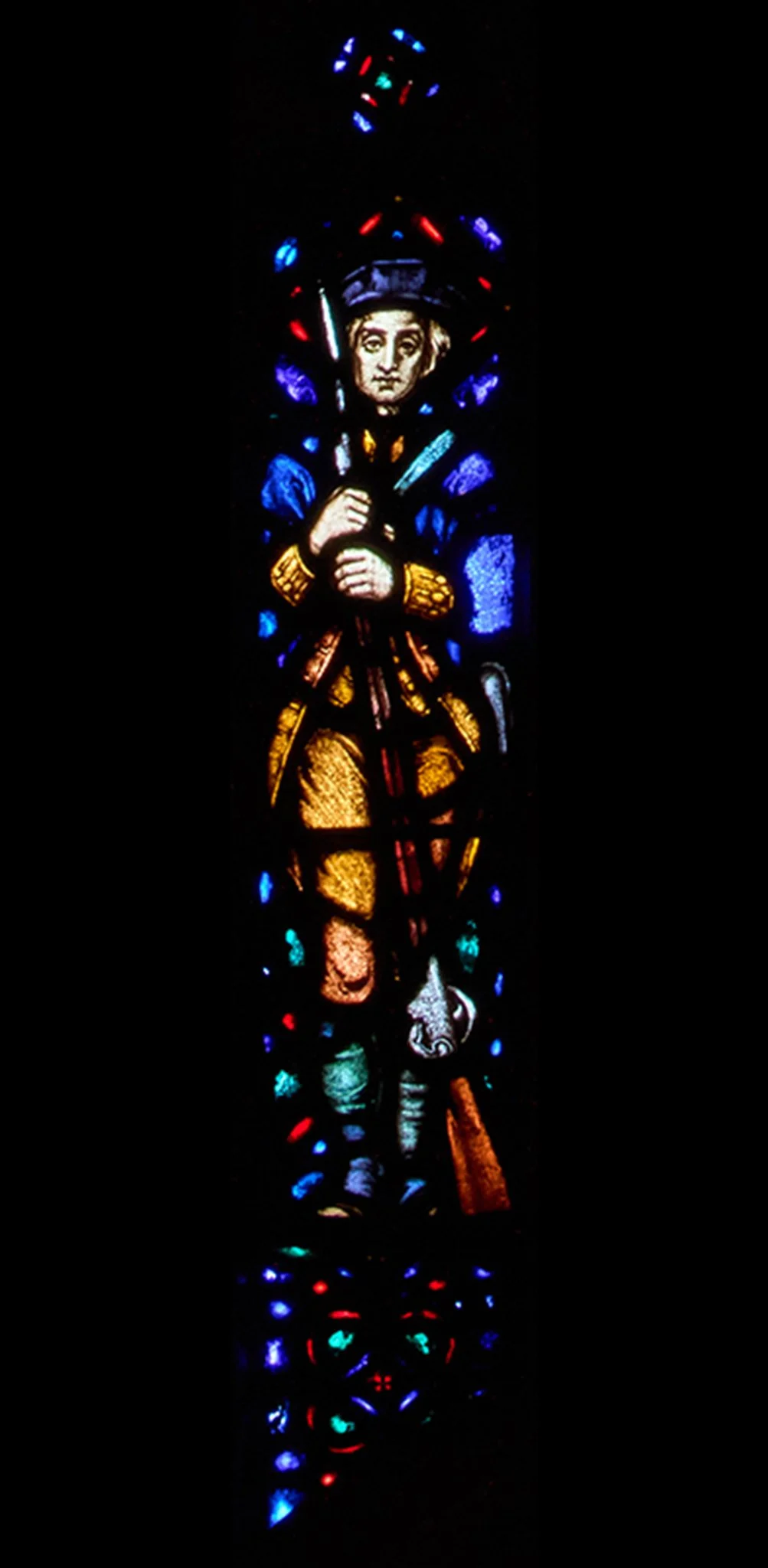
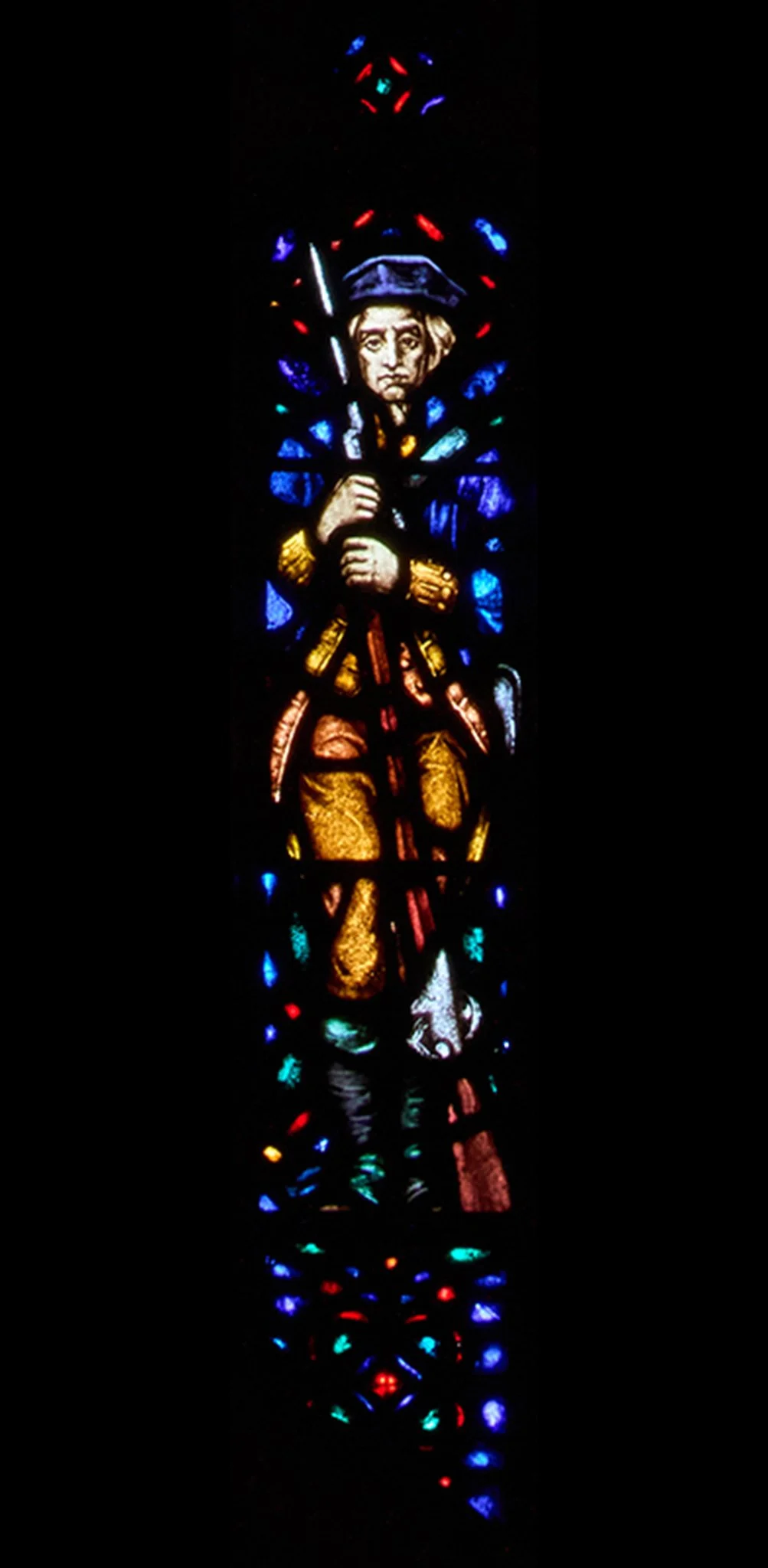
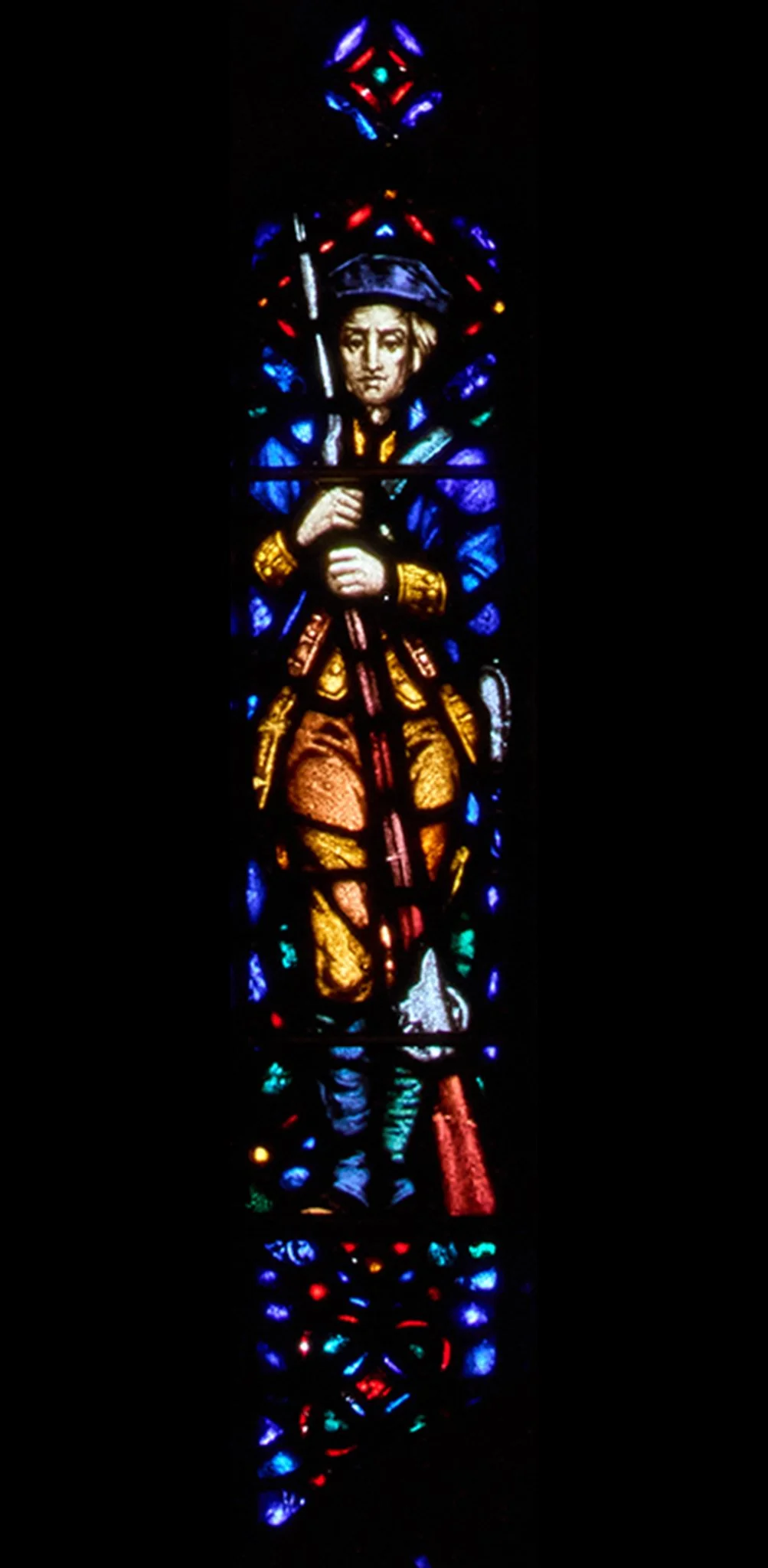
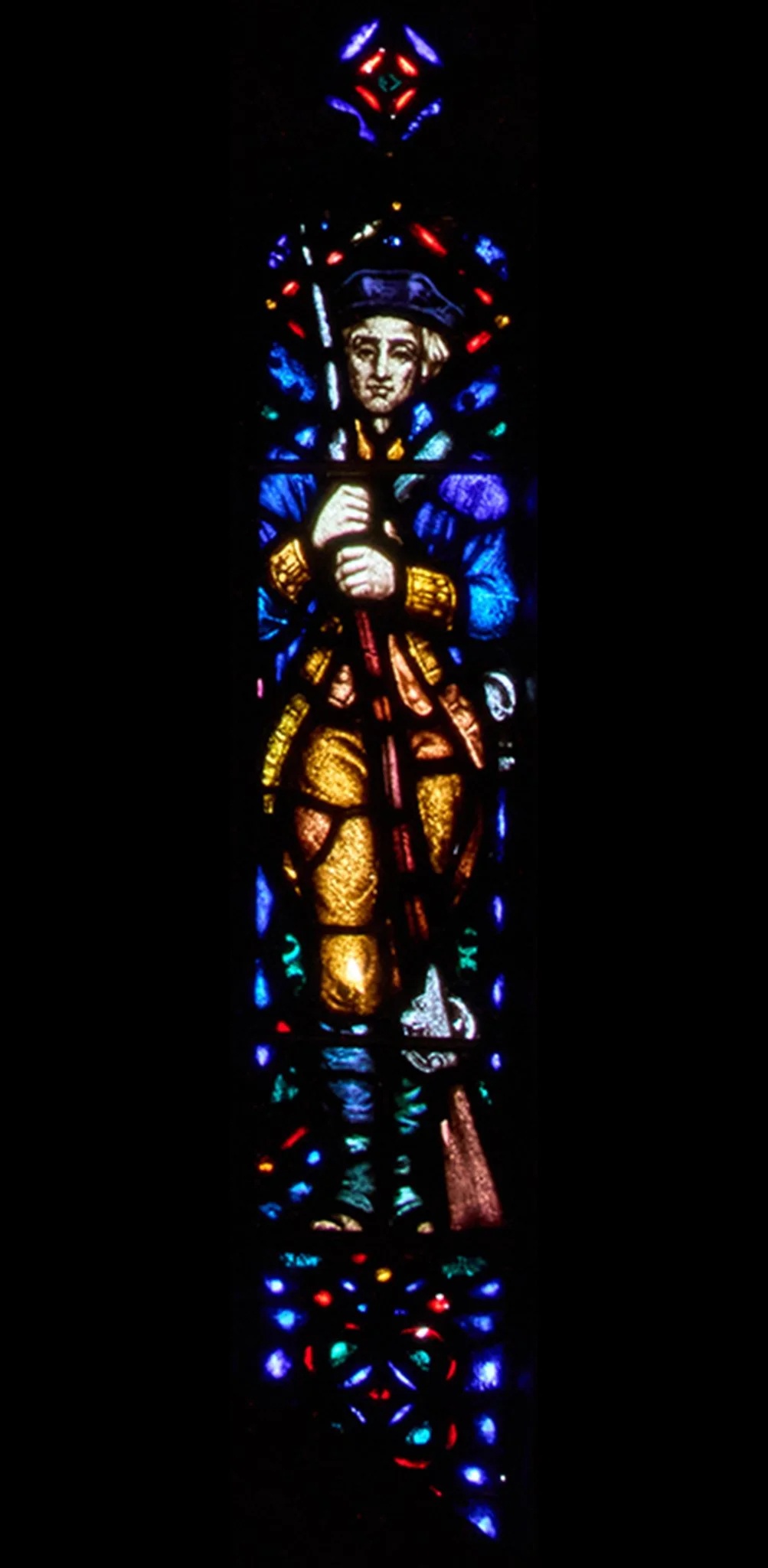
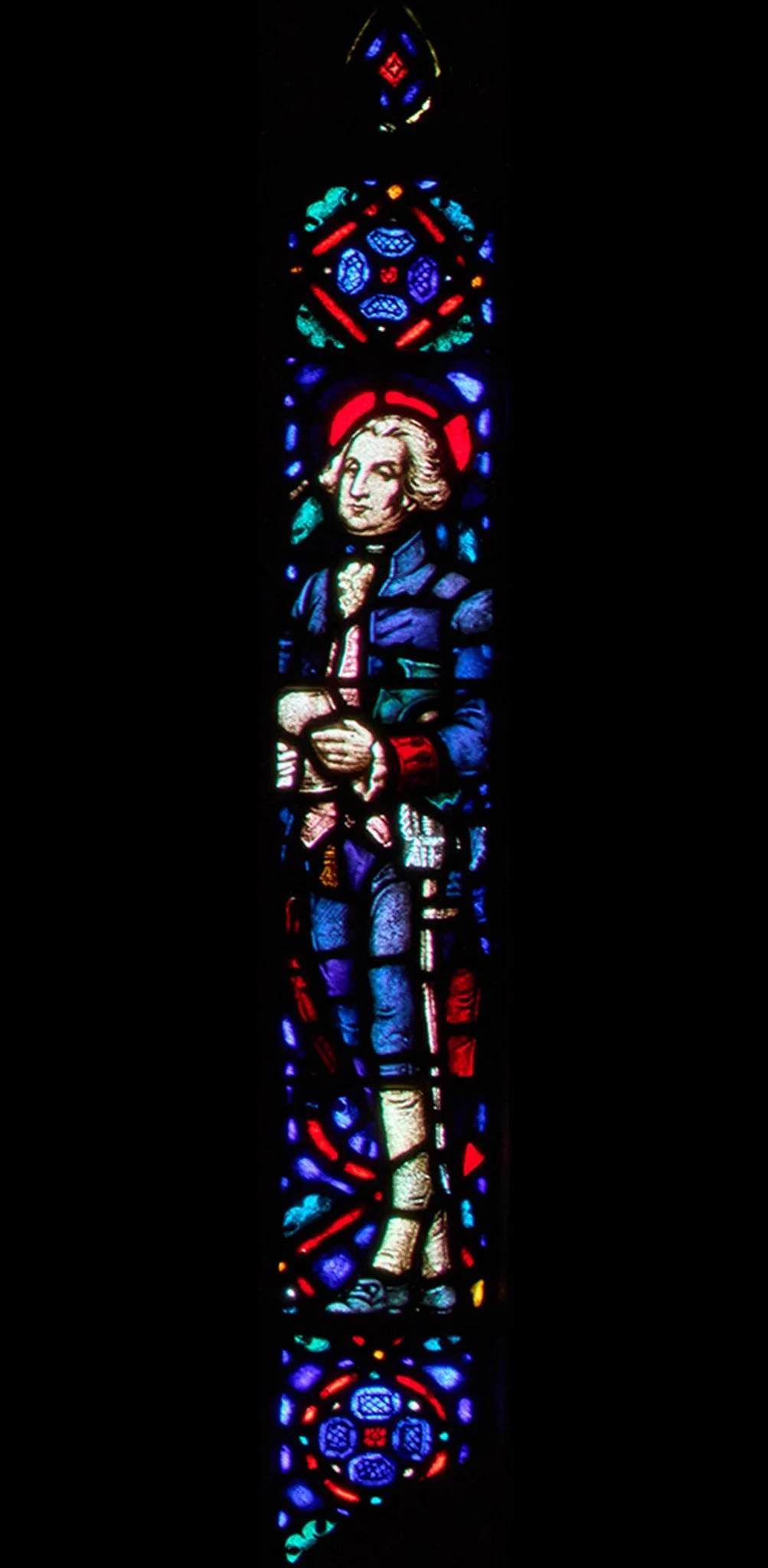
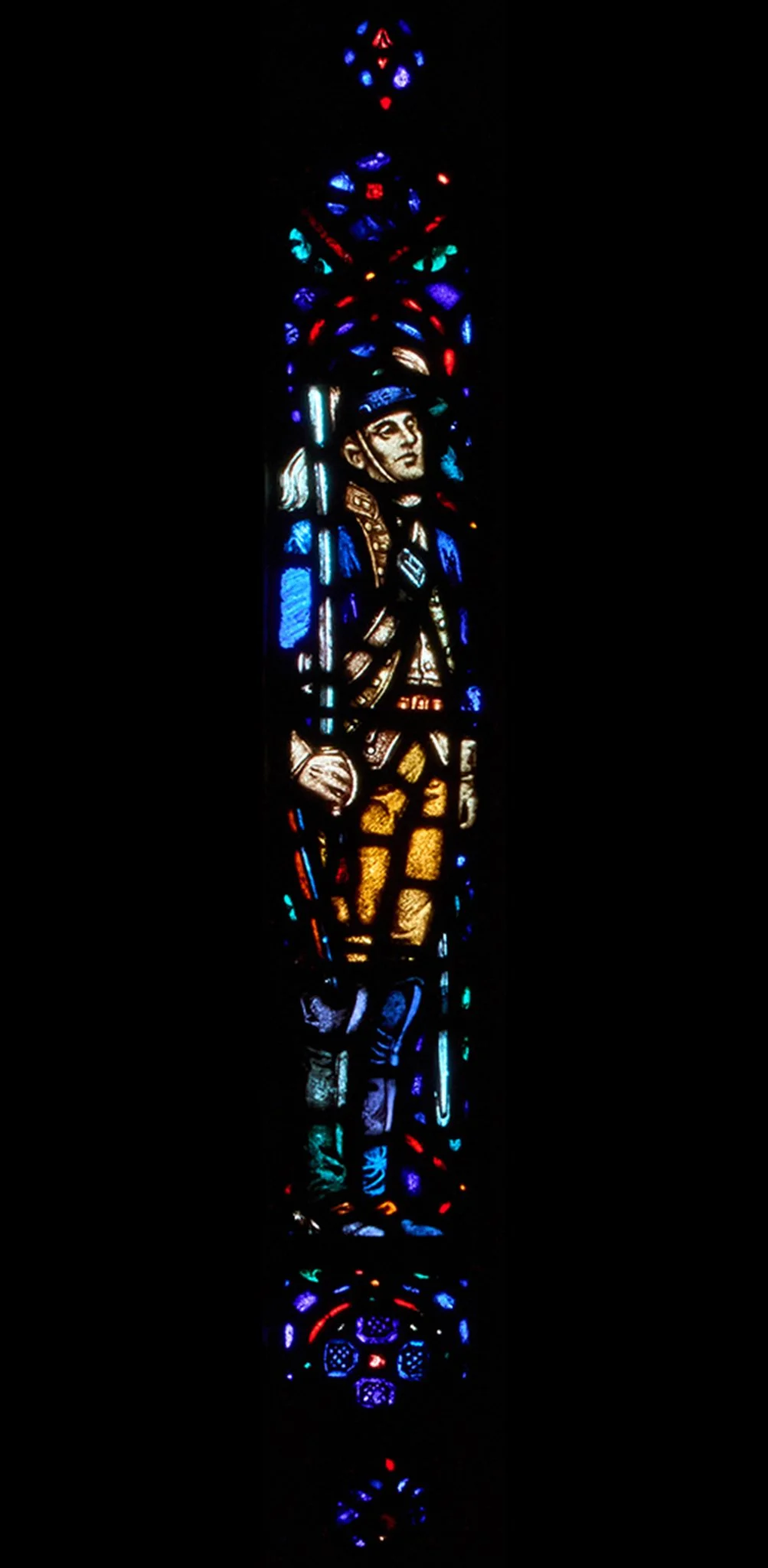
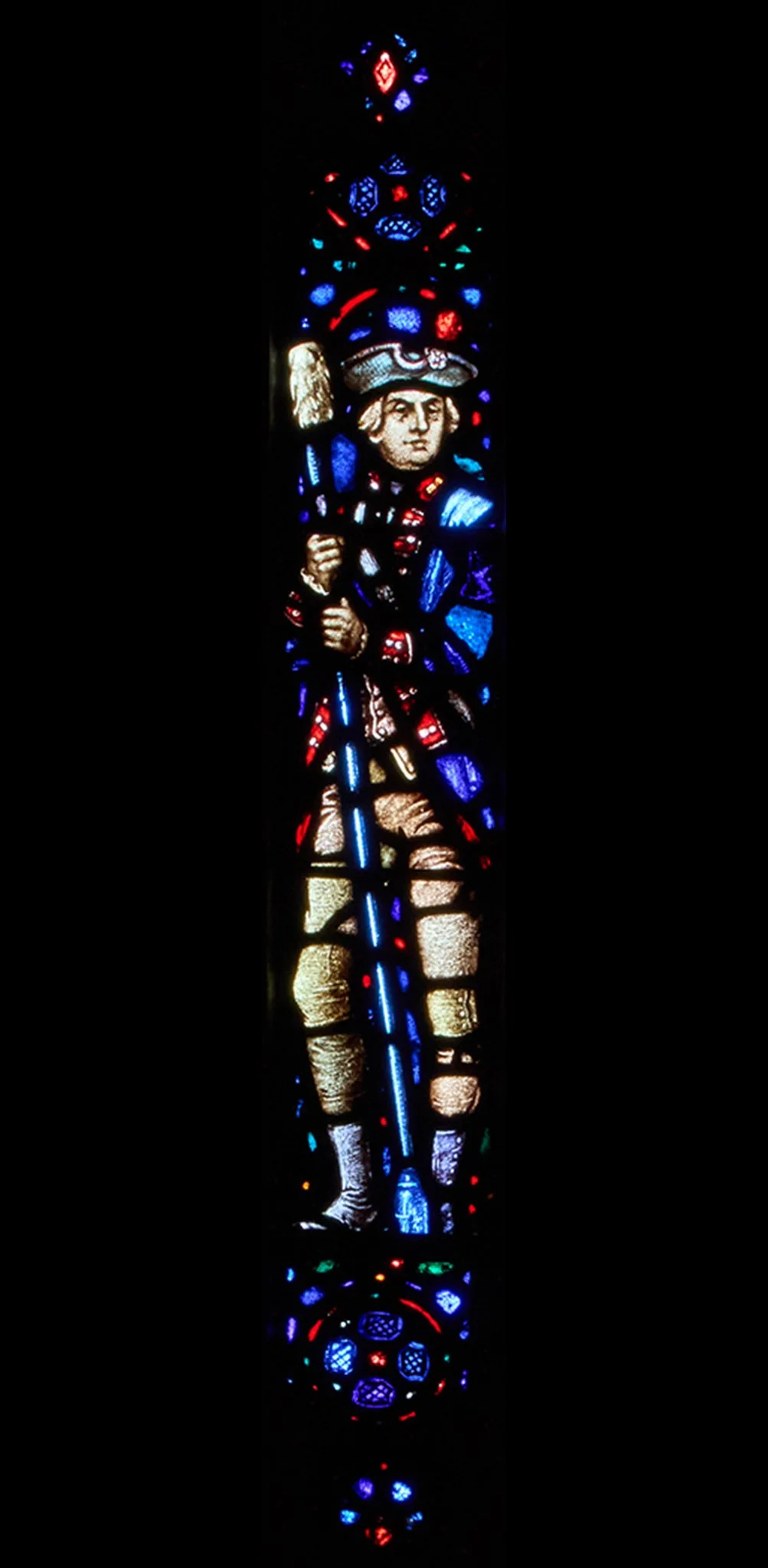
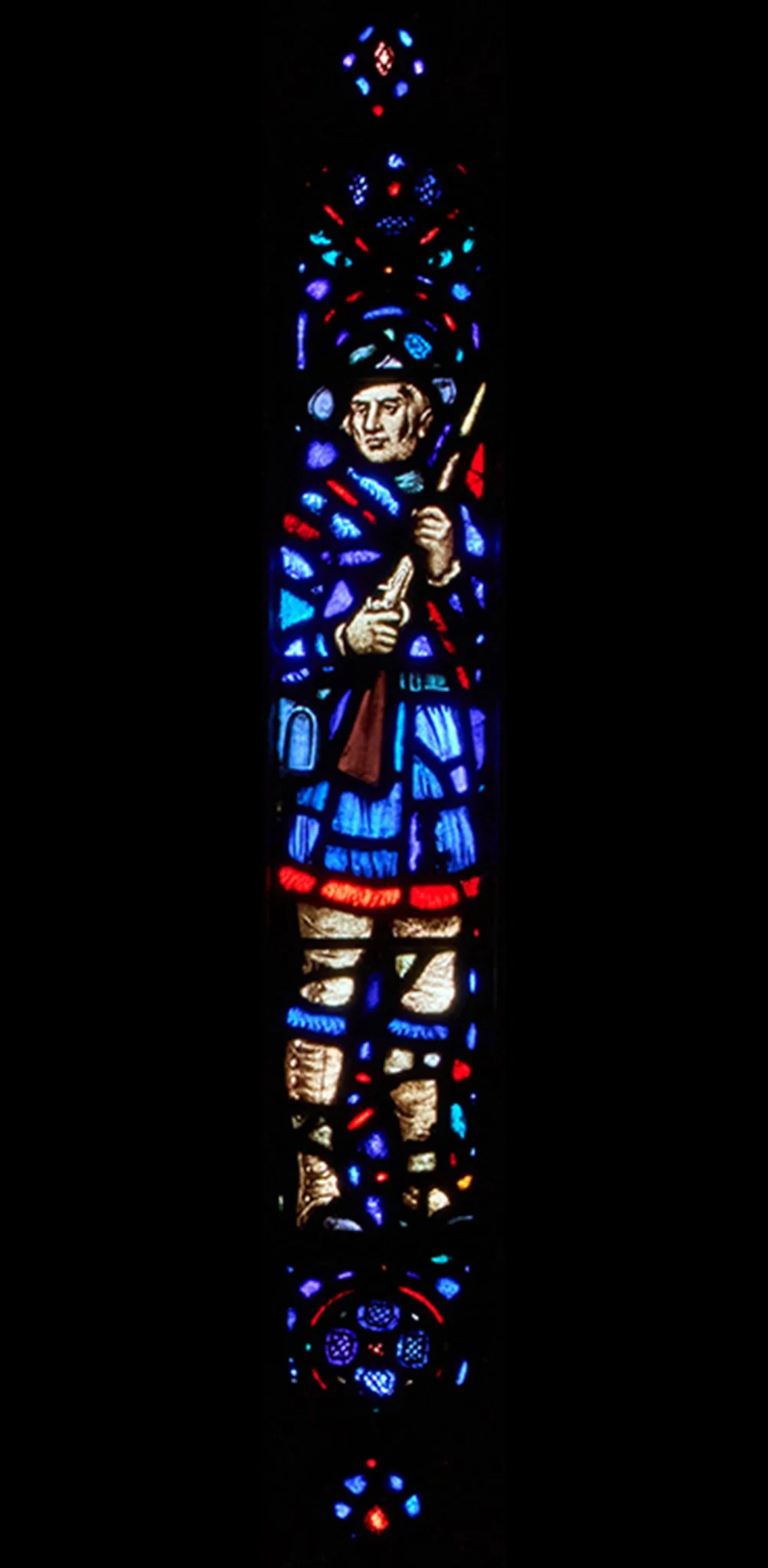
Two groups of soldiers in the center of the window’s top tracery parallel the archangels surmounting the Martha Washington Window. The top line of four soldiers represent different branches within the Continental Army: Dragoon, Artilleryman, Rifleman, and Life Guard (in pose of sentry saluting a high-ranking officer).[2] The bottom line of four soldiers below these are regular infantrymen of the Continental Line, like the soldiers standing guard in the top tracery of the nave windows. The inclusion of these figures is part of the Chapel’s theme of comprehensively honoring the service and sacrifice of all patriots, both famous and obscure.
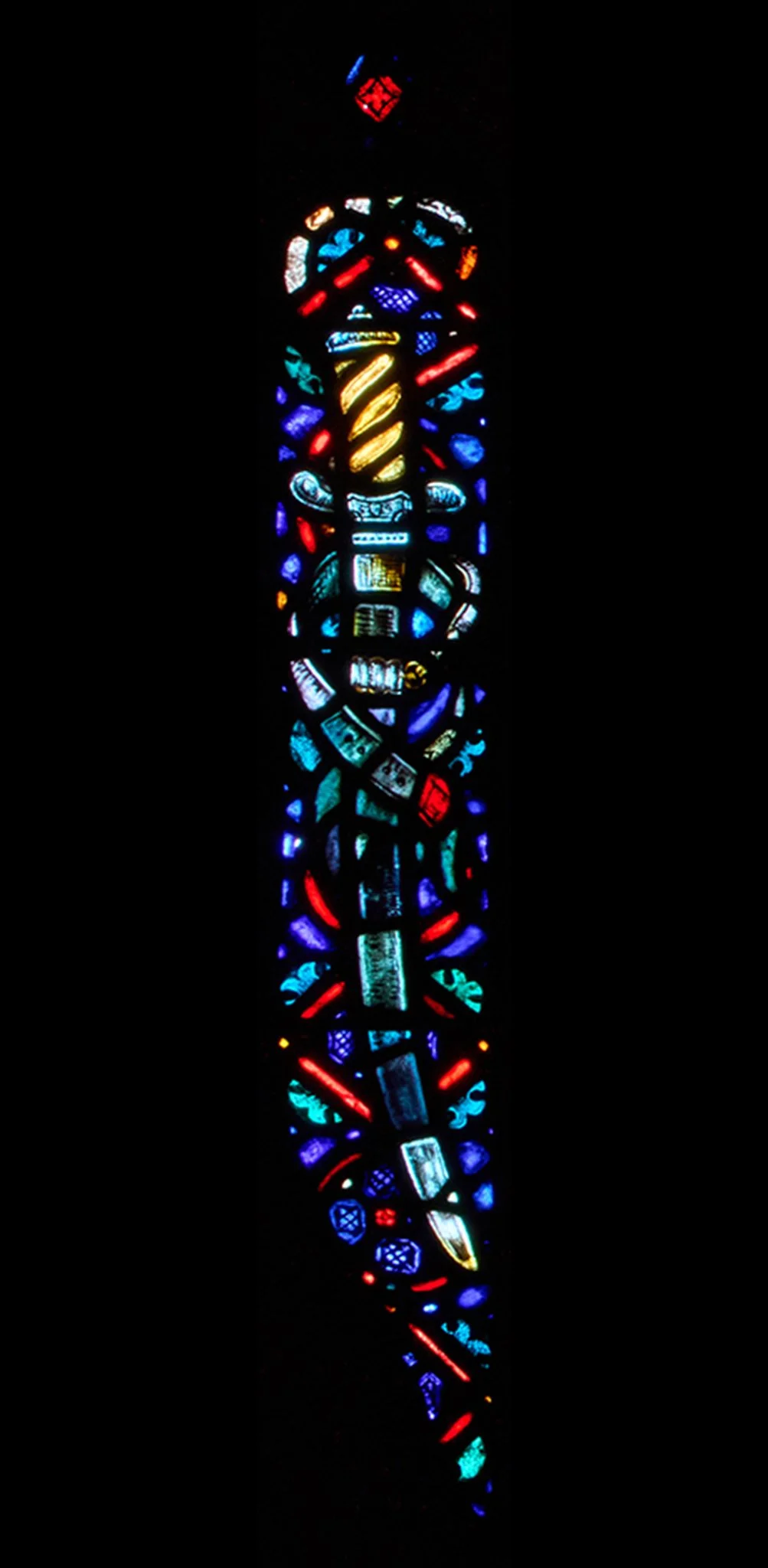
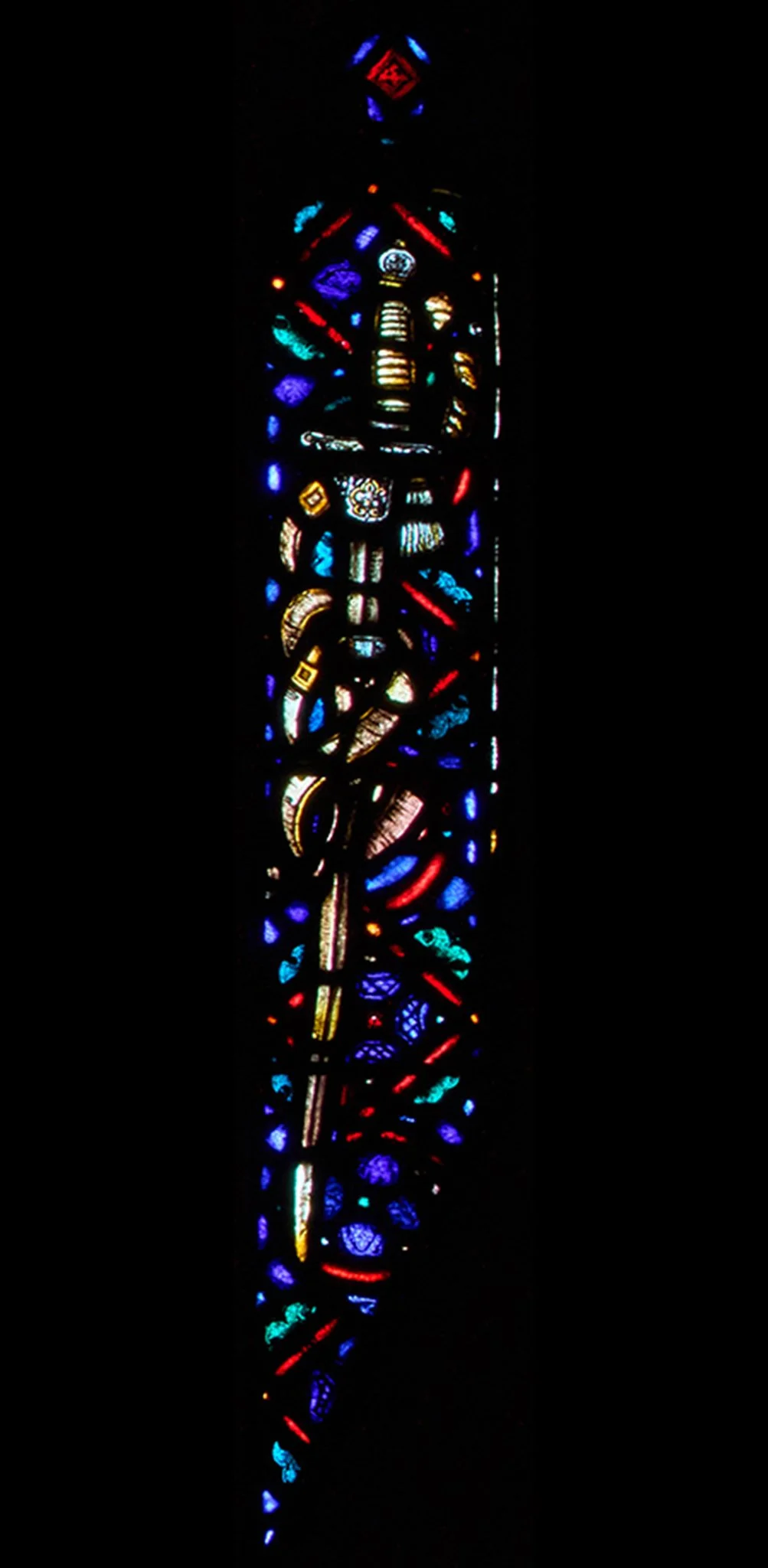
In the daggers to either side of these men are sheathed swords; on the left is Washington’s dress sword for formal occasions, while on the right is his battle sword. To either side of these are two pairs of figures showing Washington’s different roles in life: Surveyor, Colonel (French and Indian War), General (War for Independence), and President. Flanking these Washington representations are various American flags.
This window is unique in its total focus on the life of its honoree, a sharp contrast to the one or two appearances the other memorialized patriots may make in their windows. It is also distinctive in lacking a thematic title; this is because Washington’s individual character arc is being presented as the product of the Chapel’s larger story of the roots of American civilization. It echoes the Martha Washington Window of the Abundant Life, which it physically faces across the length of the chapel, by highlighting throughout Washington’s life the Christian “five-fold inheritance” of literature, social institutions (family, church, and state), religion, science, and art. Like the Chapel’s overall historical narrative, the selection of scenes in this pictorial biography highlights turning points that Burk believed were Divinely ordained.
Although some details of this window play off the patriotic mythos surrounding his life, the portrayal of Washington as a solid churchman and devout practitioner of Christianity is neither fanciful nor mistaken. As discussed in The Vision for the Windows and this window’s first scene (The Baptism of George Washington), doubts about Washington’s faith are contradicted by both eyewitnesses and his own writings (such as his prayerful words graven into the Chapel’s narthex).
By showing the importance of acts of religious devotion throughout Washington’s career, Burk hoped to communicate the Father of Our Country’s values to future generations. Burk prayed, with Washington, that God
“would most graciously be pleased to dispose us all to do Justice, to love mercy and to demean ourselves, with that Charity, humility and pacific temper of mind, which were the Characteristics of the Divine Author of our blessed Religion and without an humble imitation of whose example in these things, we can never hope to be a happy Nation.” [3]
Motifs Throughout
Blue Octagons and Red Squares: The windows’ field is of blue octagons with red squares interspersed, providing a predominantly blue backdrop.
Blue Washington/Fleurs-de-lis Lozenges in Red Bands: On either side of each panel in this window is a red vertical stripe with blue diamond shapes. This diamond shape, known as a “lozenge,” is common in heraldry. Each contains either the Washington coat of arms (shaded blue) or a single fleur-de-lis in blue. This design helps to maintain the blue color scheme of the window even as the red band provides a contrasting outline.
NKH
Stained Glass Design
Each of the windows in Washington Memorial Chapel have “medallions” depicting scenes or stories. In between those major medallions are smaller “intermedallions” which represent a theme or motif.
Within the tracery (intricate stonework window atop a stained glass window) are sections called daggers (dagger shaped), kites (diamond shaped) and panels (larger sections).
The slider below shows each section within the window.
-
![01 The Baptism of George Washington]()
01 The Baptism of George Washington
An Anglican priest stands on the far left of the medallion holding the infant George Washington. In the center is Washington’s mother, Mary Ball Washington, holding her prayer book. The man standing next to Mary is likely Washington's father, Augustine. The two male figures standing behind are likely the two godfathers. Though a cross is depicted in the center background, suggesting that the baptism took place in a church, the location of Washington’s baptism is not known.
-
![Washington His Own Teacher]()
02 Washington His Own Teacher
Washington sits alone at a desk in a library with his left hand resting on an open book as he concentrates on writing with his right hand.
-
![Washington the Surveyor]()
03 Washington The Surveyor
This medallion shows sixteen year-old George Washington surveying Little Hunting Creek Plantation in Virginia. He is the second figure on the right. The figure in the far right is a black man holding the surveyor’s chain that was used for measuring land distances. Lord Fairfax (who hired George Washington as a surveyor) is on the far left and Lawrence Washington (George Washington’s older half-brother) is next to him holding a completed survey of his estate “Hunting Creek.”
-
![Washington the King's Messenger]()
04 Washington the King's Messenger
George Washington, in a blue overcoat, presents Jacques Legardeur de Saint-Pierre (1701-1755), the French commandant of Fort LeBoeuf, with a letter written by Robert Dinwiddie, Governor of Virginia (1692-1770). Legardeur is flanked by French officers and sentries. Legardeur stands over a table, his fist closed on a roll of maps. In the background, the log walls of Fort Le Boeuf are visible.
-
![Washington's First Defeat]()
05 Washington's First Defeat
The medallion shows George Washington, who has surrendered to the French, leading his troops out of “Fort Necessity.” He is preceded by his drummer and followed by a soldier carrying the unit’s colors, as agreed in the terms of the surrender.
-
![The Burial of Braddock]()
06 The Burial of Braddock
With British soldiers to his left and right holding torches and others looking on, Washington reads from the Book of Common Prayer an impromptu burial service over General Braddock after the battle of the Monongahela River in July 1755.
-
![Washington at Fort Duquesne]()
07 Washington at Fort Duquesne
George Washington, ringed by clouds of smoke, stands atop the logs of Fort Duquesne, his sword in his right hand and the flag of Great Britain in his left. His soldiers cheer, waving their hats, at either side. The brass barrel of a cannon is partially visible near him.
-
![08 Washington’s Marriage]()
08 Washington’s Marriage
Pictured in the center of the medallion are Martha Dandridge Custis (left) facing Colonel George Washington (right), with The Reverend David Mossom, rector of St. Peter’s Church, between them officiating. To the far left is probably colonial Virginia Governor Francis Fauquier, and in the background and to the far right are other members of colonial Virginia’s leading society.
-
![Washington the Planter]()
09 Washington the Planter
Pictured is Washington, the central figure, astride a horse. To the right, an overseer awaiting instructions, to the left are two slaves, one leading an ox in the foreground.
-
![Washington the Church Builder]()
10 Washington the Church Builder
George Washington stands on the left of the medallion studying a sheaf of papers, probably the plans for the new Pohick Church. On the right are two workmen, one carrying a hod (long-handled masonry tray) on his right shoulder, the other with what appears to be a mallet bending over what may be a piece of stone. In the background is the entrance to the church with its classical arch and pilasters.
-
![Washington Keeps the Fast Day]()
11 Washington Keeps the Fast Day
The medallion shows Washington (middle figure) on the steps of old Bruton Church in Williamsburg, Virginia. To the right is Patrick Henry leaning on a cane. The figure on the left is Richard Henry Lee. The Three are about to enter the church.
-
![Washington Leaves for the Continental Congress]()
12 Washington Leaves for the Continental Congress
The medallion shows George Washington on horseback in the center bidding farewell to Martha Washington on the steps of Mount Vernon. Behind him are the figures of Patrick Henry, probably the figure whose full face is shown on the right, and Edmund Pendleton, behind Washington’s right shoulder, who accompanied Washington to Philadelphia as delegates from Virginia to attend the First Continental Congress.
-
![Washington Accepts the Office of Commander-in-Chief of the Continental Armed Forces]()
13 Washington Accepts the Office of Commander-in-Chief of the Continental Armed Forces
Pictured in the center of the medallion are George Washington (right), along with John Hancock (left), President of the Continental Congress. Behind them sit the assembled delegates of the Continental Congress. One of the figures seated behind Hancock and Washington is likely Charles Thomson, Secretary of Congress. Washington's posture is upright, yet restrained, conveying dignity and humility as he accepts his commission as Commander-in-Chief of the Continental Army.
-
![Washington Fortifies Dorchester Heights]()
14 Washington Fortifies Dorchester Heights
Washington stands in the center viewing Boston below with his looking glass. General Henry Knox is to the right. To the left soldiers roll the heavy cannons into position atop Dorchester Heights. The Grand Union flag, the first attempt at an American flag, flies prominently above them.
-
![Washington Saves His Army at Long Island]()
15 Washington Saves His Army at Long Island
The medallion shows General Washington on the left stepping into the stern of the last boat to leave Long Island. Two soldiers/seamen from Massachusetts with oars upraised salute him.
-
![Washington Wins the Battle of Princeton - January 3, 1777]()
16 Washington Wins the Battle of Princeton - January 3, 1777
General Washington is shown mounted upon his warhorse, Nelson, leading a charge against British regulars at the Battle of Princeton.
-
![Washington’s Prayer at Valley Forge]()
17 Washington’s Prayer at Valley Forge
George Washington kneels in prayer amid the woods of Valley Forge with his horse standing by and hat placed on the ground. Behind the trees, local miller Isaac Potts observes.
-
![Washington Creates the American Army]()
18 Washington Creates the American Army
The medallion shows George Washington in the middle, Von Steuben (far left figure), and Lafayette (far right figure) watching the men at Valley Forge pass in review. The new flag of the United States, with the stars and stripes, represents the new American army.
-
![Washington’s Evacuation of Valley Forge]()
19 Washington’s Evacuation of Valley Forge
Astride his horse, Washington, as Commander-in-Chief, leads the departure from the Valley Forge encampment. To the right staff follow him; to the left an infantryman salutes him.
-
![Washington Fires the First Gun at Yorktown]()
20 Washington Fires the First Gun at Yorktown
The medallion shows Washington in the center firing the first cannon in the siege of Yorktown. Smoke billows from the cannon’s muzzle. A gunner, who has just loaded the cannon, stands on the left holding the rammer, while another soldier stands behind him. On the right and behind Washington is Lafayette. In the background on right and left are what appear to be gabions, earth filled baskets used to protect and fortify the gun position.
-
![Washington Thanks Count de Grasse]()
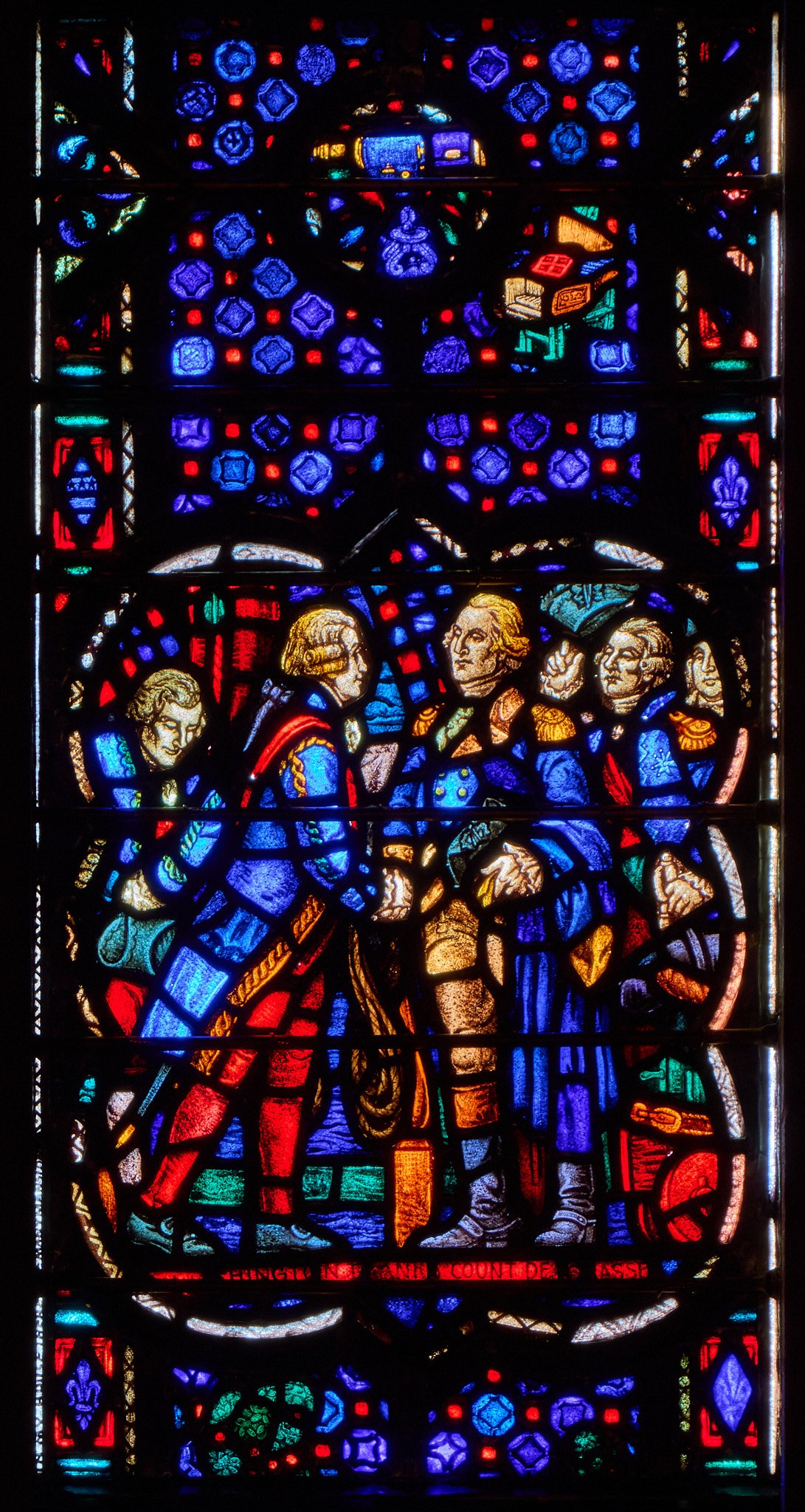
21 Washington Thanks Count de Grasse
Washington meets with Admiral Count de Grasse aboard his flagship, La Ville de Paris, (The City of Paris), a 104 gun ship of the line. Washington stands on the right shaking the hand of Admiral de Grasse on the left. Three other officers, at least two of whom are French, are pictured on either side of de Grasse and Washington with their hats off in a show of respect.
-
![Washington and His Mother Celebrate the Victory]()
22 Washington and His Mother Celebrate the Victory
George Washington, wearing his dress uniform, escorts his mother, Mary Ball Washington (1708-1789), through an open door into a ballroom. Unidentified ladies and gentlemen at either side bow and curtsey. Mrs. Washington wears a blue dress with a red pettitcoat, and leans on a gold-headed cane.
-
![Washington Quells a Rebellion]()
23 Washington Quells a Rebellion
In the center, General George Washington stands on a dais in the middle of a large room preparing to put on his spectacles. General Horatio Gates stands behind the table to the left, and five of Washington’s officers, looking contemplative, or in one case, belligerent, are gathered on the right.
-
![Washington Resigns His Commission]()
24 Washington Resigns His Commission
George Washington stands in the center of the medallion in the Old Senate Chamber of the Maryland State House. He presents the papers containing his commission to several members of Congress, among them Thomas Jefferson, James Madison, and James Monroe. Directly behind him is his aide-de-camp, Col. Benjamin Walker, and behind Walker is Col. David Humphreys. Washington's cloak lies, discarded, on a thronelike chair at lower right. The image itself is adapted from Trumbull's 1822-1824 painting for the Capitol Rotunda.
-
![Peace on Earth - Christmas 1783]()
25 Peace on Earth - Christmas 1783
Pictured is Washington, the central figure, with his wife Martha to his left. They are standing in their pew at Christ Church, Alexandria, surrounded by fellow parishioners. Washington appears pensive holding his prayer book, while the others are singing the Gloria in Excelsis, with the suggestion of a festive wreath in the background.
-
![Washington at Home]()
26 Washington at Home
George Washington is seated in his library at Mount Vernon embracing his step-grandchildren. Washington smiles as he gazes at George Washington Parke Custis, who sits upon his knee gleefully laughing and looking up at Mrs. Washington. Mrs. Washington stands to the right of her husband as she leans over his shoulder and holds out an enticing cookie. Eleanor Parke Custis, “Nelly,” stands to the left of Washington within the embrace of his arm. One of Nelly’s hands rests on Washington’s knee as she holds her rag doll in the other hand. Washington temporarily neglects the books and papers on the desk in front of him to focus on the joys of family life.
-
![Washington President of the Federal Convention]()
27 Washington President of the Federal Convention
George Washington is seated in the center with his arm resting on a desk. He is looking down at James Madison, standing on the left, addressing Benjamin Franklin and Alexander Hamilton seated on the right. The head and chest of a fifth, unidentified figure possibly taking notes with a quill pen is shown on the extreme left. The armchair Washington is sitting in has on its back the sun emblem made famous by Benjamin Franklin in his remark toward the end of the Convention, “In the vicissitudes of hope and fear I was not able to tell whether it was rising or setting; now I know that it is the rising sun.” The scene is set in the Pennsylvania State House, now known as Independence Hall, in Philadelphia.
-
![Washington Visits Valley Forge]()
28 Washington Visits Valley Forge
In what The Reverend W. Herbert. Burk describes as a sentimental visit, Washington stands in the center of the scene, hand to chin, reviewing and reflecting on the Valley Forge hills and meadows before him. His horse is directly behind him.
-
![Washington is Notified of His Election as President]()
29 Washington is Notified of His Election as President
George Washington stands on the right in his library at Mount Vernon, reaching for the official letter of notification of his election as president. Charles Thomson, his friend as well as the Secretary of the Congress, is in the center handing the communication to Washington. On the far left and in the background are Martha Washington and her grandson, George Washington Parke Custis, looking on.
-
![Washington Receives his Mother’s Blessing]()
30 Washington Receives his Mother’s Blessing
George Washington kneels on his right knee before his mother, who holds a book in her left hand and has her right hand placed upon his head. A blue table stands on the left of the green wingback armchair. In the distance, through an open window framed by red curtains, a wagon wheel in blue suggests the presence of a coach in which Washington has arrived.
-
![The President’s Preparation]()
31 The President’s Preparation
George Washington stands on the steps of St. Paul’s Chapel in New York City, shaking the hand of the Rt. Rev. Samuel Provoost, Bishop of New York and Chaplain of the Senate, who is clad in rochet, black chimere, and preaching bands. Vice President John Adams and Speaker of the House Frederick Augustus Muhlenberg stand behind Washington, and another man, possibly a representation of the Rev. William Linn, is partially visible behind Provoost.
-
![Washington and His First Cabinet]()
32 Washington and His First Cabinet
Description: On the left sits George Washington. Thomas Jefferson sits across from him on the right. Hamilton, to Washington’s left, holds a paper the three are discussing with Henry Knox, Edmund Randolph, and Samuel Osgood.
-
![Washington Lays the Cornerstone of the Capitol]()
33 Washington Lays the Cornerstone of the Capitol
George Washington is in the center with a Mason’s trowel applying mortar to the cornerstone of the United States Capitol on September 18, 1793. The next block hangs in the rear. Washington is shown wearing Masonic regalia. On either side are other Freemasons, one of whom, per The Reverend W. Herbert Burk’s description, is the Masonic Grand Master pro tem and the other the Worshipful Master of Alexandria Lodge No. 22 of which Washington was a member. An American flag is shown on the corner of the stone.
-
![Washington With the Farewell Address]()
34 Washington With the Farewell Address
George Washington, his completed Farewell Address in his left hand, makes an open-palm gesture with his right hand as he looks into the distance. In the background, a rainbow can be seen through the window of his study.
-
![Sunset in the Garden]()
35 Sunset in the Garden
Pictured in the center of the medallion are George Washington (left) and Martha Washington (right), standing together in a cultivated garden setting. Washington is depicted in an 18th-century blue coat with knee breeches and a tricorn-style hat, his posture upright and composed as he points with his walking stick to a rose in the garden. Martha Washington stands beside him in an elaborate gown, her body angled toward him in a pose of companionship. The surrounding scene is filled with foliage and flowers, shown in deep blues, reds, and greens. Although not obvious at first, curving lines of boxwood characteristic of the Mount Vernon formal Upper Garden are depicted in the lower left.
-
![Peace at Eventide]()
36 Peace at Eventide
We see George Washington at eventide, seated in his library at Mt. Vernon. Two candles rest on a side table to the right of the scene, illuminating God’s word as revealed in the Holy Bible. Washington’s Bible rests open upon his lap. To the left, a fire blazes in his hearth, upon the mantle an hourglass, symbolic of both Mankind’s and Washington’s mortality.
-
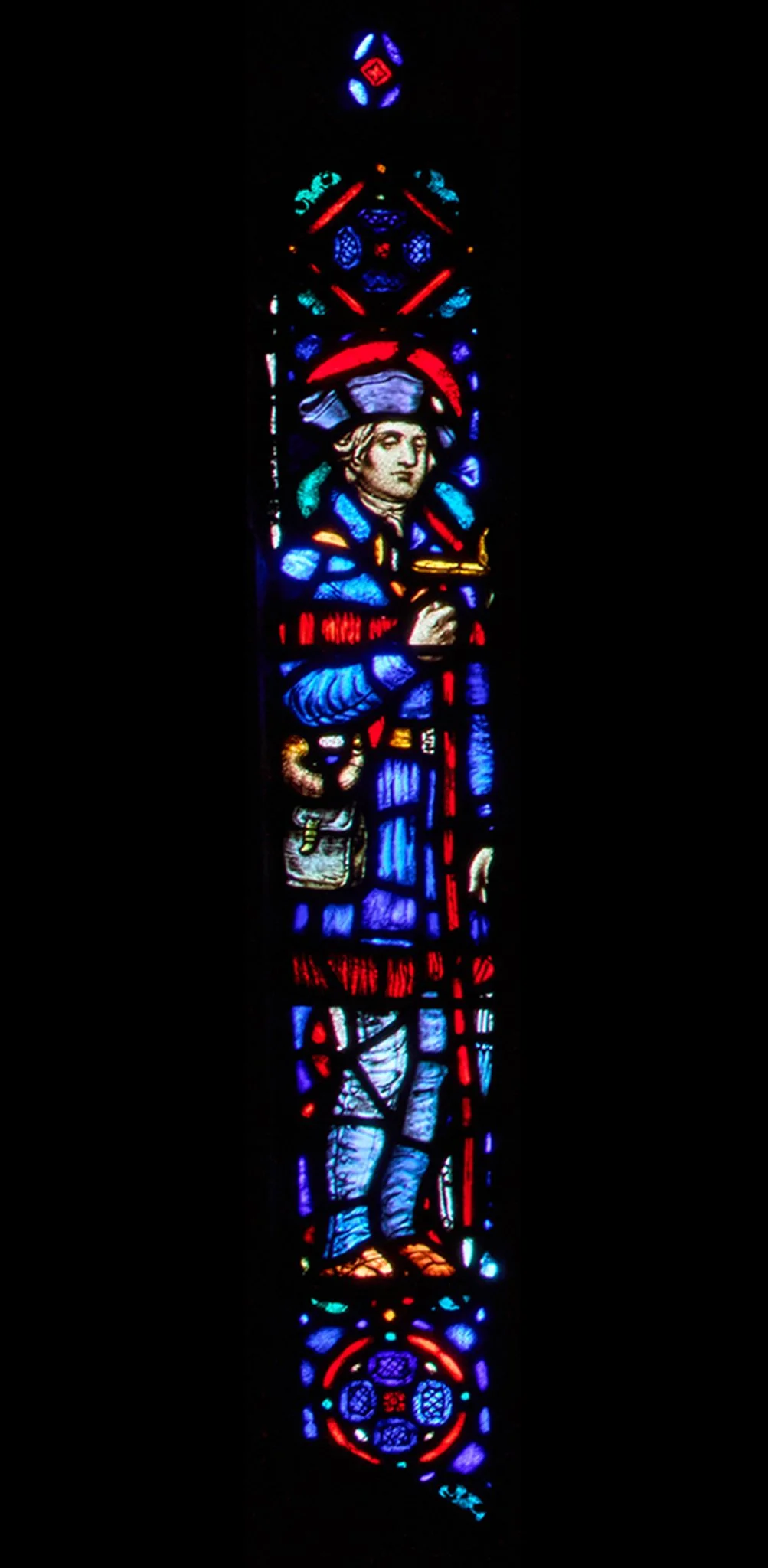
![Tracery Glass 1 (Panel) Washington the Surveyor]()
Tracery Glass 1 (Panel) Washington the Surveyor
-
![Tracery Glass 2 (Panel) Washington a Colonel of the Virginia Militia]()
Tracery Glass 2 (Panel) Washington a Colonel of the Virginia Militia
-
![Tracery Glass 3 through 6 - Panels Continental Infantry Soldier]()
Tracery Glass 3 (Panel) Continental Infantry Soldier
Learn the significance of different Continental Army uniform facing and cuff colors through the chapel windows.
-
![Tracery Glass 4 (Panel) Continental Infantry Soldier]()
Tracery Glass 4 (Panel) Continental Infantry Soldier
Learn the significance of different Continental Army uniform facing and cuff colors through the chapel windows.
-
![Tracery Glass 5 (Panel) Continental Infantry Soldier]()
Tracery Glass 5 (Panel) Continental Infantry Soldier
Learn the significance of different Continental Army uniform facing and cuff colors through the chapel windows.
-
![Tracery Glass 6 (Panel) Continental Infantry Soldier]()
Tracery Glass 6 (Panel) Continental Infantry Soldier
Learn the significance of different Continental Army uniform facing and cuff colors through the chapel windows.
-
![Tracery Glass 7 (Panel) Washington The Commander-in-Chief]()
Tracery Glass 7 (Panel) Washington The Commander-in-Chief
Learn the significance of different Continental Army uniform facing and cuff colors through the chapel windows.
-
![Tracery Glass 8 (Panel) Washington the First President of the United States of America]()
Tracery Glass 8 (Panel) Washington the First President of the United States of America
-
![Tracery Glass 9 (Kite) WASHINGTON FAMILY COAT OF ARMS]()
Tracery Glass 9 (Kite) WASHINGTON FAMILY COAT OF ARMS
-
![Tracery Glass 10 (Panel) Washington’s Dress Sword]()
Tracery Glass 10 (Panel) Washington’s Dress Sword
-
![Tracery Glass 11 (Panel) Continental Dragoon]()
Tracery Glass 11 (Panel) Continental Dragoon
Learn the significance of different Continental Army uniform facing and cuff colors through the chapel windows.
-
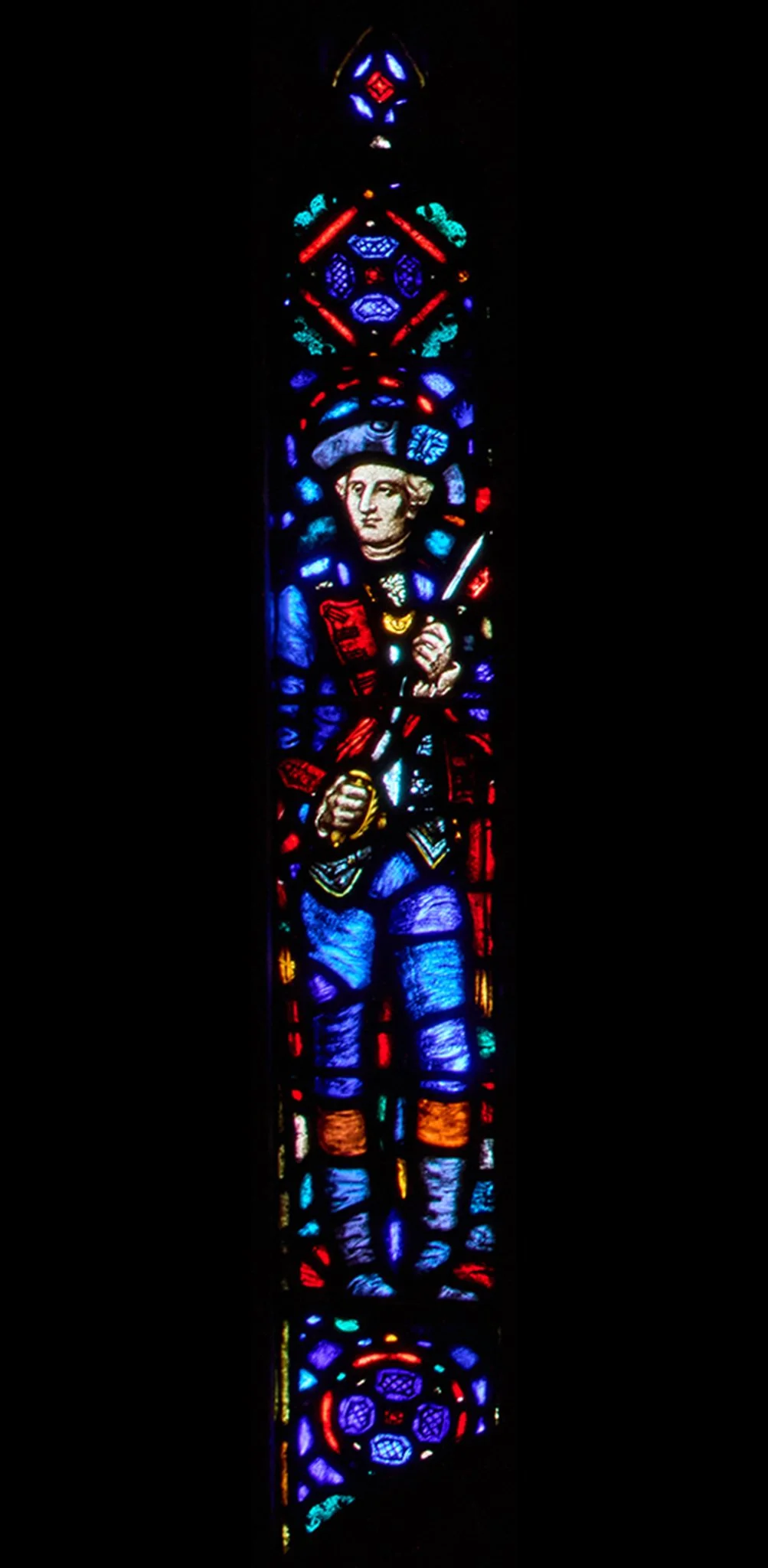
![Tracery Glass 12 (Panel) Continental Artilleryman]()
Tracery Glass 12 (Panel) Continental Artilleryman
Learn the significance of different Continental Army uniform facing and cuff colors through the chapel windows.
-
![Tracery Glass 13 (Panel) Continental Rifleman]()
Tracery Glass 13 (Panel) Continental Rifleman
Learn the significance of different Continental Army uniform facing and cuff colors through the chapel windows.
-
![Tracery Glass 14 (Panel) Continental Lifeguard]()
Tracery Glass 14 (Panel) Continental Lifeguard
Learn the significance of different Continental Army uniform facing and cuff colors through the chapel windows.
-
![Tracery Glass 15 (Panel) Washington’s Military Sword]()
Tracery Glass 15 (Panel) Washington’s Military Sword
-
![Tracery Glass 16 (Kite) WASHINGTON FAMILY COAT OF ARMS]()
Tracery Glass 16 (Kite) WASHINGTON FAMILY COAT OF ARMS






Detailed Medallion Text
01 The Baptism of George Washington
Medallion 1: The Baptism of George Washington
Location: Left section, left lancet, top
Description:
An Anglican priest stands on the far left of the medallion holding the infant George Washington. In the center is Washington’s mother, Mary Ball Washington, holding her prayer book. The man standing next to Mary is likely Washington's father, Augustine. The two male figures standing behind are likely the two godfathers. Though a cross is depicted in the center background, suggesting that the baptism took place in a church, the location of Washington’s baptism is not known.
Background:
The Reverend W. Herbert Burk specified that the subject of the first medallion of the Washington Window, located above (more or less) the Chapel’s baptismal font which commemorates Washington’s birth and baptism, “should be his baptism, by which he was consecrated a soldier of the cross.” In Burk’s description of the medallion, apparently composed before its completion, he stated that “the sponsors [godparents] should stand to the right, with the father and mother, the latter with her Prayer Book in hand. . . .”. This suggests that the man standing next to Mary is Washington's father, Augustine.
As was customary at the time, a male child had two male godparents and one female godparent. George Washington’s two godfathers were Mr. Beverly Whiting and Captain Christopher Brooks. His godmother was his aunt, Mildred Washington Gregory.
George Washington was born on a tobacco plantation along the shores of Popes Creek, Virginia on February 11, 1732 according to the Julian calendar in use by Great Britain and its colonies at the time. The changeover to the Gregorian calendar did not occur until September 1752, at which point February 22, 1732 became the birthday which we observe today.
Washington was baptized into the Church of England on April 5, 1732 (Gregorian), through sprinkling, a common practice for infants in the Anglican tradition. Owing to the plantation system, the dispersion of Virginia’s population and the scarcity of clergy and accessible churches, baptisms were often conducted at home. There is no record of the site of Washington’s baptism, nor of the name of the officiant.
DCS
Intermedallion [Surrounding The Baptism of George Washington]
- Combined Washington/Kitson Coat of Arms: Center shield: Washington, impaled with Kitson (Sable, three fishes naiant in pale Argent (white); a chief Or (gold), although the fish are properly “hauriant in fess,” or in a row facing upwards, instead of in a column facing to the left). This achievement of arms commemorates the 1498 marriage of George Washington’s distant ancestor John Washington to Margaret Kitson, of Hengrave in Suffolk. All eight of the central shields in this window’s intermedallions appear to have been taken from a heraldic pedigree of George Washington, printed in 1858 at Philadelphia by Thomas Sinclair. They also appear at eye level, as wooden carvings on the inside face of the Washington Memorial Door directly below this window. This is the second one; the first in the sequence is the regular Washington coat of arms, which dates back to at least 1346.
JRW
02 Washington His Own Teacher
Medallion 2: Washington His Own Teacher
Location: Left section, left lancet, second from the top
Description:
Washington sits alone at a desk in a library with his left hand resting on an open book as he concentrates on writing with his right hand.
Background:
Despite his lack of a formal education, George Washington’s thirst for knowledge encompassed politics, business, law, agriculture, philosophy and military science, benefitting him and ultimately his country.
Though lacking the formal education typical of colonial gentry, Washington compensated for this deficiency through constant study and extensive reading. Washington had only two years of private tutoring and grammar school instruction which ended with his father’s death in 1743. But his grammar school instructor, The Reverend James Marye, instilled in Washington a lifelong love of learning and respect for the importance of education.
Only twelve at his father’s death, Washington developed a strong work ethic running the family’s Ferry Farm. His school copy books reveal his study of geometry, decimals, trigonometry, “mensuration” (measuring), calculation of the leap year, geography, calculation of interest, and surveying. By copying 110 maxims for gentlemanly etiquette and moral principles from a 16th century book called The Rules of Civility and Decent Behavior in Company and Conversation, Washington developed personal qualities of poise, virtue, respect for superiors, and humility that advanced his military and political career.
After moving to Mount Vernon at age fifteen, Washington learned riding, hunting, fencing, and dancing from his half-brother Lawrence who introduced George to the influential Fairfax family. Lawrence's father-in-law, William Fairfax, served as mentor and surrogate father to George, teaching him the requirements for advancement in colonial planter society. Fairfax offered the sixteen year old Washington his first job as a surveyor. Washington continued to increase his knowledge by studying astronomy and using legal forms like bills of exchange, tobacco receipts, leases, and patents to learn business and legal practices. As a young man, Washington read the novelists Henry Fielding, Tobias Smollett, and Daniel Defoe, and the British periodical, Spectator, expanding his knowledge of politics, society, and the arts. After inheriting Mount Vernon, Washington drafted architectural renovations and experimented with farming, construction, horticulture, domestic industry, fishing, and clothing design. The works of Enlightenment thinkers John Locke, Montesquieu, and Rousseau influenced Washington’s ideas about liberty and human rights.
Washington read Seneca’s Morals, Julius Caesar’s Commentaries, and works by the Roman general and historian Tacitus. But Washington learned from experience as well as from reading. On the frontier, in the French and Indian War and during the Revolution, Washington learned to adapt to war’s stark realities. Ultimately adopting Hannibal’s Fabian strategy during the Revolution, Washington eroded British morale, manpower, and resources by pursuing a strategy of protracted, exhausting, and inconclusive engagements. Washington’s ability to keep the Continental Army in the field despite defeats, combined with the victory at Saratoga, set the stage for the French-American Alliance which helped bring the Revolutionary War to a victorious conclusion. Washington often prioritized “nation over self” demonstrating the values of integrity and moral responsibility. The acquisition of wisdom, humility, and knowledge procured through self-study over Washington’s lifetime contributed to his success as a soldier and statesman, and prompted his resignation as commander-in-chief which shaped the future of the United States.
DCS
Intermedallion [Surrounding Washington His Own Teacher]
- Gold Button: Upper left: In the center of the button is the number “22.” An early description of the button, written by The Reverend W. Herbert Burk, labels it, “G.W. military button” with no further information. The design of the button is more intricate than was common in military buttons of the period and the significance of the number 22 is not clear. Normally, a number on a military button indicated the regiment, but there is no indication of Washington having been associated with a 22nd Regiment, either British or American. Located near the medallion of Washington’s baptism, it could be the gregorian calendar date of his birth (22 February) or it could be Washington’s age when he first saw combat in 1754 (Battle of Jumonville Glen 28 May 1754 and Fort Necessity 3 July 1754). There is a remote possibility that the number could have religious/Biblical significance.
NKH
03 Washington the Surveyor
Medallion 3: Washington the Surveyor
Location: Left section, left lancet, third from the top
Description:
This medallion shows sixteen year-old George Washington surveying Little Hunting Creek Plantation in Virginia. He is the second figure on the right. The figure in the far right is a black man holding the surveyor’s chain that was used for measuring land distances. Lord Fairfax (who hired George Washington as a surveyor) is on the far left and Lawrence Washington (George Washington’s older half-brother) is next to him holding a completed survey of his estate “Hunting Creek.”
Background:
George Washington’s first career was as a professional surveyor, which he began at age sixteen. This job involved measuring and mapping land in Virginia’s expanding western frontier. He worked primarily for influential landowners, such as Lord Fairfax. Surveying was a respected and profitable profession in the 18th century, offering social status and financial opportunities. Washington quickly proved his skill and reliability, completing over ninety surveys between 1749 and 1752.
Washington’s early experiences surveying Little Hunting Creek were heavily influenced by his family connections. Lawrence Washington, his older half-brother, owned property near Little Hunting Creek, and George regularly surveyed these lands. Lord Fairfax, a powerful Virginia landowner, controlled vast tracts of land in the region and granted George commissions to survey these frontier areas. In the 1750’s, Lawrence Washington took ownership of Little Hunting Creek Plantation and changed the name to Mount Vernon in honor of Admiral Edward Vernon, a British naval officer. Lawrence served under Vernon during the War of Jenkins' Ear that was fought between Great Britain and Spain.
The practical skills George learned through surveying, such as reading terrain and mapping boundaries, gave him valuable knowledge of the Virginia backcountry and frontier lands. This knowledge would later aid his military leadership during the French and Indian War and the American Revolution. While Washington left professional surveying behind as a career by 1752, he continued using those skills to expand and manage his personal landholdings throughout his life, amassing close to 70,000 acres.
FS
Intermedallion [Surrounding Washington the Surveyor]
- Society of the Cincinnati Eagle: Left side: This image of an eagle crowned with a laurel wreath is shown as a gold medal hanging from a blue ribbon. This is the Eagle badge of the Society of the Cincinnati, a Patriot officer organization founded at the Newburgh encampment in May 1783. Its name was taken from the ancient Roman hero Cincinnatus, to whom George Washington was often compared since both took command to save a Republic and then returned to private life. The Society, which was led by George Washington until his death, was formed to care for veterans and their families, preserve the memory of the Revolution, and defend Liberty and Union. The Eagle was designed by Pierre L’Enfant, a French officer who served as an engineer in the Continental Army and who drew up the plans for Washington DC.
- Washington Seal: Lower right: Washington’s crest depicts his coat of arms topped by a raven issuing from a ducal coronet. (This crest is also included in the intermedallion above Medallion 16: Washington Wins the Battle of Princeton, as well as in the intermedallion at the top left of the Lafayette window.) The motto, Exitus Acta Probat, translates to “The Outcome Proves the Deeds.”
- Olive or Laurel Branches: Right demilune: Olive and laurel leaves are often difficult to distinguish in traditional art due to their similar appearance and related meanings. Olive leaves could symbolize Washington as an attainer of peace, or perhaps God’s favor on his efforts. Alternatively, laurel leaves could be a statement that Washington’s devotion to study played a role in his success.
NKH
04 Washington the King's Messenger
Medallion 4: Washington the King's Messenger
Location: Left section, left lancet, fourth from the top
Description:
George Washington, in a blue overcoat, presents Jacques Legardeur de Saint-Pierre (1701-1755), the French commandant of Fort LeBoeuf, with a letter written by Robert Dinwiddie, Governor of Virginia (1692-1770). Legardeur is flanked by French officers and sentries. Legardeur stands over a table, his fist closed on a roll of maps. In the background, the log walls of Fort Le Boeuf are visible.
Background:
In the summer of 1753, the French began construction of a line of forts through the Ohio Country. This would complete the efforts of the Kingdom of France to connect its Canadian dominions with those in Upper and Lower Louisiana, thereby effectively gaining control of the American interior. Increasingly alarming reports from allied Seneca tribes circulated through the colonies, but the Colony of Pennsylvania's predominantly Quaker government was unwilling to act on claims to Western land that it viewed as tenuous. Virginia also claimed what is now western Pennsylvania, and Governor Dinwiddie of Virginia was an investor in the Ohio Company of Virginia that had been given a charter by the Crown to settle the lands of the Ohio River.
Acting on instructions from England, Dinwiddie drafted a letter to “the French commander in the Ohio Country,"[1] ordering the French to leave. Dinwiddie selected Major George Washington, then twenty-one years of age, to deliver the ultimatum. On October 31, he, with a party of assistants, frontiersmen, and servants, set out for the West, following the orders given him by Dinwiddie.[2] They arrived at Logstown, PA, near present-day Ambridge, on November 23, and traveled thence to Fort Le Boeuf, at present-day Waterford, PA.
On December 11, Washington arrived at the fort, and presented Governor Dinwiddie's letter to Jacques Legardeur de Saint-Pierre, commandant of the Fort. Legardeur received Washington politely, but rejected the Governor's ultimatum. After three days' hospitality at the fort, during which Washington discreetly made comprehensive notes on the design, armament, and layout of the fort, Legardeur gave Washington a letter to convey back to Governor Dinwiddie, ordering the Governor to deliver his demand to the leadership in Quebec City. Dinwiddie, anticipating further resistance, had already dispatched a convoy to present-day Pittsburgh, to fortify the confluence of the Monongahela and Allegheny Rivers. Washington passed the convoy on his way back to Williamsburg, which he would reach on January 16, 1754.[3] The incomplete "Fort Prince George" was captured by the French in late April 1754. A few weeks later, the Battle of Jumonville Glen would initiate the French and Indian War.
The Rev. Burk chose to include this event in Washington's life as an indication, not only of the beginning of his prominence as a leader, but also as a harbinger of the opening of the American continent, in his words, "for English civilization."
JRW
[1] Francis Parkman, Montcalm and Wolfe, vol. 1. (Boston: Little, Brown and Co., 1914), 134.
[2] "Founders Online: Instructions from Robert Dinwiddie, 30 October 1753." 2025. Archives.gov. 2025. https://founders.archives.gov/documents/Washington/02-01-02-0029.
[3] "Founders Online: Commission from Robert Dinwiddie, 30 October 1753." n.d. Founders.archives.gov. https://founders.archives.gov/documents/Washington/02-01-02-0028.
Intermedallion [Surrounding Washington the King's Messenger]
- St. Matthew’s Angel: Center roundel: The Gospel-writer and Apostle St. Matthew is represented traditionally as an angel with a human face, holding a scroll. The other three Evangelists are represented elsewhere in this window with blue figures of the other corresponding angelic “Living Creatures” from Revelation 4:7, known together as the Tetramorph (which parallel a similar set of Four Living Creatures in Ezekiel 1:5-14). The Early Church Fathers paired St. Matthew’s Gospel with the human-faced angel because it emphasizes Christ’s incarnation. As on the Chapel’s wrought-iron narthex gate, the angelic beings are featured on this window in the order of the corresponding Gospels (Matthew, Mark, Luke, John). They may perhaps be placed in the first third of this window as a nod to the formative impact of the Gospels on Washington’s early life.
- George Washington Medal: Lower right: This depiction of Washington in profile on a circle with hatchmarks around the edge seems to represent a special souvenir coin produced for the 1876 Philadelphia Centennial Exposition. Although it is a rare find today, known to numismatists as “Musante GW-470,” this silver/copper collector’s item was very common at the time the Chapel was designed and likely represents part of Burk’s extensive Americana collection. If this identification is correct, the other side (not shown in the window) featured the Liberty Bell and the year “1776.” Alternatively, it is possible that this is an even rarer coin and that the other side depicted is unknown.
NKH
05 Washington’s First Defeat
Medallion 5: Washington’s First Defeat
Location: Left section, left lancet, fifth from the top
Description:
The medallion shows George Washington, who has surrendered to the French, leading his troops out of “Fort Necessity.” He is preceded by his drummer and followed by a soldier carrying the unit’s colors, as agreed in the terms of the surrender.
Background:
On July 4th 1754 George Washington, age twenty-two and the lieutenant colonel of the Virginia Regiment, experienced his first military defeat when he surrendered his militia force to the French at Fort Necessity near the Forks of the Ohio.
As a young man in Virginia, Washington became a skilled surveyor, often exploring and surveying the territory west of Virginia, the lands at the Ohio River and beyond. When his older half-brother, Lawrence, died from tuberculosis, Washington decided to pursue a career as a soldier, seeking the position of adjutant of the North Neck District, a position Lawrence had held. Washington was eventually appointed to that position, one which created opportunities for him to interact with both political and military officials.
A key political contact was Robert Dinwiddie, Governor of Virginia, and a prime investor in the Ohio Company of Virginia. With both economic and imperial motives, King George II chartered the Ohio Company in 1749 with the objective of settling the Ohio River Valley, engaging in trade and countering French expansion on Britain’s western frontier. By 1753 France was beginning to build forts along the Ohio River and Washington volunteered to take an ultimatum from Dinwiddie to the French, ordering them to vacate. The French, however, refused.
In April 1754 Governor Dinwiddie selected Washington, now a lieutenant colonel in the Virginia militia, to take a company of militia to support an earlier effort to build a British fort at the Forks of the Ohio River. Learning that the fort had been captured by the French, Washington proceeded anyway with the intention of threatening the major French fort on the Ohio River, Fort Duquesne. In late May Washington’s force and its Indian allies attacked a French force resulting in the death of its French commander, Ensign de Jumonville.
Aware that the French would retaliate, Washington established a small, crude stockade he called “Fort Necessity” at a place called the Great Meadows which he believed he could defend with his force of three hundred. The stockade, however, could hold only sixty-seventy men; the remaining troops had to fight from shallow trenches. The French fielded a force of 600 men and about 100 Indian allies. Firing from the shelter of the surrounding forest, the French and Indian force inflicted heavy casualties on Washington's men, and further handicapped by heavy rain that ruined their gunpowder, Washington was forced to surrender.
In the ensuing negotiations through an interpreter, Washington unknowingly signed a statement that his forces had assassinated de Jumonville who had, according to the French, come to negotiate. Although Washington had obtained honorable terms that allowed his men to march out and away both with drums beating and colors flying, reports reached England of the questionable assassination accusation and of other unfavorable comments of his conduct in the battle.
Though this first experience in battle was a defeat, Washington learned an invaluable lesson in frontier warfare and demonstrated great composure and personal courage under fire and when facing danger. In addition to the invaluable personal lessons Washington gained from the battle, The Rev. Burk observed that this battle was a significant step in unifying the colonies in the face of danger, “the first step to independence.”
KRD
06 The Burial of Braddock
Medallion 6: The Burial of Braddock
Location: Left section, left lancet, bottom
Description:
With British soldiers to his left and right holding torches and others looking on, Washington reads from the Book of Common Prayer an impromptu burial service over General Braddock after the battle of the Monongahela River in July 1755.
Background:
George Washington’s courage and seemingly providential survival at the catastrophic Battle of Monongahela and his religious formation as evidenced by his conducting the funeral rites for General Edward Braddock are the theme of this medallion.
In 1754, Washington resigned his commission as colonel in the Virginia Regiment and turned his attention to managing Mount Vernon, which he rented from his half-brother Lawrence’s widow. Washington’s civilian life, however, was short-lived. In February 1755 Major General Edward Braddock arrived in Virginia from England charged with forcing the French to vacate Fort Duquesne at the junction of the Ohio and Monongahela Rivers.
Learning of Washington’s experience on the western frontier, Braddock invited Washington to join his staff as a temporary captain. Though intrigued by the opportunity to learn the military profession from someone as highly regarded as Braddock, Washington refused to accept a temporary commission at a rank lower than he had previously held in the Virginia Regiment. He finally agreed to serve on Braddock’s staff as a volunteer aide-de-camp.
Schooled in the tactics of European warfare, however, Braddock was unable to adapt to frontier warfare. On May 29th, Braddock and nearly three thousand men began the 125 mile march from Fort Cumberland in Maryland to attack and capture Fort Duquesne. Disregarding Washington’s advice to travel lightly because of the terrain, Braddock’s progress, accompanied by artillery and baggage, was slow. By 16 June, Washington had fallen ill with severe fever and dysentery, forcing him to ride in a wagon. Eventually he was able to strap himself onto his horse, but was still weak at the time of the battle.
By 1:00 p.m. on July 9 Braddock and his advance force had come within twelve miles of Fort Duquesne when they were attacked by a combined force of 254 French and Canadians from the front and 600-700 of their Indian allies from hidden, well protected positions on the British flanks. The British, unaccustomed to this frontier warfare and marching in platoon columns on the trail, suffered heavy casualties, especially among their officers. By 3:00 p.m. Braddock was mortally wounded with a bullet piercing his arm and lung, and by 4:00 p.m. the army had been routed. Washington found himself tending to Braddock who sent him several times to rally troops. Weakened by sickness, Washington spent hours on horseback and had two horses shot out from under him, but was unscathed with four bullets going through his hat and uniform. Time and again he displayed great courage and fearlessness.
Braddock died on the night of July 13. Washington had the soldiers dig a trench in which to bury him and by torchlight read the rite of burial from the Anglican Book of Common Prayer. In order to prevent the Indians from finding Braddock’s grave and desecrating his body, he ordered the retreating army to ride over the area with horses and wagons.
Washington’s behavior during the Battle of Monongahela established his reputation not only as a calm, fearless, and courageous leader, but one protected in battle by Divine Providence. Observing Washington’s battlefield behavior, Dr. James Craik observed, “I expected every moment to see him fall. His duty and station exposed him to every danger. Nothing but the care of Providence could have saved him from the fate of all around him.” Samuel Davies, a Presbyterian minister, predicted that Washington was being groomed by God for higher things: “I cannot but hope Providence has hitherto preserved him... for some important service to his country.”
KRD
Intermedallion [Surrounding The Burial of Braddock]
- Sulgrave Manor: Scenic panel: George Washington’s third great-grandfather, Lawrence, moved to Northamptonshire and built this house in the mid-16th century with proceeds from his work in trading wool. The house was sold off in the 17th century, and used as tenant lodging for many years. In 1911, with the centenary of the Treaty of Ghent rapidly approaching, former president Theodore Roosevelt proposed restoring Sulgrave Manor and maintaining it as a permanent memorial of peace between the United Kingdom and the United States. The Board of Trustees of Sulgrave Manor includes representatives of the National Society of Colonial Dames of America, an American patriotic and lineage society. This depiction shows the house as it appeared prior to the 1920s reconstruction of the west wing, which had been torn down in the late 18th century.
JRW
- IHS Christogram: Bottom demilune: A traditional abbreviation for the name of Jesus using the first three letters of its Greek form Iésous (ΙΗΣΟΥΣ). It was originally a secret way of marking Christian graves during the Roman persecutions.
NKH
07 Washington at Fort Duquesne
Medallion 7: Washington at Fort Duquesne
Location: Left section, right lancet, top
Description:
George Washington, ringed by clouds of smoke, stands atop the logs of Fort Duquesne, his sword in his right hand and the flag of Great Britain in his left. His soldiers cheer, waving their hats, at either side. The brass barrel of a cannon is partially visible near him.
Background:
This slow-burning 1758 victory in the French and Indian War taught hot-blooded 26-year-old George Washington priceless strategy lessons which would one day shape his generalship in the War for Independence.
The death of General Braddock (previous medallion) repulsed British forces only a few miles short of their target: Fort Duquesne. The small French garrison of this undersized outpost handily held the critical junction where the Allegheny and Monongahela form the Ohio River, blocking British trade and settlement.
Four years earlier, France’s fort-building in this contested region had been opposed by young Washington’s ill-fated expedition (see Medallion 5: George Washington’s First Defeat), accidentally starting the French and Indian War. This colonial clash quickly spiraled into a lopsided proto–world war stretching from New York to Southeast Asia. The underdog forces of Britain and Prussia (with tiny Hanover) were outnumbered two-to-one by France, Austria, Russia, Sweden, and Saxony.
Washington—the “Hero of Monongahela”—had been promoted to Colonel, only to spend two frustrating years defending hundreds of miles of frontier with under a thousand militiamen. Brutal raids devastated settlers, but Washington’s pleas for reinforcements were rebuffed until William Pitt the Elder took charge of the British war effort, prioritizing victory in America. Now Washington was once again to attack Fort Duquesne, this time with a 6,000-man British, colonial, Catawba, and Cherokee expedition under Brigadier General John Forbes, a former physician and quartermaster.
In the previous attempt, Braddock’s men had made a road stretching over a hundred miles through the Appalachian Mountains from Cumberland, Maryland to just ten miles short of Fort Duquesne. Washington lobbied for a rush along this existing path. Forbes did not repeat Braddock’s mistake of ignoring Washington’s hard-won knowledge of frontier fighting, eagerly seeking his input and making excellent use of his buckskin-clad Virginia Regiment.
After thoughtful consideration, however, Forbes decided to hack a new wilderness road from Carlisle, Pennsylvania, building supply depot forts every fifty miles. Though slower on paper, Forbes’s more direct plan of march crossed somewhat easier terrain while also avoiding the morale drain of re-using the infamous path of defeat. His caution was validated by unprecedented massive downpours (beyond Washington’s reasonable worst-case scenario) which subsequently swamped huge sections of Braddock’s Road.
Skirmishes and disease wore at the men as they pushed steadily forward over an agonizing six months. Washington himself barely escaped death during a friendly-fire fiasco as he scouted ahead. It was a race against winter; if French hit-and-run attacks bought enough time, heavy snowfall would force the expedition into shelter. But by November, Fort Duquesne was running low on supplies, while British diplomacy and battlefield successes convinced French-aligned local tribes to defect. With Forbes’ men closing in undeterred despite a stinging defeat of their advance force, the French blew up the fort and hastily paddled north.
Washington is shown in this image standing amid the Fort’s ruins as the Union Jack waves in triumph. Forbes renamed the place “Pittsburgh” in honor of William Pitt’s successful master strategy which enabled this critical hub’s capture, stopping French encirclement of Pennsylvania and Virginia.
This campaign gave Washington the missing piece he needed to become a truly great commander. He already had guts, leadership ability, and irregular warfare experience, but tutelage under Forbes channeled his innate determination into methodical attrition and vastly expanded his understanding of logistics. Though Forbes himself had been battling severe illness throughout the expedition and died only four months after the Duquesne victory, his lessons lived on. Washington the headstrong Colonel was to become Washington the prudent General, forged by the very Empire he would one day defeat.
NKH
Intermedallion [Surrounding Washington at Fort Duquesne]
- Combined Washington/Stanley Coat of Arms: Center shield: Washington, impaled with Stanley (Argent (white), on a bend Azure (blue) three buck’s heads cabossed Or). This achievement of arms commemorates the putative marriage of Lawrence Washington to Anna Stanley, daughter of Sir Richard Stanley. All eight of the central shields in this window’s intermedallions appear to have been taken from a heraldic pedigree of George Washington, printed in 1858 at Philadelphia by Thomas Sinclair; this is the third in the sequence. They also appear at eye level, as wooden carvings on the inside face of the Washington Memorial Door directly below this window.
JRW
08 Washington’s Marriage
Medallion 8: Washington’s Marriage
Location: Left section, right lancet, second from the top
Description:
Pictured in the center of the medallion are Martha Dandridge Custis (left) facing Colonel George Washington (right), with The Reverend David Mossom, rector of St. Peter’s Church, between them officiating. To the far left is probably colonial Virginia Governor Francis Fauquier, and in the background and to the far right are other members of colonial Virginia’s leading society.
Background:
George Washington married Martha Dandridge Custis, the twenty-seven year old widow of Daniel Parke Custis, on January 6, 1759 at her estate, White House, in New Kent County, Virginia. They remained married for forty years until his death in 1799. The marriage united two prominent individuals of colonial Virginia in a mutually beneficial and happy union. George and Martha had no children of their own. George, however, became stepfather to Martha's children from her previous marriage, Jack, “Jacky“ age six, and Martha, “Patsy” age four. George and Martha moved to Washington’s estate at Mt. Vernon after their marriage. Due to George’s long public service, they would spend many years away from Mt. Vernon and each other over the coming decades.
That the wedding occurred on the Feast of the Epiphany was no coincidence, as Twelfth Night traditionally was seen as an evening for celebration and festive events, such as a wedding ceremony. The event itself was imagined by author Helen Bryan in her biography Martha Washington: First Lady of Liberty thus:
“The wedding was probably a very robust affair. Most social occasions in the tidewater were. Martha would have known what to expect and would have made meticulous preparations in advance to feed and accommodate a houseful of guests who would be cooped up together in the house for an indeterminate number of days. Plantation weddings went on for a long time, and once guests had made the trip over bad, frozen, or snow-covered roads or up the icy Pamunkey River to White House, they would have had no inclination to go home quickly. Advance preparations must have involved making up endless sleeping pallets; preparing bedding; stocking up with firewood, extra soap, and candles; and an orgy of roasting, smoking, and baking; not to mention provisioning with cordials, brewing of beer, and ordering plenty of wine, Madeira, port, rum, brandy, and whiskey. Colonials were a notoriously hard-drinking lot. And in keeping with the custom of the time, Martha probably decorated White House with pine boughs, holly, mistletoe, and ivy.” [1]
In marrying Martha, George Washington gained vast farmlands, capital, and slaves, elevating his status in colonial Virginia’s society. Martha gained a dashing war hero husband known for his judgment, demeanor, and gallantry with excellent prospects, as well as a father for her children. Managing their merged plantations would be their joint focus in the decade ahead.
DRS
[1] Bryan, Helen. Martha Washington: First Lady of Liberty, Trade Paper Press, 2002
Intermedallion [Surrounding Washington’s Marriage]
- George Washington’s Inaugural Bible: Center roundel: This image of a thick tome secured with metal clasps appears to have been directly based on an 1883 engraving depicting the Bible on which George Washington was sworn in as the first President of the United States. This Bible was famously borrowed at the last minute from nearby St. John’s Lodge, and appropriately happened to have “God Shall Establish” emblazoned on its cover in gold (not visible in the window). Today the leather has faded to brown, but it was originally dyed a bright red. It appears as blue in this window to match this window’s blue coloration.
- George Washington’s Coach: Lower right: This stately transport was the centerpiece of an hour-long parade as Washington rode from the Governor of New York’s house to Federal Hall in New York City for the first Presidential Inauguration, escorted by soldiers, federal officials, and bagpipers. In real life, the carriage was cream-colored; in the window, it is blue, like the above Bible, to maintain the window’s color scheme.
NKH
09 Washington the Planter
Medallion 9: Washington the Planter
Location: Left section, right lancet, third from the top
Description:
Pictured is Washington, the central figure, astride a horse. To the right, an overseer awaiting instructions, to the left are two slaves, one leading an ox in the foreground.
Background:
As Colonial Virginia law forbade married women to own property, upon his marriage to Martha in 1759, George Washington acquired control over 17,000 acres of farmland and roughly 300 slaves. In addition to his estate on the Potomac, Mount Vernon, George Washington became one of the leading landowners in Virginia. He looked upon farming as a suitable pursuit for a gentleman and rapidly became an avid student of agriculture, farming, and animal husbandry. He ordered and studied many texts on farming techniques, farm management, and crop cultivation.
Throughout the remainder of his life he approached the management of his plantations in a pragmatic, disciplined, and scientific manner, always aiming for maximum productivity and profit. He realized early on that tobacco was poorly suited to the local soil, difficult to grow, harvest and market and so abandoned it. Instead he diversified his crops, turning to wheat and maize (Indian corn), developed a schedule of crop rotation, initiated soil restoration, and implemented more efficient systems for harvesting. By the early 1770’s, Mount Vernon and its associated endeavors included fields of grain crops and vegetables, orchards, a flour mill, livestock, a fishery, and a distillery. In 1771 Mount Vernon produced an astounding abundance of grain and fish for the local economy. In addition to 7,000 bushels of wheat a year, 679,000 herring and 7,760 shad were also sold. All of these business activities, however, relied on slave labor for their operation and success.
The paradox of George Washington’s life: that of being both the leading figure in America’s struggle for freedom and independence and his role as the owner of slaves remains a conundrum for us today. Colonial Virginia’s economy was based on slave labor and this was the milieu into which Washington was born. Over the course of his adulthood, especially during the Revolutionary War and specifically at the winter encampment at Valley Forge, Washington began to see the immorality and evil of slavery, although he never embraced full emancipation until the very end of his life. Washington’s correspondence with a friend showed that the issue weighed on his conscience when he stated, “ I can clearly foresee that nothing but the rooting out of slavery can perpetuate the existence of our union, by consolidating it in a common bond of principle.” Upon his death, his will instructed that his slaves should be freed upon Martha’s death. Perhaps Washington hoped to lead by example and show his fellow Virginia plantation owners that Emancipation was the only path forward for the nascent country he had founded. It would however require a cataclysmic civil war sixty years hence to bring an end to slavery in America.
DRS
Intermedallion [Surrounding Washington the Planter]
- Lion of St. Mark: Right demilune: As with St. Matthew’s scroll-bearing angel earlier in this window, the winged lion from Revelation 4:7 has long been paired with a scroll representing St. Mark’s Gospel due to that book’s fast narrative pace and emphasis on Christ’s majesty. Mark opens his Gospel by identifying John the Baptist as Isaiah’s prophesied “voice of one crying out in the wilderness,” poetically reminiscent of a lion’s roar.
NKH
10 Washington the Church Builder
Medallion 10: Washington the Church Builder
Location: Left section, right lancet, fourth from the top
Description:
George Washington stands on the left of the medallion studying a sheaf of papers, probably the plans for the new Pohick Church. On the right are two workmen, one carrying a hod (long-handled masonry tray) on his right shoulder, the other with what appears to be a mallet bending over what may be a piece of stone. In the background is the entrance to the church with its classical arch and pilasters.
Background:
The Reverend Burk included this scene in the George Washington Window to, in his words, "...present a series of pictures representing a life lived under the Providence of God..." This medallion records George Washington’s close involvement with the construction of the new Pohick Church between 1769 and 1774.
The original Pohick Church was a wooden structure built sometime before 1724 close to Pohick Creek in what is today Lorton, Virginia. In 1732, with the growing number of settlers north of the Occoquan River, the Virginia General Assembly established Truro Parish to include the churches and people between the Occoquan and the “western frontier.” Pohick Church became the Parish Church.
In 1767, the Pohick Church Vestry decided to build a new, larger and more imposing church on higher ground a little less than two miles to the north on a site chosen by George Washington in his capacity as Vestryman and surveyor. The new church was built of brick with stone quoins (blocks of stone on the corners), a hipped roof, and stone arched door frames and pilasters. Church families paid for construction with increased tithes and through the purchase of pews. Washington bought one of the pews and supervised the construction of the church, which was completed in 1774.
Both before and after the war, Washington was described as a faithful attendant at Pohick. The website of Pohick Episcopal Church records that The Reverend Lee Massey, Pohick’s second Rector and a close friend of the Washingtons, once wrote: "I never knew so constant an attendant at Church as [Washington]. And his behavior in the house of God was ever so deeply reverential that it produced the happiest effect on my congregation, and greatly assisted me in my pulpit labors. No company ever withheld him from Church. I have been at Mount Vernon on Sabbath morning when his breakfast table was filled with guests; but to him they furnished no pretext for neglecting his God and losing the satisfaction of setting a good example. For instead of staying at home, out of false complaisance to them, he used constantly to invite them to accompany him."
GPP
Intermedallion [Surrounding Washington the Church Builder]
- Fitch’s Steamboat Perseverance: Scenic panel: The seemingly abrupt appearance of John Fitch's steamboat Perseverance is likely meant to highlight American scientific and entrepreneurial ingenuity as also seen in Washington’s career as a planter. Fitch demonstrated his steamboat to George Washington and the other Constitutional Convention delegates in 1787. The vessel puttered along the Delaware River at three miles per hour via twelve mechanical oars with flexing paddles, inspired by both duck feet and Shawnee canoe crews. Although Washington was more impressed with the jet propulsion design already pioneered by competing inventor James Rumsey, Fitch still claimed the honor of launching the first commercial steamboat company in the world.
- Interlaced Alpha/Omega: Bottom demilune: As seen elsewhere in the Chapel windows, these Greek letters symbolize Christ as the Beginning and the End (Rev. 22:13).
NKH
11 Washington Keeps the Fast Day
Medallion 11: Washington Keeps the Fast Day
Location: Left section, right lancet, fifth from the top
Description:
The medallion shows George Washington (middle figure) on the steps of old Bruton Church in Williamsburg, Virginia. To the right is Patrick Henry leaning on a cane. The figure on the left is Richard Henry Lee. The three are about to enter the church.
Background:
In early 1774, the British Parliament passed the Boston Port Act, the first of several “Coercive Acts” designed to punish Boston for the Boston Tea Party of December 1773. The Act closed Boston’s harbor to all trade until the colonists paid for the damaged tea and order was restored. Ships could no longer dock or unload goods, hurting the city’s economy and making life harder for the people in Boston.
News of the Port Act reached the colonies in late spring and aroused anger and resistance throughout the colonies. On May 24, 1774, the Virginia House of Burgesses adopted a resolution that called for a day of “fasting, humiliation and prayer” to be observed on June 1, the day when the Boston port closure was to go into effect. The Burgesses, elected representatives of the citizens of Virginia, were to “devoutly implore the divine interposition, for averting the heavy calamity which threatens destruction to our Civil Rights and the evils of civil war.”
The resolution ordered the members of the House of Burgesses to assemble in the chamber in the morning and then proceed in a body led by the Speaker to Bruton Parish church for prayers and a "suitable" sermon. George Washington, a member of the House of Burgesses since 1758, particıpated, and noted in his diary, "Went to church, fasted all day."
Although ostensibly a mild form of protest expressing solidarity with Massachusetts and calling for Parliament to reconsider its actions, Thomas Jefferson later wrote in his autobiography that the measure was aimed at "arousing our people from the lethargy into which they had fallen as to passing events."[1] Virginia's Royal Governor, Lord Dunmore, certainly saw it in that light and promptly dissolved the House of Burgesses, explaining to the British Secretary of State for the Colonies that he believed the order was "intended to prepare the minds of the people to receive other resolutions" that "could tend only to inflame the whole Country..." [2] His dissolution, in fact, achieved that end, for the Burgesses subsequently convened in a tavern, adopted harsher resolves, and called for a "convention" to be held in early August to elect delegates to a "Continental Congress."
FS
[1] The Colonial Williamsburg Foundation, "A Revolutionary Day of Fasting, Humiliation and Prayer"
[2] ibid.
12 Washington Leaves for the Continental Congress
Medallion 12: Washington Leaves for the Continental Congress
Location: Left section, right lancet, sixth from the top
Description:
The medallion shows George Washington on horseback in the center bidding farewell to Martha Washington on the steps of Mount Vernon. Behind him are the figures of Patrick Henry, probably the figure whose full face is shown on the right, and Edmund Pendleton, behind Washington’s right shoulder, who accompanied Washington to Philadelphia as delegates from Virginia to attend the First Continental Congress.
Background:
Parliament’s passage in early 1774 of the Coercive Acts provoked outrage in the colonies. In response to the Boston Tea Party of December 1773, the Coercive Acts closed the port of Boston and nullified the Massachusetts Bay Colony’s self-governing charter of 1691. Americans saw these “Intolerable Acts" as a threat to their rights as citizens and agreed to hold a “Continental Congress” in Philadelphia in September 1774, to which all the colonies would send delegates in order to negotiate a colonial boycott of British imports.
In May 1774, Governor Dunmore dissolved the Virginia House of Burgesses when it passed a resolution declaring a day of fasting in support of Boston. The Burgesses reconvened, however, in a tavern and called for a “convention” that would elect delegates to the Continental Congress. This convention met in early August 1774 and elected Peyton Randolph, Richard Henry Lee, George Washington, Patrick Henry, Richard Bland, Benjamin Harrison, and Edmund Pendleton as delegates. The Rev. Burk quoted the early 20th century historian Worthington C. Ford’s analysis in justifying the selection of this moment in Washington’s life for the George Washington Window:
“Washington, third on the list, was chosen for his military career and for his solid qualities that had brought him to the front in his own colony. Without any of the orator’s gifts and with little knowledge of the theories of relations of dependency to mother country . . . he absorbed enough from others to understand the issue, and his common sense prevented him from making wild deductions from or applications of the catch-phrases of agitation.”
On August 30th Patrick Henry and Edmund Pendleton arrived at Mount Vernon and on the 31st they and Washington set out on horseback for Philadelphia. They arrived in time for the opening of the Continental Congress on September 5th, 1774 in Carpenters Hall.
The main accomplishment of the First Continental Congress was to draft the “Continental Association” which ended the importation of British goods and prohibited the export to Britain of colonial goods. The Virginia delegation succeeded in delaying the export restrictions, in order to ease the burden on Virginia farmers who depended on exports. The Congress devoted much time to defining the rights of the American colonies and debating whether Parliament had the right to regulate colonial trade. Congress’s most significant act, however, was to call for the convening of a Second Continental Congress in the spring of 1775. By the time the Second Continental Congress had convened, however, the battles of Lexington and Concord had occurred and circumstances had changed.
GPP
Intermedallion [Surrounding Washington Leaves for the Continental Congress]
- Ox of St. Luke: Left demilune: Like Sts. Matthew and Mark above, the writer of the third Gospel is symbolized by his traditional counterpart among Revelation 4:7’s Four Living Creatures around God’s throne, with the addition of a Gospel scroll. The Ox was a sacrificial animal in the Old Testament, foreshadowing Christ’s sacrifice of himself for the sins of the world. Luke’s Gospel begins with the priest Zechariah offering incense in the Temple (an act of prayer on behalf of God’s People which according to the Law could only be done after a sacrifice). Luke is also the only Gospel writer who includes the Parable of the Prodigal Son (which concludes with the slaying of the fatted calf). St. Luke was a physician by trade, and thus also makes an appearance in the Dr. John Houston Window of Patriotism scene “Ministering to the Sick at Valley Forge,” where he serves as a stand-in figure representing Dr. Houston and all of the other medical personnel who cared for Washington’s army during the encampment.
NKH
- Arms of the Custis family: Upper left: Echoing the depiction four panels above of Washington’s marriage to the young widow, Martha, is the heraldic eagle of her first husband, Daniel Parke Custis, as seen on family silver.
JRW
- Eagle of St. John: Right demilune: The last of the Four Living Creatures to be depicted here is the eagle-faced angel allegorically associated with St. John the Gospel-writer, bearing a scroll representing John’s account of Christ’s life and ministry. The unique “eagle-eyed” perspective of St. John’s Gospel stands apart from the other three Gospels, which are called “synoptic” (same-view) because of their relative similarity. Of the four, John focuses the most overtly on Christ’s divine nature as the eternal and pre-existent Logos (Word), and on the spiritual significance of the events he describes. In addition to this “lofty” concentration, John parallels the eagle’s supposed ability to stare directly into the sun with his beautiful opening passage describing Christ as the Light of the World who dispels all darkness.
NKH
13 Washington Accepts the Office of Commander in Chief of the Continental Forces
Medallion 13: Washington Accepts the Office of Commander in Chief of the Continental Forces
Location: Middle section, left lancet, top
Description:
Pictured in the center of the medallion are George Washington (right), along with John Hancock (left), President of the Continental Congress. Behind them sit the assembled delegates of the Continental Congress. One of the figures seated behind Hancock and Washington is likely Charles Thomson, Secretary of Congress. Washington's posture is upright, yet restrained, conveying dignity and humility as he accepts his commission as Commander-in-Chief of the Continental Army.
Background:
On June 15, 1775, Congress unanimously chose George Washington as Commander-in-Chief of the Continental Army, an army which had come into existence, on paper at least, the day before. On June 16 Washington formally accepted the role. In doing so, he emphasized his submission to civilian oversight and declined a fixed salary, requesting reimbursement only for expenses incurred. Washington's acceptance marked a decisive step in transforming disparate colonial militias into a unified Continental Army and signaled a collective commitment to organized resistance under national leadership.[1]
George Washington arrived in Philadelphia on May 9, 1775, as a delegate to the Second Continental Congress. Almost immediately, he was assigned to committees concerned with organizing colonial defense. His previous experience during the French and Indian War distinguished him from many of his colleagues, giving him practical military knowledge at a moment when the colonies urgently required experienced leadership. Significantly, Washington chose to attend Congress dressed in a blue and buff military uniform of his own design, a key signal that he stood ready to serve should the colonies call upon him.
After fighting erupted at Lexington and Concord, thousands of militia troops assembled around Boston, but lacked coordination, supplies, and centralized authority. Members of Congress debated whether command should remain in New England or be given to someone from outside the region. Selecting Washington, a Virginian, strengthened the sense that the conflict belonged to all the colonies rather than Massachusetts alone. By placing a southern officer at the head of predominantly New England troops, Congress underscored its intention to form a truly continental army.
Washington's appointment reflected both political and practical considerations. Virginia's influence was vital to sustaining resistance, and Washington's reputation for steadiness and discipline reassured delegates seeking a leader capable of maintaining unity. At 43, he had the maturity and endurance suited to what many expected would be a prolonged struggle.
MM
[1] James MacDonald, "Appointment as Commander-in-Chief," Digital Encyclopedia, George Washington's Mount Vernon, https://www.mountvernon.org/library/digitalhistory/digital-encyclopedia/article/appointment-as-commander-in-chief.
Intermedallion [Surrounding Washington Accepts the Office of Commander in Chief of the Continental Forces]
- Washington Coat of Arms with Complex Inset: Center shield: This achievement of arms commemorates the putative marriage of George of Sulgrave to Eleanor, daughter and heir of John Hastings, grandson of the 2nd Earl of Huntingdon. All eight of the central shields in this window’s intermedallions appear to have been taken from a heraldic pedigree of George Washington, printed in 1858 at Philadelphia by Thomas Sinclair; this is the fourth in the sequence. They also appear at eye level, as wooden carvings on the inside face of the Washington Memorial Door directly below this window. This intricate blazon’s technical description is as follows: Washington, with an inescutcheon of nine parts: 1. Hastings: Argent (white), a maunch Sable (black); 2. Pole: Per pale Or (gold) and Sable (black), a saltire [engrailed] countercharged; 3. George Plantagenet, Duke of Clarence: Royal arms [differenced by a label of three points Argent (white), each charged with a canton Gules (red, omitted)]; 4. Malcolm, King of Scots: or, a lion rampant Gules (red); 5. Mortimer, Earl of March (first English creation): Barry Or (gold) and Azure (blue), on a chief of the first two pallets between two gyrons of the second; over all, an inescutcheon Argent (white); 6. Nevil: Gules (red), a saltire Argent (white); 7. Montagu: Argent (white), three fusils conjoined in fess Gules (red); 8. Beauchamp: Chequy Azure (blue) and/or, [a chevron ermine (omitted)]; 9. Devereux: Argent (white), a fess Gules (red); in chief three torteaux.
JRW
14 Washington Fortifies Dorchester Heights
Medallion 14: Washington Fortifies Dorchester Heights
Location: Middle section, left lancet, second from the top
Description:
Washington stands in the center viewing Boston below with his looking glass. General Henry Knox is to the right. To the left soldiers roll the heavy cannons into position atop Dorchester Heights. The Grand Union flag, the first attempt at an American flag, flies prominently above them.
Background:
Cannon captured at Fort Ticonderoga, brought overland in winter by Henry Knox and placed overnight on Dorchester Heights overlooking Boston forced the British to evacuate the city in March 1776.
The Massachusetts “Minutemen” had stymied the British at Lexington and Concord, forcing them to retreat to Boston. In the ensuing months, militia from several other states had poured into the countryside around Boston. They built defensive works on the heights overlooking Boston and controlled access to the city by land. For their part, severely bloodied in their June attack on Bunker/Breed’s Hill, the British were unwilling to make another attempt to break the siege. A stalemate was in effect when George Washington arrived in Cambridge in July 1775.
Upon assuming command of the American forces surrounding Boston, George Washington faced two challenges; creating an effective army and dislodging the British from the city. His “army” was untrained, ill-equipped, undisciplined and lacking ammunition and food. Soldiers came and went as they pleased and neither officers nor enlisted felt obliged to obey orders. Washington informed John Hancock the state of American arms was “truly alarming.” Thus, Washington bided his time, trying both to create an effective Continental Army and to develop a strategy for dislodging the British.
In November 1775 Washington ordered Henry Knox to bring to Boston the cannons captured at Fort Ticonderoga in May. In mid-January 1776 Knox arrived with almost sixty cannons and mortars, weighing about 120,000 pounds. In one of the war’s legendary feats, Knox and his men had mounted them on large sleds pulled by teams of oxen and pulled them several hundred miles up and down mountains and across icy rivers from Ticonderoga to Boston.
Now armed, Washington and his generals devised a plan to place the cannons atop the hundred-foot-high bluffs at Dorchester Heights overlooking Boston. On the night of March 4, hidden by both darkness and diversionary cannon fire from other locations, General John Thomas and three thousand troops dragged the heavy guns up the steep slope, mounted them, and prepared them to fire. When March 5 dawned, the British saw that the Dorchester Heights had been transformed to a well-armed fortress. Legend holds that General Howe exclaimed, “My God, these fellows have done more work in one night than I could make my army do in three months!”
Now, most importantly, the British in Boston were at the mercy of Washington’s artillery. Once the cannon opened fire, Boston, the British troops in the city, and any ships attempting to resupply or evacuate them would be destroyed. Howe decided he had to attack Dorchester Heights. For his part, Washington planned that should the British attack the Heights, Generals Putnam, Sullivan, and Greene would cross the Charles River with four thousand men under cover of his new artillery and attack the British. A violent storm squashed the plans of both. Realizing he could not break the colonists’ control of land and harbor access to Boston, Howe began the evacuation of Boston on March 17. More than nine thousand British troops and many Loyalists boarded over one hundred ships to take them north to Nova Scotia.
KRD
Intermedallion [Surrounding Washington Fortifies Dorchester Heights]
- Washington’s Improved Rotherham Plow: Center lozenge: Washington, an avid farmer, continuously sought ways to improve Mt. Vernon’s agricultural efficiency and productivity. The leading commercial plough of the time, the Rotherham plow was adapted by Washington to suit the lighter soil and smaller draft horses of Colonial Virginia, than those of England.
- Robert Morris Strongbox: Lower left: Robert Morris, (1734-1806), was a wealthy Pennsylvanian entrepreneur, Continental Congressional delegate, signer of the Declaration of Independence, and superintendent of finance during the Revolutionary War. The strongbox symbolizes his role as a pivotal financier of the American Revolution. Morris was responsible for funding the provisioning of General Washington’s Continental Army. His personal strongbox (a remnant of The Reverend W. Herbert Burk’s Valley Forge Historical Society’s collection) is on display in the nave near the baptismal fount, immediately to the right of the font, upon exiting the narthex.
- Washington’s Lepine Pocket Watch: Right demilune: This handsome gold watch was purchased by Gouverneur Morris in Paris during the 1770s at Washington’s request, and was considered a high quality and elegant timepiece. It was wound by a watch key.
DRS
15 Washington Saves His Army at Long Island
Medallion 15: Washington Saves His Army at Long Island
Location: Center section, left lancet, third from the top
Description:
The medallion shows General Washington on the left stepping into the stern of the last boat to leave Long Island. Two soldiers/seamen from Massachusetts with oars upraised salute him.
Background:
Since the British evacuation of Boston in March 1776, Washington and his army knew it was only a matter of time before the British set their sights on New York. By early June, the city had become "a garrison town" [1] with more than 12,000 soldiers, not all of them well armed or equipped, preparing for the inevitable British attack.
Nearly 30,000 British soldiers under General Howe arrived by sea between late June and early August, landing on Staten Island. On August 22nd, they crossed to Long Island. Unfamiliar with the terrain and uncertain if the British move was a feint or the main attack, Washington did not adequately reinforce his positions on Brooklyn Heights. Significantly outnumbered by the British, however, it is unlikely he would have been able to avert the disaster that befell his Army on August 27th.
Early that morning, Howe attacked Washington's right flank and center, but the main effort was through the undefended Jamaica pass on Washington's left, bringing nearly 10,000 British into the American rear. The army was routed, saved from obliteration only by the determined resistance of the Delaware and Maryland Continentals under General Alexander (Lord Stirling) on the right. Their delaying action resulted in Howe's decision to give his men a rest and wait to press his attack until the following day.
August 28th, however, revealed to Howe a well defended American position on Brooklyn Heights that would involve heavy British casualties in any assault. Instead, Howe, with the American army bottled up, began digging siege works. The siege continued through the 29th and adverse winds on the 29th prevented the British Navy from blocking an American retreat across the East River.
Late in the afternoon of August 29th Washington consulted his officers and concluded that they must evacuate Long Island. Under the pretense that they were to be used to bring reinforcements from New Jersey to Brooklyn Heights, more than fifty boats of varying sizes were assembled. The boats, crewed by seamen/soldiers from coastal Massachusetts, began the evacuation late at night on the 29th. Although the moon was nearly full, rain and a thick fog hid their activity which was completed by daybreak. Washington, who in his words had not slept for 48 hours and had "hardly ever been off my horse,"[2] was in the last boat to leave Long Island. An officer of the 1st Pennsylvania Regiment, who wrote at the time, declared "never was a greater feat of generalship shown than in this retreat" [3] and The Reverend W. Herbert Burk in his comments on this medallion, quoted the 19th century American historian, John Fiske, "This retreat has always been regarded as one of the most brilliant incidents in Washington's career." Burk went on to write, "to many a Patriot this marvelous deliverance was nothing less than an act of Providence.[4]
GPP
[1] Rick Atkinson, The British Are Coming, pg 378
[2] Ibid. pg. 472
[3] Ibid. pg. 472
[4] Burk, Story of the Life and Services of Washington
Intermedallion [Surrounding Washington Saves His Army at Long Island]
- Washington’s Water-Mark: Upper left: This circular seal with “GEORGE WASHINGTON” around the edge features Lady Liberty leaning against a plow (symbolizing Cincinattus) and holding a liberty pole in her right hand and a stalk of wheat (symbolizing agriculture) in her left hand. As President, Washington designed this emblem for his own customized stationery, validating authorship of letters and personal documents. The “watermark” shown here was pressed into the wet fibers during the papermaking process, thinning out the areas of impact to create a design visible in the light. This technology was not new, but Washington was one of the very first people to use a watermark in this way; watermarks were almost universally a branding device advertising the miller who produced the paper, and occasionally were used to mark government papers. With this new practice, he set a precedent of specially identifying President-produced documents.
- Mortar: Right side: This stubby type of cannon fires at a high angle, steeply arcing its shot into an enemy position. Washington deployed mortars during the Siege of Boston shown in the medallion above; to distract the British with explosive shells while the Patriot position on Dorchester Heights was being set up. “Mortars are essential and Indispensably necessary,” Washington told John Hancock afterwards, and throughout the war they were a key part of his strategic management of limited resources.
NKH
16 Washington Wins the Battle of Princeton - January 3, 1777
Medallion 16: Washington Wins the Battle of Princeton - January 3, 1777
Location: Middle section, left lancet, fourth from the top
Description:
General Washington is shown mounted upon his warhorse, Nelson, leading a charge against British regulars at the Battle of Princeton.
Background:
The “Ten Crucial Days,” beginning with the attack on Trenton, culminated in George Washington’s routing of several British regiments at Princeton on January 3rd 1777. Trenton and Princeton demonstrated Washington’s military daring, personal courage, and leadership.
In early December 1776, with the Continental Army reeling from a series of defeats in New York, George Washington led his army south across the Delaware River to the safety of Pennsylvania. Instead of withdrawing into a winter encampment, however, Washington boldly changed tactics, halted his retreat, and planned a surprise assault against a major Hessian outpost at Trenton. The beleaguered Continental Army recrossed the nearly frozen Delaware River on Christmas night, and began what would come to be known as the “Ten Crucial Days” campaign - the pivotal battles that would change the course of the war.
The dawn attack on the Hessian garrison in Trenton on December 26th resulted in the capture of 900 Hessians and the death of their commander, Col. Johann Rall. The army went back to Pennsylvania on the 27th with its prisoners, but Washington decided to return to New Jersey on December 30th and continue the offensive against the British.
The British under General Cornwallis had concentrated around Princeton in late December and early January and advanced toward the American forces at Trenton on January 2. American delaying tactics slowed the British advance which did not reach Trenton until just before sunset. The main American force occupied strong positions south of Trenton on high ground overlooking Assunpink Creek. British and Hessian troops tried to cross the Assunpink Creek bridge, but were repulsed and decided to halt for the night. Cornwallis ordered the two British regiments at Princeton to join him the next morning and was confident that with his full force assembled he would crush the Continental Army.
Washington, however, withdrew his forces under cover of darkness and marched them by a little known road around the British left toward Princeton to attack the British rearguard stationed there. At dawn on January 3rd, the British regulars marching toward Trenton under Col. Mawhood collided with the Americans. After initial success, the Americans, many of whom were militia, began to retreat in the face of determined British attacks. The battle see-sawed back and forth until Washington rode forward with reinforcements, rallied the retreating militia, and broke through the center of the British line. Outnumbered, Mawhood ordered a retreat, successfully disengaging, but a British regiment left behind at Princeton was surrounded and many of its soldiers captured. Washington then led the Continental Army to Morristown and their winter encampment, while Cornwallis withdrew to the safety of Staten Island.
The medallion shows Washington astride his chestnut gelding, Nelson, charging the British line. An accomplished horseman, Washington relied upon two horses during the Revolutionary War: Nelson and Blueskin. In battle he preferred Nelson, a sixteen-hands high Arabian, because the horse was not disturbed by gunfire.
The victories at Trenton and Princeton reinvigorated the American public’s zeal for independence, bolstered the morale of the Continental Army, and cemented Washington’s position as the undisputed leader of the Revolution.
DRS
Intermedallion [Surrounding Washington Wins the Battle of Princeton - January 3, 1777]
- Hatchet and Cut Cherry Tree: Left demilune: A reference to the famous cherry tree myth about Washington’s boyhood (depicted in the intermedallion above Medallion 22: Washington and His Mother Celebrate the Victory).
- Washington Seal: Center lozenge: Washington’s crest depicts his coat of arms topped by a raven issuing from a ducal coronet. (This crest is also included in this window’s intermedallions above Medallion 3: The Young Surveyor, and at the top left of the Lafayette window.) The motto, Exitus Acta Probat, translates to “The Outcome Proves the Deeds.”
NKH
17 Washington's Prayer at Valley Forge
Medallion 17: Washington's Prayer at Valley Forge
Location: Middle section, left lancet, fifth from the top
Description:
George Washington kneels in prayer amid the woods of Valley Forge with his horse standing by and hat placed on the ground. Behind the trees, local miller Isaac Potts observes.
Background:
Faith in a moment of despair. A mighty leader humbly beseeching Heaven. An unnoticed onlooker silently won over to the cause of liberty. This scene is one of the most iconic of the Valley Forge encampment and one of the most hotly disputed.
The year 1777 was drawing to a bitter close and the Continental Army, having suffered a series of defeats, had encamped at Valley Forge. Isaac Potts, a 27-year-old Quaker living in Valley Forge who owned several large mills that supplied Washington's army with flour, was coming home through the woods when he heard a passionate voice. Coming closer, he found General Washington kneeling, imploring God for aid in the grim struggle. Returning home, the pacifist and Loyalist-leaning Potts recounted the incident to his wife. Potts, for whom Christianity was incompatible with the profession of arms, had changed his perspective; he was now convinced that Washington, though a man of war, was clearly an authentic Christian.
Critics focus their attention on that notorious moralizer, the Rev. Mason Weems (“Parson Weems”) whose embellished account was widely retold. A more plausible version in the Rev. Nathaniel Snowden's diary, based on Potts's own testimony, is undermined by errors; the conversation seems to have taken place long after the event, and Snowden did not write it down until some years after that.
The Rev. Herbert Burk relied on neither of these questionable sources, however. Sometime before her death in 1811, Potts’s daughter, Ruth Anna Potts Paul, hand copied an account of the event done by an unknown writer. It features the same core details and was preserved in the family papers. It obviously predates Weems’s 1816 publication, and since she saw fit to copy it, the account must have corresponded to Ruth Anna’s own memory of her father’s story.
The flowery description of Washington's prayer in her transcribed version is as follows:
With tones of gratitude that labored for adequate expression, he adored that exuberant
goodness which, from the depth of obscurity, had exalted him to the head of a great
nation, and that nation fighting at fearful odds for all the world holds dear.He utterly disclaimed all ability of his own for this arduous conflict; he wept at the
thought of that irretrievable ruin which his mistakes might bring to his country, and with
the patriot's pathos spreading the interests of unborn millions before the eye of Eternal
Mercy, he implored the aid of that arm which guides the starry host.[1]
Ruth Anna's transcription was published by Isabella James in an extensively researched 1874 Potts family history, where she provides supporting evidence. Though skeptics claim Potts would have been elsewhere at the time, James asserts that Potts would have been on location to supervise his mills as they churned out flour for the Continental Army. Contrary to claims that Potts, a Loyalist sympathizer, would not have recorded an event sympathetic to Washington, Potts held Washington in high regard and delivered a moving eulogy for him. Finally, though a Quaker, Potts testified shortly before his death that he believed all Christians, Quaker or otherwise, would be reunited in the afterlife.[2]
Isaac Potts's house at Valley Forge was used as George Washington's headquarters during the encampment. Today it is open to visitors and is conveniently only a mile and a half down the road from the Washington Memorial Chapel. Hikers can also reach the site via the Chapel Trail.
NKH
[1] Isabella Batchelder James. Memorial of Thomas Potts, Junior: Who Settled in Pennsylvania: With an Historic-Genealogical Account of His Descendants to the Eighth Generation (Cambridge, MA: Privately Printed.1874). 222-3.
[2] James. Memorial of Thomas Potts. 221-4.
18 Washington Creates the American Army
Medallion 18: Washington Creates the American Army
Location: Middle section, left lancet, bottom
Description:
The medallion shows George Washington in the middle, Von Steuben (far left figure), and Lafayette (far right figure) watching the men at Valley Forge pass in review. The new flag of the United States, with the stars and stripes, represents the new American army.
Background:
The American army was not born on a battlefield, but in the miserable conditions of the encampment at Valley Forge. There, under George Washington’s leadership and the relentless training of Inspector General Baron von Steuben, a motley collection of units from the thirteen states became a unified fighting force.
The difficult winter of 1777–1778 was a period of extreme suffering and deprivation for the Continental Army. Soldiers faced shortages of food and clothing. Disease and desertion depleted the ranks. The army’s survival was in question.
George Washington’s role at Valley Forge was defined by perseverance and leadership. As commander-in-chief, he held the army together during its darkest moment. Washington maintained discipline, encouraged his troops, and worked tirelessly to secure supplies and support from Congress.
Arriving at Valley Forge in late February, Baron Von Steuben played a crucial role in reshaping the Continental Army. George Washington saw in this former Prussian military officer the knowledge, experience, and leadership qualities necessary to realize Washington’s goal of creating a disciplined, effective fighting force. Washington appointed von Steuben temporary Inspector General, and von Steuben set out to effect the transformation.
Von Steuben introduced systematic training and standardized drills. He organized a “Model Company” trained according to his standards, the personnel of which then went out to train other units. In short, he taught soldiers how to use their weapons, especially the bayonet, to maneuver, and to fight as coordinated units. In his role as Inspector General, von Steuben also established standards for sanitation and camp organization, emphasized the importance of officer responsibility for training, and introduced careful record keeping and inspection of equipment to prevent graft and loss of materiel.
Together these two men forged an army. Washington’s calm authority and commitment inspired confidence among both soldiers and officers. His selection of von Steuben demonstrated his ability to choose talented officers and to delegate responsibility. Von Steuben inspired the men to grasp and embrace his considerable military knowledge and training.
The review which The Reverend Burk wanted this medallion to illustrate may be the celebration on May 6, 1778 of the Treaty of Alliance with France when the entire army paraded by brigade on the Grand Parade at Valley Forge. The presence of the Marquis de Lafayette in the medallion supports this conjecture.
Regardless of the specific event, however, leadership, training, and cooperation transformed the Continental Army into a disciplined, confident, and capable force. When it left Valley Forge in the spring of 1778, it was stronger, better trained, and cohesive. Valley Forge became a symbol not only of perseverance, but also of the creation of an American army.
FS
Intermedallion [Surrounding Washington Creates the American Army]
- Washington’s Bookplate: Top right: This unique display of Washington’s coat of arms and motto uses a stylized jousting shield.
- Hatchet: Left demilozenge: A reference to the famous cherry tree myth about Washington’s boyhood (depicted in the intermedallion above Medallion 22: Washington and His Mother Celebrate the Victory).
- “G Wn” Initials: Bottom demilune: Although Washington usually signed his name formally and in full, he often used abbreviations such as “Go: Washington” or “G. Washington.” Less frequently, he hurriedly signed “G. Wn.”
NKH
19 Washington Evacuates Valley Forge
Medallion 19: Washington Evacuates Valley Forge
Location: Middle section, right lancet, top
Description:
Astride his horse, Washington, as Commander-in-Chief, leads the departure from the Valley Forge encampment. To the right staff follow him; to the left an infantryman salutes him.
Background:
On June 19th, 1778, General Washington’s Continental Army left its winter encampment at Valley Forge unified, well trained, eager for battle, and confident of victory. Nine days later it met the British near Monmouth Courthouse and fought them to a standstill.
By the late fall of 1777, Washington’s army had suffered repeated defeats, was extremely low on food and clothing and was in dire need of military training. Washington decided that rather than attack the British in Philadelphia he would find a place to winter over and rebuild his army.
After discussion with his Council of General Officers, he decided on Valley Forge. It blocked British access to towns and mills to the west, was close enough to Philadelphia to keep an eye on the British, and was far enough away to give warning of a possible attack. Patrols from the encampment could hinder, if not entirely prevent, farmers from selling food to the British. After crossing the Schuylkill River on December 10th and camping at Gulph Mills, the army moved to Valley Forge on December 19th.
Washington described Valley Forge as “…a dreary kind of place and uncomfortably provided….” Ill-fed, ill-clad and ravaged so badly by disease that about two thousand of those encamped there died that winter; the army, kept together through Washington’s leadership, not only survived but emerged stronger in June of 1778.
Washington’s leadership was manifested in his personal behavior. He slept in a tent until all his soldiers had huts, he provided inspiration through his steady presence, and he openly acknowledged the plight of the ordinary soldier. He wrote “…naked and starving as they are, we cannot enough admire the incomparable patience and fidelity of the soldiery.”
But Washington’s leadership was also marked by his choice of extraordinary subordinates. He assigned Major General Nathanael Greene to the position of Quartermaster General. Though reluctant, Greene proved to be a brilliant choice, strengthening logistics and acquiring supplies. Baron von Steuben, a Prussian army captain, arrived in late February. Washington identified him as a talented leader and made von Steuben a temporary Inspector General, entrusted with the training of the army. Von Steuben undertook his role with gusto, teaching all phases of military practice from drill, maneuver, and bayonet use to latrine construction. Late April provided a morale boost. Washington learned that the American envoys to France had finally negotiated two treaties with France: one to recognize America’s independence and another committing France to a military alliance. The latter meant French military support and an increase in French supplies and armaments.
Faced with a global war by this French Alliance, the British government ordered General Henry Clinton, the new commander in chief of British forces in America, to send 5,000 soldiers to protect British colonies in the West Indies. Clinton then decided to evacuate Philadelphia and consolidate his remaining forces in New York City. Upon learning this news, Washington, having great faith in his newly revived army, wrote to the President of Congress on June 18, “…I was advised the enemy evacuated the city early this morning…I have put six brigades in motion; and the rest of the army are preparing to follow with all possible dispatch.” The next day, the army left Valley Forge.
The Valley Forge encampment proved to be a major turning point in the war. The Reverend W. Herbert Burk describes Washington leading the evacuation of Valley Forge on June 19 “…radiant with hope…behind him the hills of Valley Forge with their memories of suffering and endurance, of sorrow and joy.”
KRD
Intermedallion [Surrounding Washington Evacuates Valley Forge]
- Combined Washington/Wallace Coat of Arms: Center shield: Washington, impaled with Wallace of Buckinghamshire (Sable (black), a bend ermine of five points). This achievement of arms appears to be included in error; John Washington who emigrated to America married Anne Pope; his father Lawrence married Amphyllis Twigden. (It is through the Twigden line that Presidents Coolidge, Bush, and Franklin Delano Roosevelt shared a common ancestor, Henry Spencer, with George Washington.) All eight of the central shields in this window’s intermedallions appear to have been taken from a heraldic pedigree of George Washington, printed in 1858 at Philadelphia by Thomas Sinclair; this is the fifth in the sequence. They also appear at eye level, as wooden carvings on the inside face of the Washington Memorial Door directly below this window.
JRW
20 Washington Fires the First Gun at Yorktown
Medallion 20: Washington Fires the First Gun at Yorktown
Location: Middle section, right lancet, second from the top
Description:
The medallion shows Washington in the center firing the first cannon in the siege of Yorktown. Smoke billows from the cannon’s muzzle. A gunner, who has just loaded the cannon, stands on the left holding the rammer, while another soldier stands behind him. On the right and behind Washington is Lafayette. In the background on right and left are what appear to be gabions, earth filled baskets used to protect and fortify the gun position.
Background:
With a thunderous report that shook the earth and changed the fate of an empire, George Washington touched off the cannon that would change history at Yorktown. When the first cannon roared from the American lines, it signaled not just an attack—but the beginning of the end for British rule in the colonies. The siege of Yorktown began in late September 1781, when American and French forces moved to trap British General Lord Cornwallis and his army in Yorktown, Virginia. Cornwallis had fortified the town, believing the British navy would provide support or evacuation. However, the French fleet under Admiral de Grasse defeated the British navy at the Battle of the Chesapeake, also known as the Battle of the Capes, cutting off Cornwallis’s resupply and escape. This naval victory made Yorktown the decisive confrontation of the war.
On September 28, 1781, as allied American and French troops completed their encirclement of Yorktown, George Washington ordered the opening of the siege. Tradition holds that Washington personally fired the first American cannon on October 9th to signal the start of the bombardment. Although historians debate whether he literally lit the fuse himself or directed the first shot, the moment was widely remembered and celebrated by contemporaries as Washington “firing the first cannon.”
Washington’s shot on October 9th unleashed a devastating bombardment involving 155 American and French artillery pieces that fired almost continuously for the next five days. The cannon bombardment destroyed much of the British defenses and crushed morale. On October 14th French soldiers under the Vicomte de Viomenil and American soldiers commanded by Alexander Hamilton stormed and captured two key British defensive positions, Redoubts 9 and 10. The bombardment continued and on October 17th Cornwallis requested a ceasefire. On the 19th he surrendered, effectively ending major combat in the Revolutionary War. Washington’s personal firing of the opening cannon shot marked the moment when American arms, leadership, and resolve converged to secure independence.
Although the war did not officially end until the Treaty of Paris in 1783, Yorktown effectively ended major fighting and convinced Britain that the war was no longer winnable. George Washington’s firing of the first cannon at Yorktown stands as a symbolic opening of the final chapter of the American Revolution. It represents decisive leadership, international cooperation, and the moment when American independence became all but assured.
FS
Intermedallion [Surrounding Washington Fires the First Gun at Yorktown]
- Chamberstick with Candle and Snuffer: Top left: In the 18th century, chambersticks lit the way from the main living quarters to the bedchamber, whether at home or at an inn. During the day, a chamberstick would be stored in a main part of the house – often the kitchen, on a wall or on the mantel.
DRS
- Custis Coat of Arms: Right demilune: This is the mis-colored coat of arms of George Washington Parke Custis, Martha Washington’s grandson who was raised at Mount Vernon by her and George Washington. Unrelated to the occasional errors in heraldic sources consulted by The Reverend W. Herbert Burk, D’Ascenzo sometimes took artistic license with colors of minor objects to match his broader color scheme; in this case he made the Custis’s red eagle gold and changed its background from gold to blue. Such decisions were likely driven by Burk’s strong interest in a clear red/blue alternation across all thirteen windows, a design feature which sometimes clashed with D’Ascenzo’s own preferences in regard to certain details.
NKH
21 Washington Thanks Count DeGrasse
Medallion 21: Washington Thanks Count DeGrasse
Location: Middle section, right lancet, third from the top
Description:
Washington meets with Admiral Count de Grasse aboard his flagship, La Ville de Paris, (The City of Paris), a 104 gun ship of the line. Washington stands on the right shaking the hand of Admiral de Grasse on the left. Three other officers, at least two of whom are French, are pictured on either side of de Grasse and Washington with their hats off in a show of respect.
Background:
Throughout the Revolutionary War, the Continental armed forces lacked one critical resource to successfully wage war against the British Empire - a navy large enough to dispute Britain’s control of America’s sea coast. In 1781, however, for a brief but pivotal period, the French Navy appeared off the coast of Virginia and changed the course of history.
By the fall of 1781, Britain’s “southern strategy” to subdue and control the southern states had failed. Loyalists had not rallied to the British in the numbers expected. Washington’s commander of the southern theater, General Nathaniel Greene, had, through his own strategy of avoiding major engagements and retreating through the back country, exhausted the British army under Lord Cornwallis. Cornwallis moved his army to Yorktown, Virginia on the Chesapeake Bay, to seek a deep water port where he could resupply or evacuate.
Washington, with his ally the French General Comte de Rochambeau, maintained a constant vigil around New York waiting for an opportunity to retake the city. In August French Admiral DeGrasse informed Washington of his plan to bring his fleet north from Caribbean waters and commence offensive operations against the British in North America.
Rather than attack the British fleet in New York, DeGrasse decided to commit his naval armada to the Chesapeake Bay. Washington abandoned his plans for an attack on New York and with Rochambeau marched the combined Franco-American force 400 miles south to Yorktown. Joining French forces brought from the West Indies and Continental forces under Lafayette already in Virginia, they prepared to besiege Yorktown. Admiral deGrasse led his twenty-four ship force against British Admiral Graves’ fleet off the mouth of the Chesapeake in the Battle of the Capes on September 5, 1781. Admiral Graves withdrew, leaving control of the Chesapeake to the French. Unable to get reinforcements or supplies or to evacuate Yorktown, Cornwallis surrendered his army on 19 October 1781.
DeGrasse met with General Washington aboard his flagship, La Ville de Paris, on September 18, 1781. The meeting included Major Generals Knox and Lafayette, Major Alexander Hamilton, Washington’s chief engineer Brigadier General Duportail, and General Rochambeau and his staff officer the Marquis de Chastelux. The final battle plan was agreed upon and Admiral DeGrasse agreed to maintain his blockade of Yorktown through the end of October.
Washington acknowledged DeGrasse’s vital role in the American victory in his correspondence to Congress reporting Cornwallis’s surrender: “I wish it was in my power to express to Congress, how much I feel myself indebted to the Count de Grasse and the Officers of the Fleet under his Command.” Further proof of the importance he attached to the French navy came in his personal letter to DeGrasse, "Your Excellency will have observed that whatever efforts are made by the Land Armies, the Navy must have the casting vote in the present contest." – George Washington to de Grasse, October 28, 1781.
DRS
Intermedallion [Surrounding Washington Thanks Count DeGrasse]
- George Washington’s Whitford Telescope: Center roundel: An inventory of Mount Vernon’s contents following George Washington's death revealed that the former surveyor and general owned 12 "Spye glasses" and one larger telescope. The latter was a London-made brass reflecting telescope made by Whitford, which Washington displayed in his study. Through its lens, he could glimpse ships on the Potomac or study the stars and planets. Telescopes such as this came with two eyepieces that served different functions based on the viewer's needs. This telescope only survives with the "sun filter," a non-optic lens made of red opaque glass that scientists believed would protect the viewer's eyes when observing the sun.
- Nelly Custis’s 2-manual Harpsichord: Lower right: Harpsichords date back to the mid-16th century, long before the piano. They came in two varieties during colonial times: the smaller, cheaper, single manual spinet; and the larger, expensive, two manual grand harpsichord. A spinet first appeared at Mount Vernon in 1761 for the use of young Martha “Patsy” Parke Custis, presumably under the tutelage of Martha Washington. A grand harpsichord, a status symbol among the colonial elite, was ordered by Washington for Eleanor “Nelly” Parke Custis, (George Washington’s step granddaughter), and delivered to the Presidential house in Philadelphia in 1797. It was later shipped to Mt. Vernon.
DRS
22 Washington and His Mother Celebrate the Victory
Medallion 22: Washington and His Mother Celebrate the Victory
Location: Center section, right lancet, fourth from the top
Description:
George Washington, wearing his dress uniform, escorts his mother, Mary Ball Washington (1708-1789), through an open door into a ballroom. Unidentified ladies and gentlemen at either side bow and curtsey. Mrs. Washington wears a blue dress with a red pettitcoat, and leans on a gold-headed cane.
Background:
The Reverend W. Herbert Burk included this event in the George Washington Window because, in his words,
"Our story of Washington the Emancipator would be incomplete if we were to omit from it all that speaks of the personal life of the great Commander. He gave his whole life to his work, and it is only when the final victory is won that we find him taking the time for his family affairs. Strange to say, within a week we find him in the deepest personal sorrow and in the greatest personal joy. John Parke Custis, the only son of Mrs. Washington, while on duty at Yorktown as his aide, was stricken with camp fever, and removed to Eltham. Washington reached the bedside before his death on November 5, to comfort his heartbroken mother.
"A week later he rode into Fredericksburg, where his mother was living . . . . The land rang with the praises of his victory, but within that house he was only "George." That night Fredericksburg rejoiced at the presence of Washington, and gave a ball, at which Mrs. Washington was the guest of honor.”
Subsequent scholarship has shown this story to be only partly true. The story of a "Peace Ball" at Fredericksburg traces its origins to the Recollections and Private Memoirs of Washington, written by George Washington Parke Custis (1781-1857), Martha Washington’s grandson. It was published posthumously by his daughter in 1859. George’s father, John Parke Custis, the son of Martha Washington’s first husband, had served as an aide-de-camp at Yorktown. He contracted "camp fever" (likely typhus) during the siege and was sent to his uncle's plantation at Eltham, Virginia. He died on November 5, 1781, shortly after Washington arrived. On November 12, so the Custis narrative goes, George Washington arrived at Fredericksburg to visit his mother, and there, with her, opened a ball in the presence of numerous foreign officers.
The story is not attested in any contemporary reports. Lafayette and De Grasse had already departed for Philadelphia and the West Indies, respectively, while Rochambeau was preparing for winter quarters at Yorktown. No newspapers or letters discuss such an event and the timing of the ball, just a week after the death of Washington's beloved stepson, would have been unseemly. Research by David M. Matteson, acting historian of the George Washington Bicentennial Commission, indicated that Washington was preparing to depart Yorktown for Philadelphia, and had already done so when he learned that he was needed at Eltham.
"Stories like this usually have a start in facts of some sort or other." [1] Matteson writes, and indeed, on February 14, 1784, a festive celebration was held for George Washington by "several Gentlemen of the Town and neighborhood" [2], replete with twenty-one gun salutes and an "elegant ball" at the Town Hall, "where a numerous and brilliant company of ladies assembled, who now in turn received the pleasure of beholding their great protector and virtuous defender.” [3]
This medallion, then, commemorates less an historical event, and more the growing devotion to George Washington - and, by extent, his mother - that began to flourish in earnest after they had both died.
JRW
[1] David M. Matteson. "The Fredericksburg Peace Ball." The Virginia Magazine of History and Biography 49, no. 2(1941): 152-56. http://www.jstor.org/stable/4245083.
[2] "Citizens of Fredericksburg to George Washington, 14 February 1784," Founders Online, National Archives, https://founders.archives.gov/documents/Washington/04-01-02-0087. [Original source: The Papers of George Washington, Confederation Series, vol. 1. 1 January 1784-17 July 1784, ed. W. W. Abbot. Charlottesville: University Press of Virginia, 1992, pp. 120-122.]
[3] https://www.virginiachronicle.com/?a=d&d=VGAA17840221
Intermedallion [Surrounding Washington and His Mother Celebrate the Victory]
- Washington Chops Down the Cherry Tree: Scenic panel: This scene references a popular myth regarding George Washington. The legend was initiated by Mason Locke Weems, a 19th century minister and biographer, who wanted to emphasize Washington’s character in regards to honesty and integrity. Purportedly, a young George chopped down his father’s favorite cherry tree, and when confronted by his father, claimed, “ I cannot tell a lie; I did cut it with my hatchet.”
DRS
23 Washington Quells a Rebellion
Medallion 23: Washington Quells a Rebellion
Location: Center section, right lancet, fifth from the top
Description:
In the center, General George Washington stands on a dais in the middle of a large room preparing to put on his spectacles. General Horatio Gates stands behind the table to the left, and five of Washington’s officers, looking contemplative, or in one case, belligerent, are gathered on the right.
Background:
George Washington’s deft response to the Newburgh-conspiracy once again demonstrated his remarkable talent as a leader, revived patriotism and courage in the soldiery of the Continental Army, and shepherded America through one of its first challenges as a new nation.
The Articles of Confederation prevented Congress from enforcing tax payments or conscripting soldiers. The victory at Yorktown, the initiation of peace talks, and the accumulation of Congress’s $6 million debt prompted some members to view the military as an optional expense. Robert Morris, Congress’s Superintendent of Finance, cut funding to the Army in 1782. This effectively halted the 1780 Congressional legislation providing half-pay for discharged soldiers during their lifetime.
Supported by Major General Henry Knox, senior officers at the Continental Army’s winter encampment in Newburgh, New York drafted a memorandum to Congress in December 1782 requesting the payment of back pay and pensions in a lump sum. The memorandum stated that, “Any further experiments on (the Army’s) patience may have fatal effects.” In January 1783, Congress considered the memorandum in committee, but declined to finance the soldiers’ pensions.
On February 8, 1783, General Knox learned that Newburgh officers under Major General Horatio Gates, possibly with his knowledge, planned to use force in response to Congress’s decision. Four days later, a letter written by General Alexander McDougall, one of the officers who had delivered the original memorandum to Congress, explained to Knox that the Army might refuse to disband until the soldiers received their payment. This was clearly a threat.
Replying on February 21, Knox wrote to McDougall and Assistant Superintendent of Finance of the U.S., Gouverneur Morris, (Robert Morris had recently resigned) stating that the Army, “is a sharp point which…will never be directed [other] than against the Enemies of the liberties of America.”
On March 10, an anonymous letter circulated through the Newburgh camp calling for an ultimatum from the soldiers to Congress and for a meeting of officers on March 11. Washington responded immediately, cancelling the March 11 meeting and setting it for March 15 to be chaired by General Gates. His order gave the impression that he would not attend.
When the meeting convened, to everyone’s surprise Washington entered, and Gates relinquished the floor. Washington delivered an ardent speech condemning the coercive maneuvers proposed against Congress. Washington criticized the anonymous letter stating that anyone should express horror and detestation at those who would,
“overturn the liberties of our Country, & who wickedly (attempt) to open the flood Gates of Civil discord, & deluge our rising Empire in Blood.” Washington beseeched the officers to, rely on the plighted faith of your Country, and place a full confidence in the purity of the intentions of Congress…”
Washington, then reached for his glasses saying, “Gentlemen, you will permit me to put on my spectacles, for I have not only grown gray but almost blind in service of my country…” and then read a letter from Joseph Jones of Virginia, assuring the Army of Congress’s good intentions.
With his powerful words and theatrical reminder of the sacrifices he and they had made, Washington convinced the assembled officers not to mutiny. In Philadelphia, Congress learned of and received copies of Washington’s address. On March 19 it voted to provide full pay for all soldiers for five years.
Washington quelled the Newburgh Rebellion, avoiding a possible coup d'état or civil war, in one of his greatest non-military accomplishments prior to his election as President.
DCS
24 Washington Resigns His Commission
Medallion 24: Washington Resigns His Commission
Location: Center section, right lancet, bottom
Description:
George Washington stands in the center of the medallion in the Old Senate Chamber of the Maryland State House. He presents the papers containing his commission to several members of Congress, among them Thomas Jefferson, James Madison, and James Monroe. Directly behind him is his aide-de-camp, Col. Benjamin Walker, and behind Walker is Col. David Humphreys. Washington's cloak lies, discarded, on a thronelike chair at lower right. The image itself is adapted from Trumbull's 1822-1824 painting for the Capitol Rotunda.
Background:
By the conclusion of the American Revolution, George Washington was nearly universally admired throughout the fledgling United States. Following the departure of the last British troops in late November 1783, Washington resolved to resign his commission and traveled to Annapolis where the Continental Congress was meeting in the Maryland State House. At noon on December 23, 1783, he entered the Old Senate Chamber with his aides-de-camp, returned the papers containing his commission as Commander-in-Chief of the Continental Army to Thomas Mifflin, President of the Continental Congress, and made the following address:
"Mr. President: The great events on which my resignation depended, having at length taken place, I have now the honor of offering my sincere congratulations to Congress, and of presenting myself before them, to surrender into their hands the trust committed to me, and to claim the indulgence of retiring from the service of my country.
"Happy in the confirmation of our independence and sovereignty, and pleased with the opportunity afforded the United States, of becoming a respectable nation, I resign with satisfaction the appointment I accepted with diffidence - a diffidence in my abilities to accomplish so arduous a task; which however was superseded by a confidence in the rectitude of our cause, the support of the supreme power of the union, and the patronage of Heaven.
"The successful termination of the war has verified the most sanguine expectations; and my gratitude for the interposition of Providence, and the assistance I have received from my countrymen, increases with every review of the momentous contest.
"While I repeat my obligations to the army in general, I should do injustice to my own feelings not to acknowledge, in this place, the peculiar services and distinguished merits of the gentlemen who have been attached to my person during the war. . . . Permit me sir, to recommend in particular those who have continued in the service to the present moment, as worthy of the favorable notice and patronage of Congress.
"I consider it an indispensable duty to close this last act of my official life by commending the interest of our dearest country to the protection of Almighty God, and those who have the superintendence of them to his holy keeping.
"Having now finished the work assigned me, I retire from the great theatre of action, and bidding an affectionate farewell to the august body, under whose orders I have so long acted, I here offer my commission, and take my leave of all employment of public life."[1]
This voluntary renunciation of the significant power attendant upon Washington as Commander-in-Chief brought him lasting fame, and established in the United States the precedent of civilian control over the military. Comparisons were made to Cincinnatus, the Roman statesman who set aside near-absolute authority to return to a simple life of farming. In 1797, no less a figure than King George III would praise Washington to the American painter Benjamin West, who would later report him saying, “that act closing and finishing what had gone before and viewed in connection with it, place him in a light the most distinguished of any man living” making him, in the King’s opinion, “the greatest character of the age.” [2]JRW
[1] Washington, George. George Washington Papers, Series 3, Varick Transcripts, 1775 to 1785, Subseries 3A, Continental and State Military Personnel, 1775 to 1783, Letterbook 7: Jan. 3, 1783. January 3, 1783, 1783. Manuscript/Mixed Material. https://www.loc.gov/item/mgw3a.007/.
[2] Clark, Harrison (1996). All Cloudless Glory: The Life of George Washington: Making a Nation. Regnery. pp. 349-350. ISBN 978-0-895-26445-9.
Intermedallion [Surrounding Washington Resigns His Commission]
- Washington’s Masonic Apron: Center roundel: Washington was initiated into Freemasonry at age 20, soon becoming a Master Mason. Masonic precepts had a deep, lasting impact upon Washington’s conduct and thinking throughout his life. Masonic aprons are emblematic of innocence and the badge of Freemasonry. This particular apron, now on display in the Grand Lodge Museum of the Masonic Temple in Philadelphia, was owned by Washington, and, according to tradition, was given to him by the Marquis de Lafayette.
- Whiskey Still: Lower left: Towards the end of Washington’s life and owing to the hiring of a new farm manager, Mt. Vernon began a new enterprise making rye and corn whiskey. This “new” business was quickly successful and showed Washington’s willingness to diversify Mt. Vernon’s business ventures.
DRS
25 Peace on Earth - Christmas 1783
Medallion 25: Peace on Earth - Christmas 1783
Location: Right Section, left lancet, top
Description:
Pictured is Washington, the central figure, with his wife Martha to his left. They are standing in their pew at Christ Church, Alexandria, surrounded by fellow parishioners. Washington appears pensive holding his prayer book, while the others are singing the Gloria in Excelsis, with the suggestion of a festive wreath in the background.
Background:
With the cessation of combat, ratification of the Treaty of Paris, and resignation of his commission as Commander-in-Chief of the Continental Army, George Washington finally returned home to Mt. Vernon on Christmas Eve 1783 - a private citizen in a free and peaceful land. His return, following nearly nine years away from his beloved plantation at Mt. Vernon was an occasion for joy, relief, and gratitude.
Having ridden with his aide-de-camp, David Humphreys, from Annapolis, Maryland the day before, Washington arrived at Mt. Vernon late on Christmas Eve. On Christmas Day he and Martha traveled to Alexandria to attend church. Officiating at this service was the Rev. David Griffith, an old Virginian friend of the Washingtons, who had served during the war as chaplain of the 3rd Virginia Regiment. Throughout his life, Washington was both a regular church attendee and devoted Christian. He viewed the success of the American Revolution as evidence of the will of God, (Divine Providence in the era's vernacular), manifest on Earth. Washington's presence at that Christmas service was no mere act of empty formality. His heart was full of gratitude for the many mercies granted to him during years of hardship, and we may conclude that the Gloria in Excelsis was for him a real psalm of thanksgiving and praise for peace on earth.
We can gain insight into Washington's state of mind at this time through his correspondence with his beloved war comrade, the Marquis de Lafayette. After reaching Mt. Vernon in 1783, Washington wrote to Lafayette:
"At length, my dear Marquis, 1 am become a private citizen on the banks of the Potomac, and under the shadow of my own vine and my own fig tree. Free from the bustle of a camp and the busy scenes of public life, 1 am solacing myself with those tranquil enjoyments of which the soldier who is ever in pursuit of fame, the statesman whose watchful days and sleepless nights are spent in devising schemes to promote the welfare of his own, perhaps the ruin of other countries (as if this globe was insufficient for us all); and the courtier who is always watching the countenance of his prince, in hopes of of catching a gracious smile, can have very little conception. I am not only retired from all public employments, but I am retiring within myself, and shall be able to view the solitary walk and tread the paths of private life with heartfelt satisfaction. Envious of none, 1 am determined to be pleased with all, and this, my dear friend, being the order for my march, I will move gently down the stream of life until I sleep with my fathers."[1]
DRS
[1] James Thomas Flexner, George Washington and the New Nation:(1783-1793), (Boston:Little, Brown and Company, 1969), 9
Intermedallion [Surrounding Peace on Earth - Christmas 1783]
- Combined Washington/Ball Coat of Arms: Center shield: Washington, impaled with Ball of London (Azure (blue), on a cross Or (gold) pierced, four caltrops of the first.) This achievement of arms commemorates the marriage of Augustine Washington and Mary Ball, George Washington’s parents. (However, Crozier’s General Armory attributes to the Virginia branch of the Ball family Argent (white), a lion passant Sable (black), on a chief of the second three mullets of the first.) All eight of the central shields in this window’s intermedallions appear to have been taken from a heraldic pedigree of George Washington, printed in 1858 at Philadelphia by Thomas Sinclair; this is the seventh in the sequence. They also appear at eye level, as wooden carvings on the inside face of the Washington Memorial Door directly below this window. JRW
JRW
26 Washington At Home
Medallion 26: Washington At Home
Location: Right section, left lancet, second from the top
Description:
George Washington is seated in his library at Mount Vernon embracing his step-grandchildren. Washington smiles as he gazes at George Washington Parke Custis, who sits upon his knee gleefully laughing and looking up at Mrs. Washington. Mrs. Washington stands to the right of her husband as she leans over his shoulder and holds out an enticing cookie. Eleanor Parke Custis, “Nelly,” stands to the left of Washington within the embrace of his arm. One of Nelly’s hands rests on Washington’s knee as she holds her rag doll in the other hand. Washington temporarily neglects the books and papers on the desk in front of him to focus on the joys of family life.
Background:
Often perceived as reserved and formal, George Washington’s demeanor contributed to a public image of him as serious and distant. Very few people had the opportunity to experience his personal side.
Washington's commitment to the Continental Army and his leadership during the war kept him from any prolonged stay with his beloved family at Mount Vernon for more than six years during the Revolutionary War. In the spring of 1775, Washington left Mount Vernon for Philadelphia and the Second Continental Congress. With the exception of a brief visit home in 1781, Washington did not return again until December 24, 1783, the day after resigning his commission as commander-in-chief. From then until departing for the Federal Convention in Philadelphia on May 13, 1787, Washington focused on family life and estate management in days of peace at Mount Vernon.
Colonel John Parke Custis, Washington’s step-son and the father of Eleanor “Nelly” Parke Custis and George Washington Parke Custis died in 1781 of typhus. After their father’s death, Nelly (age four and half years) and George (age two and a half years) moved to Mount Vernon to be raised by Martha and George Washington who became their legal guardians.
George Washington showed a deep emotional connection to Nelly and her brother George as war orphans since their father had died while serving as an aide-de-camp during the siege of Yorktown. The children occupied an important place in George Washington's thoughts and plans, and their childish voices formed a part of Washington's welcome home after the long and weary war. Washington took an active role in their education and upbringing, expressing affection and concern for their futures in personal letters, particularly emphasizing the importance of choosing suitable partners for marriage.
DCS
Intermedallion [Surrounding Washington At Home]
- Washington Equestrian Medalet with Pastoral Scene: Top left: This unknown item, listed in The Reverend W. Herbert Burk’s notes as “medal” with no elaboration, may be the other side of the coin shown in the intermedallion above Medallion 4: The King’s Messenger, which Burk lists as “Medal” (capitalized). Whether this side belongs to that coin or not, it is still probably from a rare privately-issued gold commemorative coin sold at the Philadelphia Centennial Exposition in 1876, perhaps by an exhibitor of agricultural machinery or a farmer’s society. The design has the name “GEORGE WASHINGTON” arced across the top and features a man (likely Washington) on the left riding a right-facing, rearing horse; on the right there are hills in the background and what appears to be Washington’s improved Rotheram plow (see intermedallion above Medallion 14: Washington Fortifies Dorchester Heights) in the foreground.
- Chi-Ro: Right demilune: The compound letter ☧ is an ancient abbreviation for Christ equivalent to “Chr.” It is drawn from the Greek lettering for Christos (ΧΡΙΣΤΟΣ). Before being used in this way, ☧ was already a common abbreviation for chrēston (ΧΡΗ͂ΣΤΟΝ), a term meaning “good, kind, or useful.” After becoming a Christian symbol, ☧ was adopted as a late Roman military emblem after Constantine’s claim to have seen it flaming in the sky in a vision with a voice instructing “Conquer in this sign!”
NKH
27 Washington President of the Federal Convention
Medallion 27: Washington President of the Federal Convention
Location: Right section, left lancet, third from the top
Description:
George Washington is seated in the center with his arm resting on a desk. He is looking down at James Madison, standing on the left, addressing Benjamin Franklin and Alexander Hamilton seated on the right. The head and chest of a fifth, unidentified figure possibly taking notes with a quill pen is shown on the extreme left. The armchair Washington is sitting in has on its back the sun emblem made famous by Benjamin Franklin in his remark toward the end of the Convention, “In the vicissitudes of hope and fear I was not able to tell whether it was rising or setting; now I know that it is the rising sun.” The scene is set in the Pennsylvania State House, now known as Independence Hall, in Philadelphia.
Background:
By 1786 the government of the newly independent United States was in crisis. Congress could not raise money to pay war debts, the individual states acted as independent nations, Congress had no authority to force compliance, and the economy was experiencing a depression. Something had to be done.
Representatives of Maryland and Virginia who met in September 1786 to resolve border disputes between the two states called for a convention in Annapolis that same month to discuss the problem of trade barriers erected between the various states. The representatives of the five states that attended the “Annapolis Convention” unanimously reported to Congress that a convention of all the states should be held in Philadelphia the following May. It would address not only trade issues, but also revisions to the Articles of Confederation established in 1781.
Realizing that the Convention would be contentious and that its outcome would be important, Thomas Mifflin, President of the Congress wrote to Washington on 21 May 1787, asking him to preside over the Convention. Though he had written in March to James Madison expressing support for the Convention and his belief that “reform of the present system is indispensable” [1], Washington was reluctant to preside. Apart from fatigue with public service and politics and a desire to concentrate on his family and the affairs of Mount Vernon, Washington feared that the Convention might yield results viewed as exceeding its remit and that he might be seen as positioning himself for a grab for power. He was, as ever, extremely protective of his reputation.
His friends, especially James Madison and Alexander Hamilton, argued that he was indispensable to the success of the Convention. Recognizing the importance of reform and driven by his sense of duty to his country, Washington ultimately accepted. His presence, indeed, proved critical to the Convention’s success.
Initially, some delegates suggested that nothing radical should be done; that half-measures would be better accepted by the people. To this Washington replied: "It is too probable that no plan we propose will be adopted . . . . If, to please the people, we offer what we ourselves disapprove, how can we afterward defend our work? Let us raise a standard to which the wise and the honest can repair; the event is in the hand of God."
Thus, he not only provided legitimacy to the proceedings to the participants and the public, and as a neutral, non-partisan figure enforced procedure without appearing to promote a personal agenda, but he also set a standard of excellence.. His subsequent support for the resulting Constitution encouraged the public and the states to ratify it. Washington, again, proved to be the “indispensable man.”
GPP
[1] Letter to James Madison March 31, 1787 George Washington, Writings John Rhodehamel ed. Literary Classics of the United States, Inc. New York, NY 1997
Intermedallion [Surrounding Washington President of the Federal Convention]
- Olive or Laurel Branches: Left demilune: Olive and laurel leaves are often difficult to distinguish in traditional art due to their similar appearance and related meanings. Olive leaves could symbolize Washington as an attainer of peace, or perhaps God’s favor on his efforts. Alternatively, laurel leaves could be a statement that Washington’s devotion to study played a role in his success.
NKH
- Early American Coat of Arms: Right demilune: Azure (blue) bordered Or (gold), an eagle Or (gold) clasping arrows and laurels. This intermedallion object appears to represent the Great Seal of the United States. The Great Seal is the symbol of national sovereignty adopted by the Continental Congress on June 20, 1782. It features an American Bald Eagle clutching olive branches in its right talon and a quiver of arrows in its left talon. Its breastplate consists of red and white stripes on a blue field. Above the eagle is a constellation of thirteen stars representing the original states of the union. Finally, in its beak it carries a banner inscribed in Latin with the national motto, “ E Pluribus Unum “ - “Out of Many, One”.
DRS
28 Washington Visits Valley Forge
Medallion 28: Washington Visits Valley Forge
Location: Right section, left lancet, fourth from the top
Description:
In what The Reverend W. Herbert. Burk describes as a sentimental visit, Washington stands in the center of the scene, hand to chin, reviewing and reflecting on the Valley Forge hills and meadows before him. His horse is directly behind him.
Background:
During a recess of the Constitutional Convention in Philadelphia in late July 1787, Washington visited Valley Forge. Rather than go trout fishing with a friend, his original intention, he spent a day visiting the Valley Forge encampment, the hallowed ground where he, his officers, and men had spent difficult days rebuilding the army before resuming the war in June 1778.
By 1786 the inadequacies of the Articles of Confederation had become critical, and Congress agreed to hold a Constitutional Convention in May 1787 to revise them. Washington was reluctant to attend for a variety of reasons. James Madison and others, arguing that his presence would help confer legitimacy, finally convinced Washington to be a delegate and to be elected as President of the Convention.
During the Convention the delegates struggled to consider the key issue of whether representatives would be elected in equal numbers from each state or on a proportional basis based on population. To take a break from the contentious issue, the Convention recessed from July 26 to August 6. In his diary for July 30th, Washington noted that he and Gouverneur Morris went "…into the Neighborhood of the Valley forge to a Widow Moores a-fishing at whose house we lodged." However, on the following day his diary reports that "Before breakfast I rid [sic] to the Valley forge and over the whole Cantonment & works of the American Army in the Winter of 1777-8 and on my return to the Widow Moores found Mr. & Mrs. Rob: Morris." He makes no further mention of the experience, and the next day he notes in his diary a summary of information he learned from local farmers about the pros and cons of raising buckwheat and using it as feed.
While historians and diary readers may speculate that the visit stirred in Washington feelings about the encampment experience, there is no other recorded commentary from him about his visit to the Valley Forge. There are no other recorded accounts of Washington’s visit except one that surfaced in 1850 and again in 1921. In 1921 a book entitled The History of Valley Forge was published containing the accounts of the Valley Forge encampment as told by Edward Woodman, a soldier at the encampment, to his son Henry. Henry wrote the accounts in weekly letters to the newspaper, the Doylestown Intelligencer, around 1850. They were never published as a book until 1921, authorized by Henry’s granddaughter, Alice Woodman Smith. Henry recounts that his father, Edward, encountered George Washington one day as he was plowing his fields. He claimed that Washington had stopped him to inquire of his farming methods and eventually revealed he was George Washington. Given that the account surfaced decades after the Valley Forge encampment and gave the year as 1796 for the visit, its validity is often questioned.
Burk, considering the context of this visit amidst the difficulties of the Convention, states "This visit to Valley Forge is well worth commemoration, for it reveals the spirit of the man. It was a sentimental act. It recalled the scenes of the past. The old camp was a milestone on the pathway of duty, of success, of glory. God had guarded and guided him in those dark days. He was guiding him now, through all the intricacies of incompetence, political intrigue and individual and sectional jealousies to the right goal."
KRD
Intermedallion [Surrounding Washington Visits Valley Forge]
- Canal Boat: Center roundel: George Washington was instrumental in the planning and promotion of the Patowmack Canal, which aimed to improve navigation between the Potomac River and the Ohio River Valley. While he did not personally build the canal, he served as the president of the Patowmack Company, incorporated in 1785, and oversaw its construction efforts. The canal opened for business in 1802 - three years after Washington’s death.
DRS
29 Washington is Notified of his Election as President
Medallion 29: Washington is Notified of his Election as President
Location: Right section, left lancet, fifth from the top
Description:
George Washington stands on the right in his library at Mount Vernon, reaching for the official letter of notification of his election as president. Charles Thomson, his friend as well as the Secretary of the Congress, is in the center handing the communication to Washington. On the far left and in the background are Martha Washington and her grandson, George Washington Parke Custis, looking on.
Background:
The United States had a new Constitution with a new form of government. To occupy the position of President, it needed a universally respected man whose dedication to his country was unquestioned.
In the spring of 1789, George Washington was living a quiet life at his plantation, Mount Vernon, after years of public service during the American Revolution and the Constitutional Convention. Though widely admired and respected, he had no active ambition to return to political life. Nevertheless, the newly ratified Constitution had established a system of government that required strong, trusted leadership. Since the previous summer at least, Washington’s intimates, among them Alexander Hamilton, had been putting his name forward for President, and he had been equally persistent in demurring. Though a firm supporter of the new Constitution in principle and indeed an active advocate behind the scenes, Washington was reluctant to appear interested in assuming the role. He did not want to appear ambitious. However, once the Constitution became effective with ratification by Virginia and New York, the tenth and eleventh states to do so, in June and July 1788, he believed that declining the role might undermine confidence in the new Constitution and the stability of the republic. Guided by his strong sense of honor and public service, Washington allowed his name to be put forward to the College of Electors. In January of 1789 Washington was the unanimous choice of the Electoral College to become the first President of the United States.
The responsibility of informing Washington of his election fell to Charles Thomson, the longtime secretary of the Continental Congress. Thomson traveled from New York, the nation’s temporary capital, to Mount Vernon to deliver the official notification. Upon arriving on April 14th Thomson formally presented the results of the election, confirming that Washington had been unanimously chosen by the electors.
Washington’s reaction was marked by humility, gravity, and a deep sense of duty rather than celebration. He later wrote that receiving the news filled him with anxieties for the immense responsibility he was about to undertake. At fifty-seven years old, he had hoped to spend his remaining years in retirement, tending to his estate and enjoying private life. Instead, he now faced the challenge of leading an untested government in a fragile new nation. On April 16th Washington set out for New York City for his inauguration.
Washington’s acceptance of the presidency set a powerful precedent for the office. This moment marked the beginning of the American presidency that would shape the role for generations to come.
FS
Intermedallion [Surrounding Washington is Notified of his Election as President]
- Olive or Laurel Branches: Bottom demilune: Olive and laurel leaves are often difficult to distinguish in traditional art due to their similar appearance and related meanings. Olive leaves could symbolize Washington as an attainer of peace, or perhaps God’s favor on his efforts. Alternatively, laurel leaves could be a statement that Washington’s devotion to study played a role in his success.
NKH
30 Washington Receives His Mother's Blessing
Medallion 30: Washington Receives His Mother's Blessing
Location: Right section, left lancet, bottom
Description:
George Washington kneels on his right knee before his mother, who holds a book in her left hand and has her right hand placed upon his head. A blue table stands on the left of the green wingback armchair. In the distance, through an open window framed by red curtains, a wagon wheel in blue suggests the presence of a coach in which Washington has arrived.
Background:
Even before the results of the first Presidential election had been formally published, George Washington was becoming increasingly certain that he would need to place his affairs in order to take on a role in the new government. On the first weekend in March 1789, he visited his mother, Mary Ball Washington, who was in the later stages of breast cancer. In a letter to Richard Conway written the day prior to his departure, he notes that he was traveling south to Fredericksburg “in order probably to discharge the last Act of personal duty, I may, (from her age) ever have it in my power to pay my Mother.”[1] The scene depicted here is drawn from George Washington Parke Custis’s Recollections and Private Memoirs, in which Mary Washington interrupts George to impart something in the nature of a benediction: “But go, George, fulfill the high destinies which Heaven appears to have intended you for; go, my son, and may that Heaven’s and a mother’s blessing be with you always.”
As with other scenes in the Recollections, this event should be seen as condensing a much more drawn-out process of leave-taking. George Washington Parke Custis was not quite eight years old when this meeting occurred, and did not accompany his step-grandfather on this brief mission to Fredericksburg. We do know, however, that despite their differences of opinion over the years, Washington and his mother were fully reconciled when he departed Fredericksburg; she would die in late August, some eighty years of age.
JRW
[1] “George Washington to Richard Conway, 6 March 1789,” Founders Online, National Archives, https://founders.archives.gov/documents/Washington/05-01-02-0279. [Original source: The Papers of George Washington, Presidential Series, vol. 1, 24 September 1788 – 31 March 1789, ed. Dorothy Twohig. Charlottesville: University Press of Virginia, 1987, pp. 368–369.]
Intermedallion [Surrounding Washington Receives His Mother's Blessing]
- Washington Coat of Arms: Center lozenge: The familial Coat of Arms of George Washington features three red mullets, (five pointed stars), above two red horizontal bars on a field of silver or white. This design can be traced back to Sir William de Wessynton’s great grandson in 1346. Although George Washington’s ancestors originally resided in the northeast of England, his branch relocated to Northamptonshire in Central England by the sixteenth Century. The seal was modified over time based on familial alliances, land purchases, and marriages until it was likely carried to Colonial Virginia by Colonel John Washington, George Washington’s great grandfather.
DRS
- Olive or Laurel Branches: Left demilune: Olive and laurel leaves are often difficult to distinguish in traditional art due to their similar appearance and related meanings. Olive leaves could symbolize Washington as an attainer of peace, or perhaps God’s favor on his efforts. Alternatively, laurel leaves could be a statement that Washington’s devotion to study played a role in his success.
NKH
31 The President's Preparation
Medallion 31: The President's Preparation
Location: Right section, right lancet, top
Description:
George Washington stands on the steps of St. Paul’s Chapel in New York City, shaking the hand of the Rt. Rev. Samuel Provoost, Bishop of New York and Chaplain of the Senate, who is clad in rochet, black chimere, and preaching bands. Vice President John Adams and Speaker of the House Frederick Augustus Muhlenberg stand behind Washington, and another man, possibly a representation of the Rev. William Linn, is partially visible behind Provoost.
Background:
George Washington’s first inauguration as President of the United States was preceded by prayer services held in every church in New York City and immediately followed by a solemn church service at St. Paul’s Chapel.
Following George Washington’s inauguration on the loggia of Federal Hall, and his address to the Legislature, he walked in procession with the Vice President, the Speaker of the House, and the members of both Houses of Congress, to St. Paul’s Chapel, a few blocks north of Wall Street at Broadway and Vesey Street. The first Trinity Church, at the head of Wall Street, had burned in the Great Fire of 1776, and was only just being reconstructed. The parish’s rector, Samuel Provoost, was consecrated a bishop in England in 1787 with William White, rector of Christ Church in Philadelphia. Provoost had become the Bishop of New York, as well as first Chaplain to the Senate. Although Congress had resolved that the liturgy should be led by the chaplains of both chambers, the House had yet to name the Rev. William Linn, a Presbyterian minister, to be its Chaplain, so he took no part in the liturgy.
Bishop Provoost composed a liturgy from the provisional Book of Common Prayer, which the fledgling Episcopal Church would ratify at its third General Convention in Philadelphia later in 1789. The precise order of this liturgy has been lost to time, but included the ancient Christian hymn of praise and thanksgiving, Te Deum Laudamus. A pew was reserved for the Washington family in the north aisle of St. Paul’s Chapel, where he worshiped until the seat of government was relocated to Philadelphia in 1790. Although this pew was removed during recent renovations, its spot is still marked by a large painting of an early Great Seal of the United States - featuring Ben Franklin’s suggested turkey in lieu of a bald eagle - made for the Inauguration.
The Rev. Burk used this event to mark George Washington’s inauguration rather than the inauguration ceremony itself because, in his words, “Washington was a Man of Prayer and to this great fact this Chapel stands witness and here in this window that side of his life should be emphasized.”
JRW
Intermedallion [Surrounding The President's Preparation]
- Washington Armorial: Central shield: All eight of the central shields in this window’s intermedallions appear to have been taken from a heraldic pedigree of George Washington, printed in 1858 at Philadelphia by Thomas Sinclair; this is the eighth and final in the sequence. (They also appear at eye level, as wooden carvings on the inside face of the Washington Memorial Door directly below this window.) This achievement of eleven “quarterings” is an armorial: much like the celebrated Stowe Armorial, with some 719 quarterings, it shows all the emblems to which George Washington could, in theory, have been entitled to. However, due to Sinclair’s genealogy error (see intermedallion above Medallion 19: Washington’s Evacuation of Valley Forge), its accuracy is questionable. The coats of arms featured in this armorial are: 1. Washington: Argent (white), two fesses Gules (red), in chief three mullets of the second; 2: Hastings; 3: Pole; 4: George, Duke of Clarence; 5. Malcolm, King of Scots; 6. Mortimer, Earl of March; 7. Nevil; 8. Montagu; 9. Beauchamp, Earls of Warwick; 10. Devereux; 11. Washington.
JRW
32 Washington and His First Cabinet
Medallion 32: Washington and His First Cabinet
Location: Right section, right lancet, second from the top
Description:
Description: On the left sits George Washington. Thomas Jefferson sits across from him on the right. Hamilton, to Washington’s left, holds a paper the three are discussing with Henry Knox, Edmund Randolph, and Samuel Osgood.
Background:
The Constitution does not provide for a Cabinet, but within two years of his inauguration, George Washington had moved from informal discussions with the talented department secretaries he had selected to formal meetings with them to consult on affairs of state, thereby creating a Cabinet.
George Washington agreed to accept the presidency aware that the success or failure of the new government depended on a president who was respected and who could shape it to the needs of the nation. Following his inauguration on April 30, 1789, Washington considered the design of the new government. The Constitution mentioned executive departments, but not a cabinet. This was a British institution that Washington and the members of the Convention had opposed and which Americans in general saw as the source of the oppressive legislation on the colonies [1]. The Constitution, however, authorizes the president to request written advice from the department secretaries. Washington’s leadership style during the war had involved regular consultation with his generals, so he was comfortable with soliciting advice from trusted subordinates.
Washington’s first step was to select these trusted subordinates. During the war, Washington had demonstrated an ability to identify and select men who had the talent he was looking for. It is no surprise that his first five choices for departmental secretaries had served in the war or had impressed Washington in a variety of roles for the new nation.
Henry Knox, the new Secretary of War, had been Secretary of War under the Articles. His wartime exploits, military prowess, hard work, and deep loyalty to Washington undergirded his selection. Washington wanted Robert Morris, a prime financier of the Revolutionary War, for Secretary of the Treasury, but Morris declined. At Morris’s recommendation, he then selected Alexander Hamilton. Hamilton and Washington had worked well together both during the war and at the Convention, and Washington believed in his talent and integrity. He also knew that Hamilton understood the need for a strong central government.
Although Thomas Jefferson was a lukewarm supporter of the new Constitution, Washington chose him as Secretary of State. He had a high opinion of Jefferson from their days together in the Virginia House of Burgesses and his recent service in France with Franklin. Jefferson was reluctant to serve, but Washington and Madison persuaded him to accept the post. Edmund Randolph as Attorney General and Samuel Osgood as Postmast General were two other trusted selections from both wartime and Constitutional Convention experience. Randolph had served as Washington’s aide-de-camp and led the Virginia delegation to the Convention. Osgood had both respected Revolutionary War service and reliable administrative experience.
Once his appointments were confirmed, Washington communicated with them regularly by letter and occasionally in individual personal meetings. This became increasingly cumbersome. In August 1790 he authorized Hamilton and Jefferson to meet and advise him of their joint recommendation on a foreign policy matter. In March 1791, during his absence from Philadelphia, he authorized all the Secretaries to meet if necessary. The first formal cabinet meeting over which he presided was held by Washington in November 1791, again to discuss a foreign policy issue. [2] Washington continued to solicit written advice from his Secretaries, but the Executive branch of the government now had a policy and decision-making body, a Cabinet.
The Reverend W. Herbert Burk reflected on Washington’s keen appreciation of the need to get the new government off to a strong start and noted: “To these five men Washington looked for aid in determining the policies of the new nation.”
KRD
[1] pg. 164, Lindsay M. Chervinsky, The Cabinet, Belknap Press of Harvard University Press 2020
[2] ibid. Pp 166-168
Intermedallion [Surrounding Washington and His First Cabinet]
- Washington Coat of Arms: Center roundel: The familial Coat of Arms of George Washington features three red mullets, (five pointed stars), above two red horizontal bars on a field of silver or white. This design can be traced back to Sir William de Wessynton’s great grandson in 1346. Although George Washington’s ancestors originally resided in the northeast of England, his branch relocated to Northamptonshire in Central England by the sixteenth Century. The seal was modified over time based on familial alliances, land purchases and marriages until it was likely carried to Colonial Virginia by Colonel John Washington, George Washington’s great grandfather.
DRS
33 Washington Lays the Cornerstone of the Capitol
Medallion 33: Washington Lays the Cornerstone of the Capitol
Location: Right section, right lancet, third from the top
Description:
George Washington is in the center with a Mason’s trowel applying mortar to the cornerstone of the United States Capitol on September 18, 1793. The next block hangs in the rear. Washington is shown wearing Masonic regalia. On either side are other Freemasons, one of whom, per The Reverend W. Herbert Burk’s description, is the Masonic Grand Master pro tem and the other the Worshipful Master of Alexandria Lodge No. 22 of which Washington was a member. An American flag is shown on the corner of the stone.
Background:
Before the White House was finished, and before Washington, D.C. even fully existed, George Washington stood on an empty plot of land and helped lay the physical foundation of a dream.
On September 18, 1793, George Washington presided over one of the most symbolic ceremonies in early American history: the laying of the cornerstone of the United States Capitol. This event marked a major step in establishing Washington, D.C. as the permanent capital of the new nation and reflected the young republic’s aspirations for unity, stability, and democratic governance.
At the time, the United States was still a fragile union, less than two decades removed from independence. The decision to build a new federal city along the Potomac River had been part of a compromise between northern and southern states, known as the Residence Act of 1790. By laying the Capitol’s cornerstone, Washington reinforced the legitimacy of the federal government and the permanence of the capital.
The ceremony took place on Jenkins Hill, the site chosen for the Capitol building. Washington arrived dressed in Masonic regalia, as the event was conducted with full Freemasons' ceremonial honors. Washington himself was a prominent Mason, and his participation underscored both his personal beliefs and the symbolic importance of the occasion.
During the ceremony, a cornerstone—typically a ceremonial first stone laid in the foundation of a building—was placed at the southeast corner of the Capitol’s foundation. Accompanied by a procession of government officials, local dignitaries, and citizens, Washington helped lower the stone into position. Masonic rites followed, including the use of ceremonial tools like a silver trowel, and the pouring of corn, wine, and oil over the stone.
Although Freemasonry in Europe at the time was often anti-Christian and especially anti-Roman Catholic, American Freemasonry was loudly and overtly Christian. In early America it played a meaningful role in civic and intellectual life, bringing together many of the era’s leaders in a shared commitment to moral virtue, enlightenment ideals, and public service. Men, like George Washington, saw the fraternity as a way to promote unity, integrity, and democratic principles in the new nation, and he viewed it as useful for morale in the military. Masonic lodges served as spaces where men of different backgrounds could gather as equals, fostering dialogue, leadership, and a spirit of cooperation that helped shape the foundations of the United States.
Though the building would undergo many changes and expansions over the years, its construction began with this foundational moment led by Washington. Public celebrations followed the ceremony, including feasts and gatherings that brought together people from various backgrounds. These festivities helped foster a sense of shared national identity. For many attendees, witnessing the president personally oversee the event reinforced confidence in the country’s leadership and future.
FS
Intermedallion [Surrounding Washington Lays the Cornerstone of the Capitol]
- Marble Bust: Center lozenge: The bust is of inventor and mechanical engineer, Eli Whitney, creator of the cotton gin in 1793. This invention revolutionized the processing of cotton, making cotton a highly profitable and prized crop in the southern states of America at the turn of the 19th Century.
DRS
- Olive or Laurel Branches: Left demilune: Olive and laurel leaves are often difficult to distinguish in traditional art due to their similar appearance and related meanings. Olive leaves could symbolize Washington as an attainer of peace, or perhaps God’s favor on his efforts. Alternatively, laurel leaves could be a statement that Washington’s devotion to study played a role in his success.
NKH
34 Washington with the Farewell Address
Medallion 34: Washington with the Farewell Address
Location: Right section, right lancet, fourth from the top
Description:
George Washington, his completed Farewell Address in his left hand, makes an open-palm gesture with his right hand as he looks into the distance. In the background, a rainbow can be seen through the window of his study.
Background:
By the end of his second Presidential term, Washington was ready to retire from public life. As his last act in office, however, he wanted to give the American people a clear understanding of the priorities that would preserve their future.
This image is based on Gilbert Stuart’s 1796 imaginative depiction of Washington’s Annual Address to Congress. As in the painting, the rainbow through the window over Washington’s right shoulder represents peace maintained, and the fasces‑styled table leg evokes classical republican ideals. The medallion contains two important changes to illustrate the Farewell Address. Instead of his sword, Washington holds the Farewell Address in his left hand. His sword lies on the chair behind him, marking his resignation as Commander‑in‑Chief. And, rather than looking off to his right, as in the painting, Washington looks directly at the viewer as if to address the whole American people.
Indeed, Washington did not speak the Farewell Address. Instead, he wrote it for publication in the newspapers of the time. It was published for the American people to read on September 19, 1796.
Since Benjamin Franklin’s postal reforms in the 1750s, American newspaper publishers could exchange individual issues free of charge, quickly moving news between cities. President Washington later enshrined the “free exchange” in law and sharply cut and capped newspaper postage. By 1794, a newspaper could be mailed anywhere in the country for 1.5 cents (about 45 cents today). The United States was fostering the biggest and rowdiest free press yet seen. [1]
When Washington first considered retiring in 1792, James Madison urged him to use the newspaper network for a “direct address to the people…through the medium of the press,” paired with brief parting advice. In 1796 he drew on Madison’s wording and recruited Alexander Hamilton as a collaborator. [2]
Washington wrote in “plain and intelligible” language for “the Yeomanry of this Country” to counter what he saw as a misinformation crisis, believing most citizens “mean well” and “will always act well” when they understand the facts. [3] He argued that American independence depended on preserving the Union, reminding a divided people that they shared “religion, manners, habits, and political principles,” and had “fought and triumphed together.” He urged “uniform vigilance” against “the spirit of party” and warned against the “spirit of encroachment,” insisting that even well‑intended “change by usurpation” weakens free government. He endorsed “religion and morality” as supports for republican life, and he closed by cautioning against heavy national debt, favoritism or hatred toward other nations, and “the insidious wiles of foreign influence.”
Since Washington’s death in 1799, his advice that these words be given “frequent review” has sustained a tradition of commemorating his birthday by reading the Farewell Address, and it is read annually on the floor of the Senate.
NKH
[1] Michael S. Kochin, “Communications and Empire: George Washington’s Farewell Address,” American Political Thought 8, no. 3 (2019): 348, 354-7.
[2] Kochin, “Communications and Empire,” 359.
[3] “…the Address was designed in a more especiall manner for the Yeomanry of this Country …in language th[at] was plain & intelligable to their understand[ing.]” George Washington to Alexander Hamilton, August 25, 1796, Founders Online, National Archives, https://founders.archives.gov/documents/Hamilton/01-20-02-0197; “I am sure the mass of Citizens in the United States mean well; and I firmly believe they will always act well whenever they can obtain a right understanding of matters….” George Washington to John Jay, May 8, 1796,” Founders Online, National Archives, https://founders.archives.gov/documents/Washington/05-20-02-0085.Intermedallion [Surrounding Washington with the Farewell Address]
- Federal Hall (former US Custom House); flag of the Revenue Cutter Service: Scenic panel: Pictured here is the first Custom House, located at 2nd and Walnut Streets in Philadelphia, and the flag of the Revenue Cutter Service. President Washington played a foundational role in the establishment of the Revenue Cutter service, commissioning its first masters of the cutters in 1791. This service was tasked with enforcing tariffs and combating smugglers, and was the first federal maritime law enforcement agency of the country.
DRS
35 Sunset in the Garden
Medallion 35: Sunset in the Garden
Location: Right section, right lancet, fifth from the top
Description:
Pictured in the center of the medallion are George Washington (left) and Martha Washington (right), standing together in a cultivated garden setting. Washington is depicted in an 18th-century blue coat with knee breeches and a tricorn-style hat, his posture upright and composed as he points with his walking stick to a rose in the garden. Martha Washington stands beside him in an elaborate gown, her body angled toward him in a pose of companionship. The surrounding scene is filled with foliage and flowers, shown in deep blues, reds, and greens. Although not obvious at first, curving lines of boxwood characteristic of the Mount Vernon formal Upper Garden are depicted in the lower left.
Background:
This scene represents George and Martha Washington at Mount Vernon, the Virginia estate that served as both their home and as a symbol of Washington’s identity as a planter, statesman, and private citizen. Following his long life of military service, the scene emphasizes Washington’s role within the domestic and agricultural world that he repeatedly returned to throughout his life.
Mount Vernon was central to Washington’s personal and public identity. Following his service in the French and Indian War and the American Revolution, Washington consistently expressed a desire to retire from public life and return to his estate. His resignation of command in 1783 and his departure from the presidency in 1797 were both framed as returns to private life at Mount Vernon. In this way, the estate and this garden setting symbolize his republican virtue, self-restraint, and the ideal of leadership grounded in service rather than ambition.
Martha Washington’s inclusion reinforces this interpretation. As matriarch of Mount Vernon, she played a central role in managing the household and maintaining the social and economic life of the estate. Her presence beside Washington reflects the partnership that underpinned both his life and public image, particularly during the Revolutionary War when she often joined him at military encampments.
The garden setting is especially significant. Eighteenth-century gardens were not merely decorative, but expressed order, cultivation, and control over nature, all qualities associated with Enlightenment ideals. In American commemorative art, Washington in a garden setting evokes not only his identity as a Virginia planter, but also a broader vision of the republic as rooted in land and stability.
MM
Intermedallion [Surrounding Sunset in the Garden]
- Olive or Laurel Branches: Bottom demilune: Olive and laurel leaves are often difficult to distinguish in traditional art due to their similar appearance and related meanings. Olive leaves could symbolize Washington as an attainer of peace, or perhaps God’s favor on his efforts. Alternatively, laurel leaves could be a statement that Washington’s devotion to study played a role in his success.
NKH
36 Peace at Eventide
Medallion 36: Peace at Eventide
Location: Right Section, right lancet, bottom
Description:
We see George Washington at eventide, seated in his library at Mt. Vernon. Two candles rest on a side table to the right of the scene, illuminating God’s word as revealed in the Holy Bible. Washington’s Bible rests open upon his lap. To the left, a fire blazes in his hearth, upon the mantle an hourglass, symbolic of both Mankind’s and Washington’s mortality.
Background:
It was the hope of The Reverend W. Herbert Burk that visitors to the Chapel would realize that Washington relied on faith and prayer, not only in times of crisis, such as at the Valley Forge encampment, but in his daily life regardless of his, or our nation’s, circumstances. As the previous medallions have shown, Christian faith, prayer, worship, service, and sacrifice were woven into the fabric of George Washington’s life and soul. In every phase of his life, whether as a son, husband, step-father, farmer, military commander, or chief executive of the fledgling United States of America, Washington took time to pray and study the Bible, and these activities shaped his own conduct and sense of self.
That Washington was a devout man of prayer was attested to by Robert Lewis, Washington’s nephew and personal secretary during his presidency. Lewis said he frequently witnessed Washington’s devotions morning and evening and that Bible reading was part of this daily practice. Additionally, after Washington’s death some of his belongings were sold by his descendants. Included in that tranche of items was a small book titled Daily Sacrifice, a personal prayer journal or collection of prayers written by Washington in his twenties. Whether in his orders to the Continental Army, declarations to Congress, or correspondence with family and friends, Washington emphasized his belief in the need for prayer in asking for guidance and forgiveness, as well as expressing gratitude to God for the many blessings of this life.
“That we may then unite in most humbly offering our prayers and supplications to the Great Lord and Ruler of Nations and beseech him to pardon our national sins and other transgressions, to enable us all, whether in public or private stations, to perform our several and relative duties properly and punctually, to render our national government a blessing to all people, by constantly being a government of wise, just and constitutional laws, discreetly and faithfully executed and obeyed.”
By viewing Washington’s reliance on prayer and faith, we gain insight into the character and values of our nation’s founder. His sacrificial service, bravery in battle, and profound leadership have endeared him to generations of freedom loving people the world over. Perhaps Henry Lee III summed it up best in saying of Washington, "First in War, First in peace, and first in the hearts of his countrymen."
DRS
Intermedallion [Surrounding Peace at Eventide]
- Washington’s Tomb: Scenic panel: Pictured above the final medallion of the Washington Window, is a scene of the family tomb at Mt. Vernon, flanked by two soldiers. Washington was interred there on December 18, 1799, four days after his death.
- Early American Coat of Arms: Right demilune: Azure (blue) bordered Or (gold), an eagle Or (gold) clasping arrows and laurels. This intermedallion object appears to represent the Great Seal of the United States. The Great Seal is the symbol of national sovereignty adopted by the Continental Congress on June 20, 1782. It features an American Bald Eagle clutching olive branches in its right talon and a quiver of arrows in its left talon. Its breastplate consists of red and white stripes on a blue field. Above the eagle is a constellation of thirteen stars representing the original states of the union. Finally, in its beak it carries a banner inscribed in Latin with the national motto, “ E Pluribus Unum “ - “Out of Many, One”.
DRS
Overview Endnotes
[1]According to correspondence preserved in the Chapel’s archives, the long delay between the 1926 installation of this window and its official “giving” by the financial donor, the Pennsylvania State Society of the Daughters of the American Revolution, was due in large part to the group's fundraising efforts being nobly redirected toward buying ambulances and other war relief supplies during World War One. The first donation of $100 toward this window’s $11,946 total cost was therefore not received by the Chapel until May 1925, with the full amount eventually being donated by 1930.
[2] Washington’s Life Guard was the elite unit which protected him on the battlefield; they are also commemorated on the Chapel’s choir stall finials and front panels as well as the congregational kneeler cushions. The Life Guard played a significant role during the Valley Forge encampment. As the core of General Von Steuben’s demonstration corps that showed his new drills and maneuvers to the rest of the army, they helped to make the ragtag band of patriots into a disciplined fighting force.
[3] Text of quote slightly changed to match current spelling conventions; capitalization preserved. (Letter from George Washington to the States, June 8, 1783, Founders Online, National Archives, https://founders.archives.gov/documents/Washington/99-01-02-11404.) This prayer is said at the daily official wreath-laying ceremony at Washington’s tomb at Mount Vernon. Washington deliberately echoes two verses from the King James Version of the Bible in this quote: “He hath shewed thee, O man, what is good; and what doth the Lord require of thee, but to do justly, and to love mercy, and to walk humbly with thy God?” (Micah 6:8) and “Looking unto Jesus the author and finisher of our faith…” (Hebrews 12:2a). He also closely parallels the core message of the fifteenth-century monk Thomas of Kempen’s devotional book The Imitation of Christ, which was very widely read and appreciated among both Catholics and Protestants in Washington’s time. Washington, known to be an avid reader of printed sermons, was also clearly influenced by the Biblical concepts of national covenant (God’s judgement on public vice and blessing on public virtue) emphasized in many early American sermons, especially in New England. His phrasing was also closely shaped by the 1662 Book of Common Prayer, so much so that Burk made it the official altar prayer of the Chapel.
© Text copyright of Washington Memorial Chapel and courtesy of the God's Glass Project.
© Photos copyright of Sam Cornwall, licensed exclusively to Washington Memorial Chapel and courtesy of the God's Glass Project.
Unauthorized sharing or distribution of text or images from this website is strictly prohibited without written permission from the copyright holders.