Thomas Jefferson
The Window of Democracy
Stained Glass / View All Windows

INSCRIPTION
“To the Glory of God in Honor of Thomas Jefferson April 13, 1745 - July 4, 1826 and in Memory of Joseph Frederic Houston, a Member of the Society of the Sons of the Revolution, Established under the Instruction of his Widow, Marian P. Houston.”
“That ye may be the children of your Father which is in heaven: for he maketh his sun to rise on the evil and on the good, and sendeth rain on the just and on the unjust.”
— Matthew 5:45
Original Installation: 1923
Repaired and restored through gift of:
Mr. and Mrs. Robert Hardiman - 2022
Rededication: Unknown
Medallion Reading Order:
Left to right, top to bottom.
Overview
This window celebrates America’s development of representative government anchored in civic equality. Each scene follows the journey of this ideal from America’s first elected assembly convening in the choir pews of Jamestown’s church in 1619 to the courtyard of Independence Hall where the Declaration of Independence was first formally read to the public in 1776.
The space between the scenes is adorned with red shields bearing crowns, crosses, chalices, and flowers. Scene-specific symbolism as well as agricultural motifs representing Thomas Jefferson’s interests as a gentleman farmer are also woven into this background.
Colonial advisory assemblies were the seeds that would grow into thirteen self-governing states. William Penn’s 1701 Charter of Privileges led the way forward by establishing a powerful legislature with somewhat wider suffrage, broad religious toleration, codified “rights of Englishmen,” and milder punishments and fines; all trends that would increasingly define America in the coming decades. The 1754 Albany Congress was the first attempt at uniting the colonies under a shared representative body, and the 1765 Virginia Resolves spoke on behalf of all the colonies to contest Parliamentary overreach into the jurisdictions of their legislatures.
It was this shared threat of overreach that pushed these self-governing commonwealths to unite under the Continental Congress through Richard Henry Lee’s Resolution for Independence, and then submit the foundations of their cause and the facts of their case “to a candid world” in Jefferson’s Declaration of Independence. The final scenes show buildings emblematic of this process: Boston’s Faneuil Hall, where patriots gathered to protest Parliament’s invasion of their rights and debate the best courses of action, and Philadelphia’s Independence Hall, where both the Declaration of Independence and the Constitution were signed. At each step, Americans advanced the principle of representative government to protect their rights.
Thus, to the Rev. Burk, the word “democracy” meant not merely the mechanism of government being installed by voting, but the motivations undergirding America’s embrace of this model. He intended this window to represent the “spirit of democracy” by commemorating American independence, which was announced alongside Jefferson’s immortal assertion “that all men are created equal” and “that they are endowed by their Creator with certain unalienable Rights.” This is why Burk chose Matthew 5:45 as the window’s theme verse; he believed that American “Democracy has its origin in the fatherhood of God.” [1]
This idea was beautifully expressed on July 4, 1915, when Pennsylvania Governor Martin G. Brumbaugh made an address about the meaning of Valley Forge to an outdoor crowd of over 3,000 from the Chapel cloister’s outdoor pulpit:
…[T]he recognition of the inalienable rights of the humblest by the loftiest, is the very essence and substance of our democracy by law, by procedure, by education. …No American is better than another American, save as he better exemplifies the spirit of true Americanism that greatness lies in service, that the best gift one can give his country is his time, his talent, his service in the advancement, the welfare, the happiness of all his fellows. [2]
These sentiments match closely the views of Jefferson, who contended that majority rule needed to be held back from oppression by “equal rights” protected under “equal law.” [3] Specifically, he believed that it was “the equal right of every citizen in his person and property and in their management” that was the foundation of the republic, a foundation defended “by representatives chosen by [the citizen] himself and responsible to him at short periods.” To solidify this responsibility to the voters, he also argued that power must be clearly given to elected officials, with no “screen” of unelected officials with ambiguous overlapping authority for leaders to hide behind and “skulk from responsibility.” [4]
Yet Jefferson placed no “permanent reliance” on the people to resist tyranny. He argued that “the time for fixing every essential right on a legal basis is while our rulers are honest, and ourselves united,” fearing that in the future Americans would “forget themselves, but in the sole faculty of making money, and will never think of uniting to effect a due respect for their rights.” Jefferson believed that ultimately the “only firm basis” to preserve freedom was “a conviction in the minds of the people that these liberties are of the gift of God” and “not to be violated but with his wrath.” [5]
Despite his doctrinal disagreements with orthodox Christianity, Jefferson consistently sought to reinforce these theistic foundations of American freedom. As President, not even pouring rain could deter his faithful attendance at Sunday morning worship in the U.S. Capitol’s Hall of the House of Representatives (now Statuary Hall). These public interdenominational services featured a variety of Protestant preachers (and occasional accompaniment from the U.S. Marine Corps Band on the hymns). Jefferson sometimes personally invited guest preachers; for example, two days after writing his famous “wall of separation between church and state” letter, he attended a Capitol service where he had arranged for his friend the Rev. John Leland to preach. Jefferson’s actions show that his “wall” interpretation of the First Amendment meant that no single denomination could control the federal government, and the federal government could not discriminate against any denomination. Religious liberty was one of the most “essential” rights he hoped would serve as an anchor for the republic amid the shifting tides of public opinion.
NKH
Motifs Throughout
Red and Gold Shields: The window’s field is of red latticework on a blue ground, green diamants (diamonds) where the lattice staves (crisscrossing supports) intersect. There is an abundance of both red and gold shields. The shields are variously emblazoned with crowns, chalices, flowers, and crosses with rays of glory.
Blue Flowers: Foliate (leaf-shaped) patterns decorate the window’s sides.
NKH
Stained Glass Design
Each of the windows in Washington Memorial Chapel have “medallions” depicting scenes or stories. In between those major medallions are smaller “intermedallions” which represent a theme or motif.
Within the tracery (intricate stonework window atop a stained glass window) are sections called daggers (dagger shaped), kites (diamond shaped) and panels (larger sections).
The slider below shows each section within the window.
-
![The First Deliberative Assembly in America]()
01 The First Deliberative Assembly in America
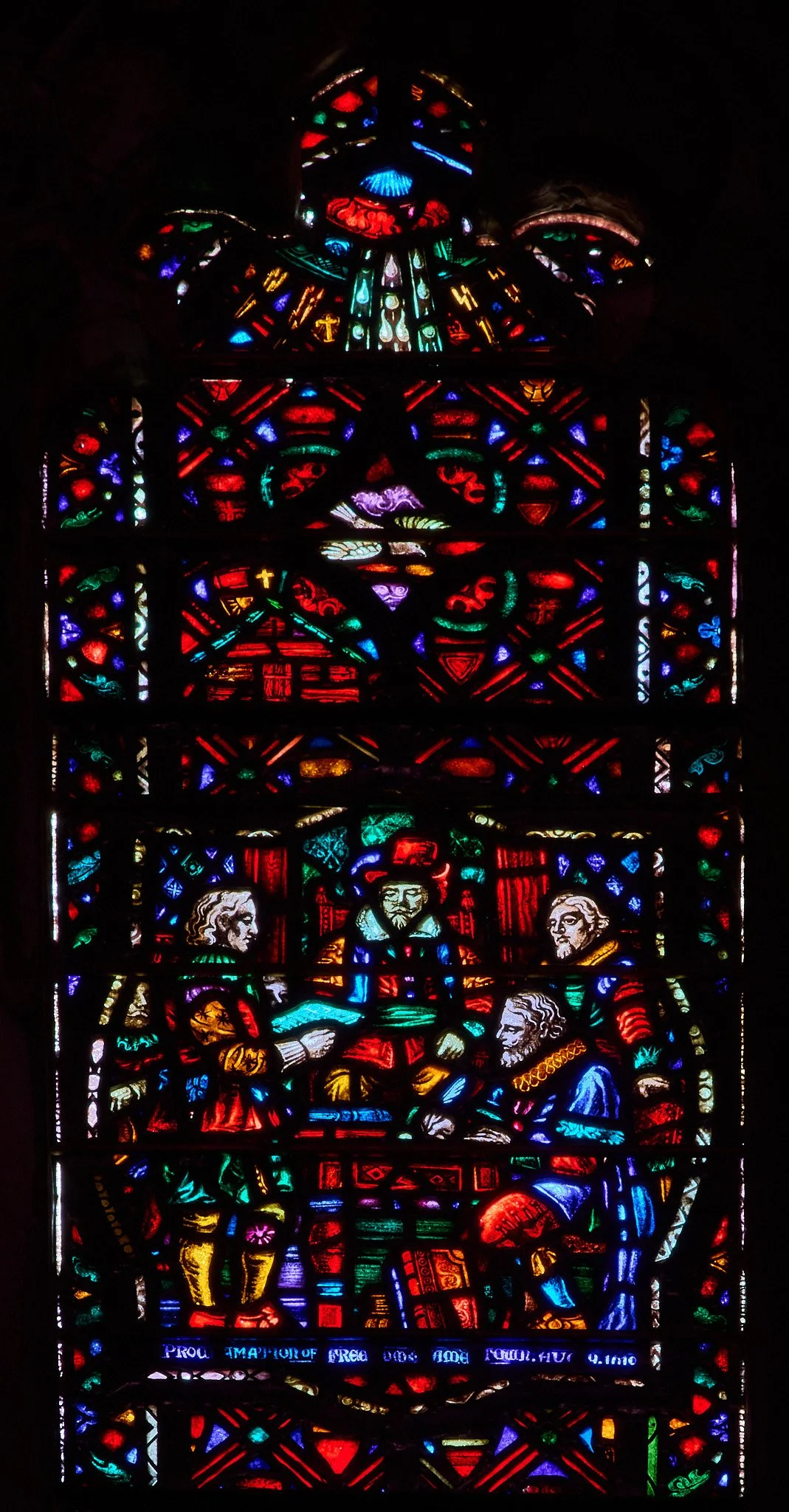
Men in Stuart-era garb are arrayed around a heavy table, piled with books. Seated in a large chair, flanked by two leaded-glass windows, is Governor George Yeardley. He is surrounded by the officers of the General Assembly: Secretary and Speaker John Pory, Clerk of the Assembly John Twine, and Sergeant at Arms Thomas Pierce. Another man is partially visible to one side. The inscription in the glass below the scene reads, Proclamation of Freedom: Jamestown, Aug. 4, 1619.
-
![The Charter of Freedom of Conscience and Democratic Government]()
02 The Charter of Freedom of Conscience and Democratic Government
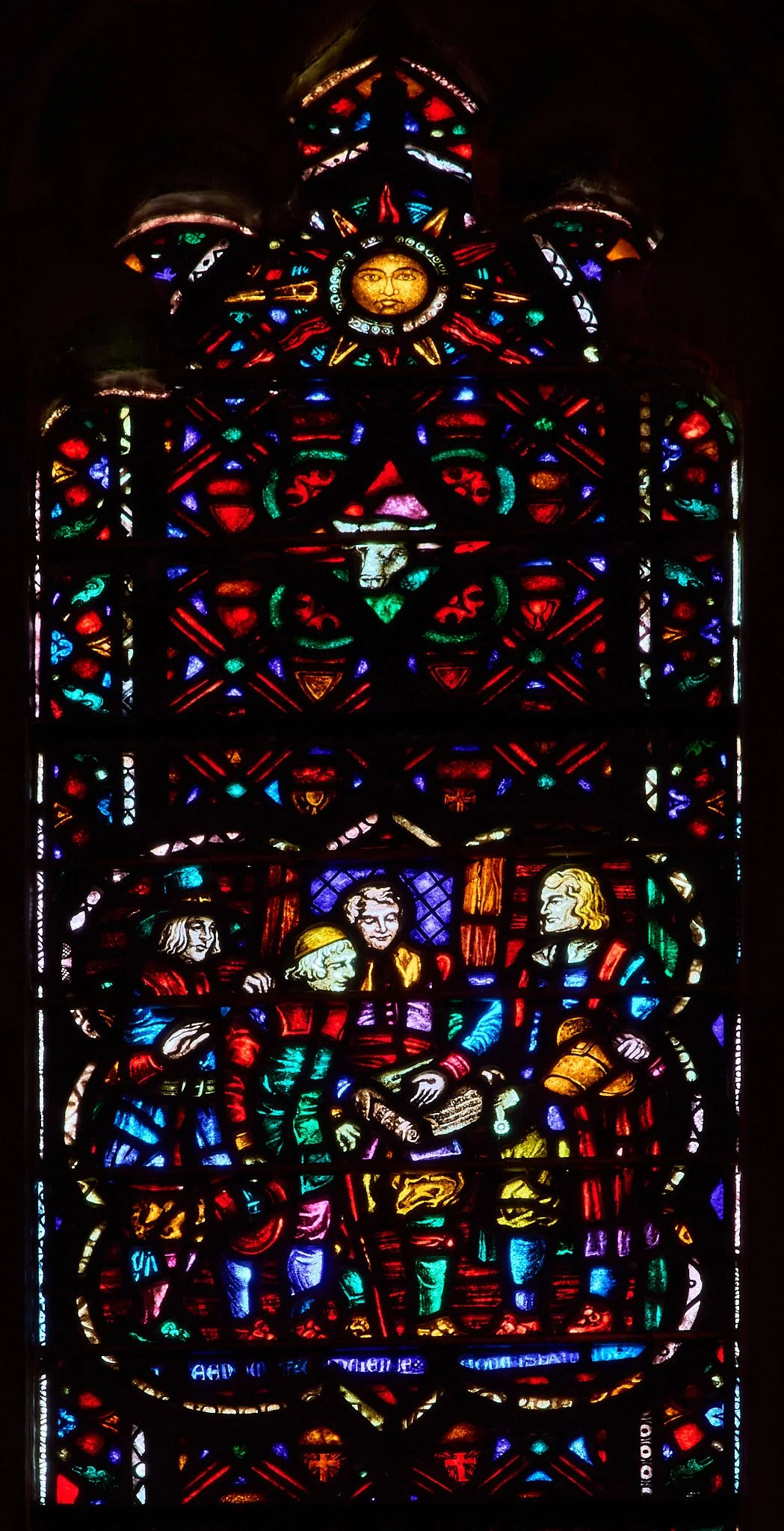
At the center of the panel stands a colonial legislative figure likely representing Joseph Growdon, Speaker of the Pennsylvania Assembly in 1701. He holds a volume symbolizing Pennsylvania’s Charter of Privileges, also known as the Charter of Liberties, granted by the colony’s proprietor, William Penn, on October 28, 1701. Penn is likely represented in the far right, as his formal appearance and hat in hand convey his authority as proprietor and founder of Pennsylvania.
-
![The Albany Congress]()
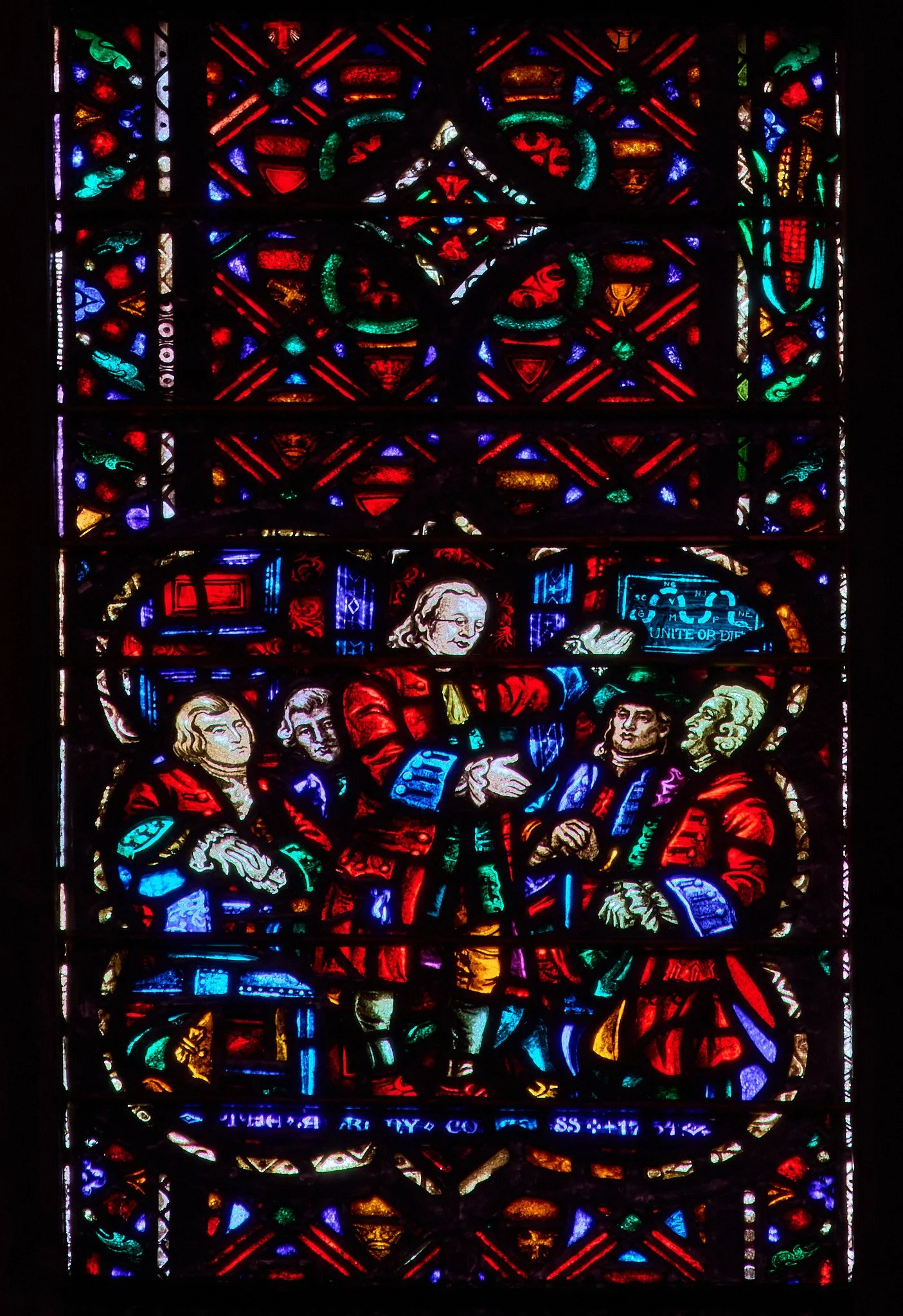
03 The Albany Congress
Benjamin Franklin stands in the center, gesturing with his left hand toward his “snake cartoon” which shows a snake divided into thirteen sections representing the thirteen colonies and bearing the slogan “Unite or Die” (the cartoon’s slogan was, in fact, “Join or Die”). He is addressing one of the four unidentified individuals, two to Franklin’s right and two to his left, who are listening to his speech. It is possible that the person he is addressing is the chairman of the Albany Congress, the Lieutenant Governor of New York, James De Lancey. The others, presumably, are delegates from the colonies attending the Congress.
-
![Patrick Henry Writes the Virginia Resolutions]()
04 Patrick Henry Writes the Virginia Resolutions
Patrick Henry, seated in the Virginia House of Burgesses, prepares propositions for floor debate. On the right, holding a document, stands his ally George Johnston, while Thomas Jefferson, with arms crossed, looks on from the other side. Two others converse behind them.
-
![Lee Declares America Free and Independent]()
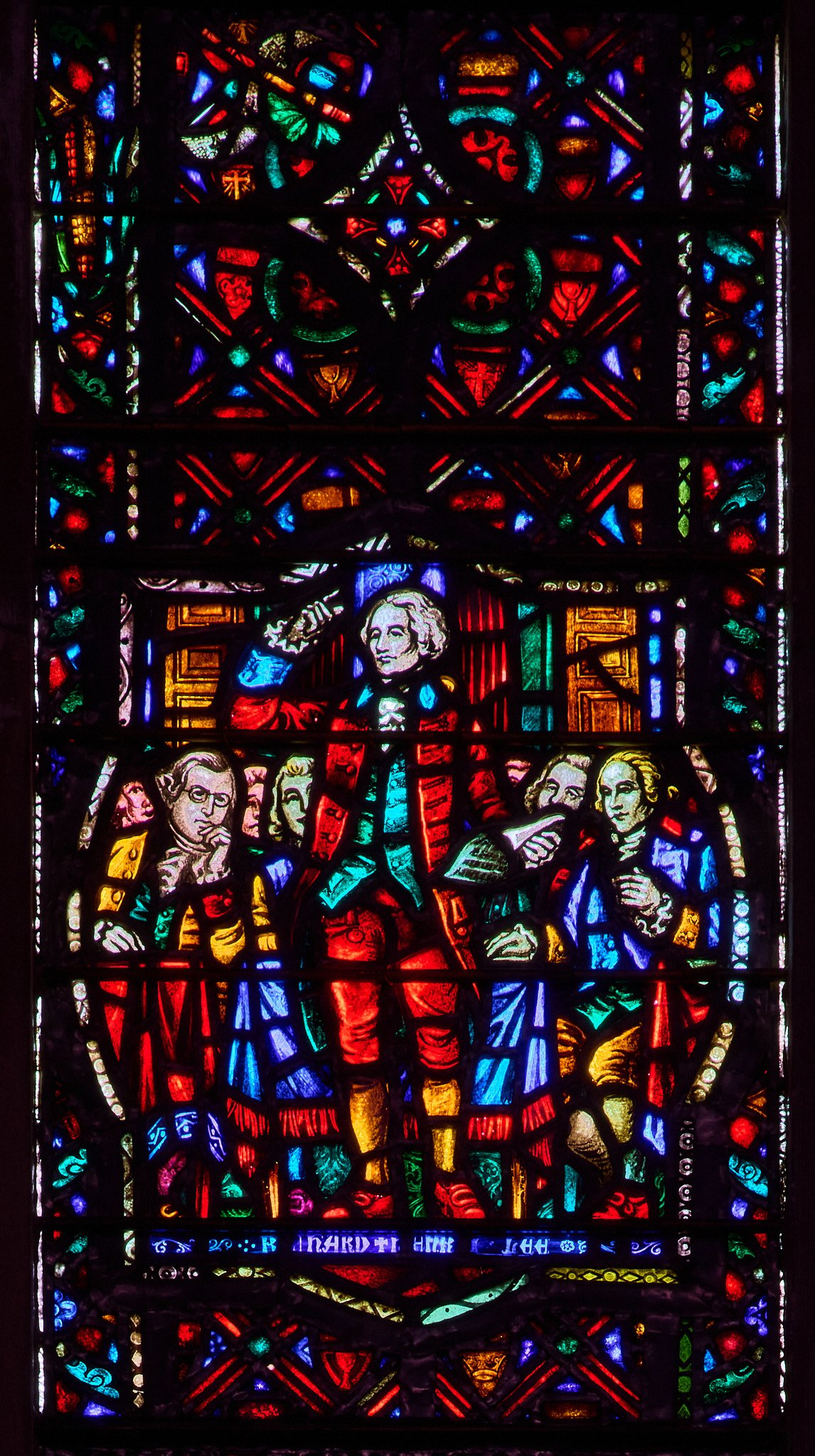
05 Lee Declares America Free and Independent
Acting under the instruction of the Virginia Convention, Richard Henry Lee is shown standing and addressing the Second Continental Congress in Independence Hall, Philadelphia. In his left hand he is holding the resolution he is introducing declaring that the united colonies ought to be free and independent states. Behind him are delegates to the Congress. Given the detail, it is certain that the figures to Lee’s immediate right and left are intended to be specific individuals, but The Rev. Burk’s description is not available. The figure to Lee’s right may be John Adams and to Lee’s left Thomas Jefferson.
-
![Jefferson Writes the Declaration of Independence]()
06 Jefferson Writes the Declaration of Independence
In the parlor of his small second floor apartment a few blocks away from Independence Hall, Jefferson is shown sitting at his desk. He is writing with a quill pen on his “writing box,” (made by a Philadelphia cabinet maker). His left arm rests on a sheaf of papers, possibly drafts. In front of his desk on a chair, a small table, and at his feet are scattered books and documents; possibly writings by Locke and others that he consulted as he prepared to write a common sense explanation of Congress’s call for independence.
-
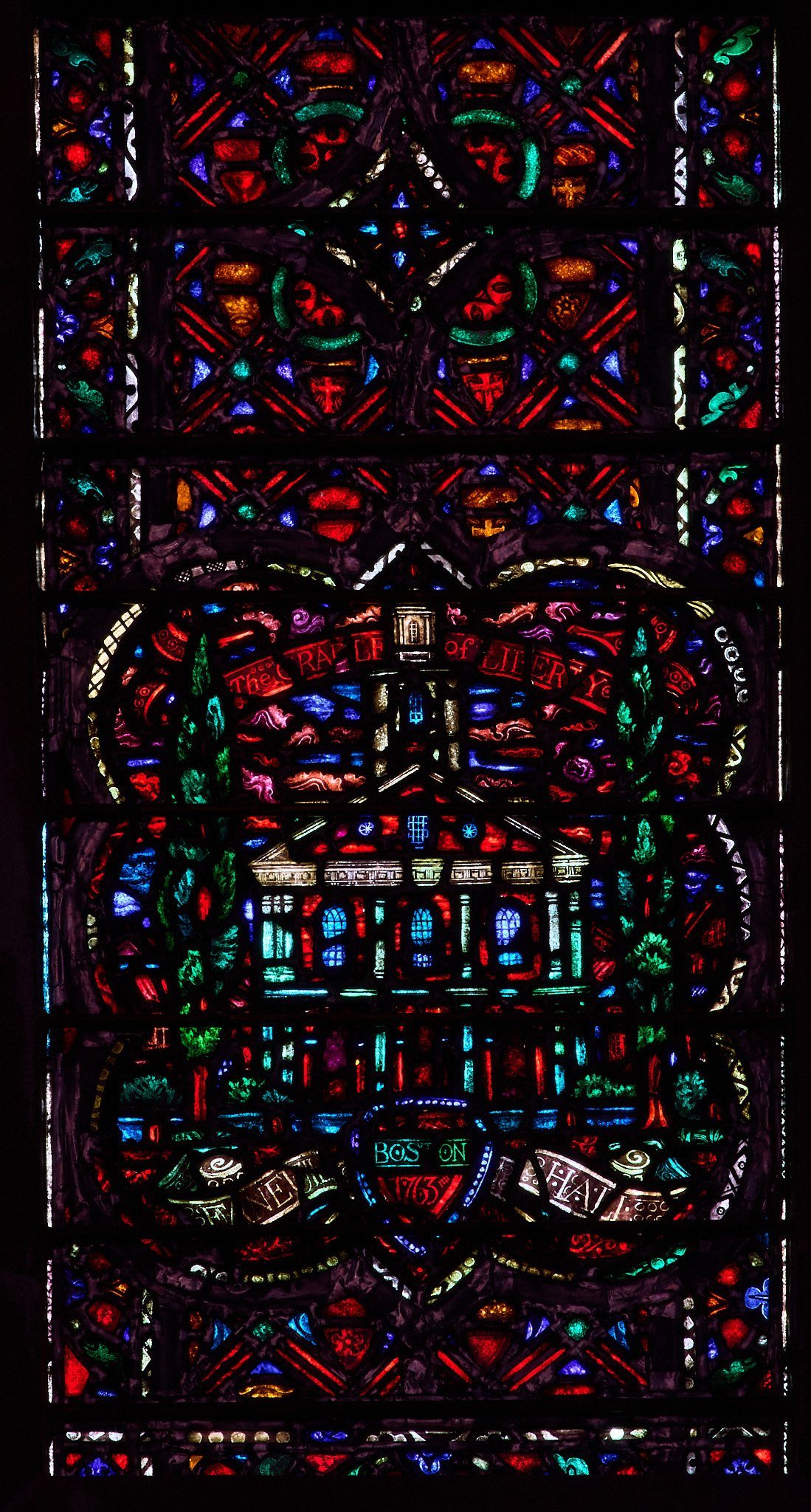
![Faneuil Hall]()
07 Faneuil Hall
Pictured is Faneuil Hall in Boston, Massachusetts, the central political meeting place of Colonial Boston.
-
![Independence Hall]()
08 Independence Hall
The south facade of Independence Hall, flanked by trees and greenery, as it appeared in the early 20th century. At top is a red scroll, bearing the legend “The Shrine of the Nation;” at bottom, supported by two Continental soldiers flanking the Liberty Bell, is a white scroll bearing the legend “Independence Hall - Philadelphia.”
-
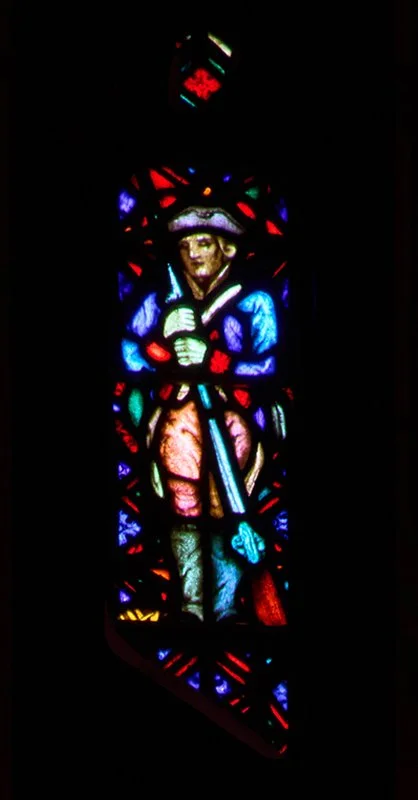
![Tracery Glass 1 (Panel) Continental Soldier]()
Tracery Glass 1 (Panel) Continental Soldier
Learn the significance of different Continental Army uniform facing and cuff colors through the chapel windows.
-
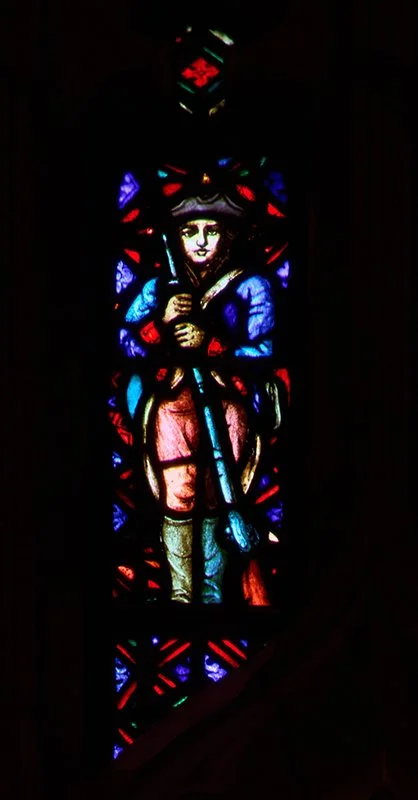
![Tracery Glass 2 (Panel) Continental Soldier]()
Tracery Glass 2 (Panel) Continental Soldier
Learn the significance of different Continental Army uniform facing and cuff colors through the chapel windows.

Detailed Medallion Text
01 The First Deliberative Assembly in America
Medallion 1: The First Deliberative Assembly in America
Location: Left lancet, top
Description:
Men in Stuart-era garb are arrayed around a heavy table, piled with books. Seated in a large chair, flanked by two leaded-glass windows, is Governor George Yeardley. He is surrounded by the officers of the General Assembly: Secretary and Speaker John Pory, Clerk of the Assembly John Twine, and Sergeant at Arms Thomas Pierce. Another man is partially visible to one side. The inscription in the glass below the scene reads, Proclamation of Freedom: Jamestown, Aug. 4, 1619.
Background:
Governor Yeardley arrived at Jamestown in April 1619, brought the welcome news of the abolition of martial law, and announced the creation of an annual legislative assembly. The foundation for the oldest continuing legislative body in the New World was laid.
From the first charter of the Virginia Company, there had been a guarantee that residents of the British colonies would “have and enjoy all liberties, franchises, and immunities as if they had been abiding… within this our realm of England.” In the first decade of the Jamestown Settlement, however, this guarantee was honored more in the breach than in the observance, and the settlers lived under what amounted to martial law.
The new assembly would consist of the Governor and his council, as well as two burgesses (landowners) from each of the towns or plantations. Its structure was similar to that of the stockholders’ meetings of the Virginia Company, and the Company retained the right to veto any ensuing legislation. The assembly met in the church at Jamestown from July 30 to August 4, 1619, and in the face of the oppressive heat and humidity of a Tidewater midsummer, rapidly concluded its affairs after one of the burgesses died of malaria. Perhaps prophetically, Speaker John Pory, in his final correspondence on the Assembly, encouraged the Company in England to not lightly use its power to veto the Assembly’s legislation, “for otherwise this people would in shorte time growe so insolent, as they would shake off all government, and there would be no living among them.”
Despite its modest beginning, this General Assembly would ultimately evolve into the House of Burgesses, the lower house of the colonial government of Virginia. While the original House of Burgesses would be wound up sine die in the spring of 1776 to be supplanted by the House of Delegates, the bicameral legislative structure of the Colony of Virginia informed the development of the national Legislative Branch under the Constitution. Indeed, the Virginia General Assembly, tracing its lineage back four centuries to those stifling days in the little frame church, remains to this day the oldest continuing legislative body in the New World.
JRW
Intermedallion [The First Deliberative Assembly in America]
- Thunderstorm: Top center: This stylized thunderstorm features rain and lightning bolts emanating from a red stormcloud that conceals blue rays of glory. This represents Divine Providence overseeing the developments shown in this window and illustrates the window’s theme verse about God providing both sun and rain equally “on the just and on the unjust.” The symbolism also seems to be framed as a reference to Psalm 29: “Give the LORD the honour due unto his Name: worship the LORD with holy worship. It is the LORD that commandeth the waters: it is the glorious God that maketh the thunder. …The LORD sitteth above the water-flood, and the LORD remaineth a King for ever. The LORD shall give strength unto his people; the LORD shall give his people the blessing of peace.”
- Dove: Center lozenge: This image of a dove flying above purple waves or clouds is likely a depiction of Genesis chapter 1, verse 2: “And the earth was without form, and void; and darkness was upon the face of the deep. And the Spirit of God moved upon the face of the waters.” In the famous opening to Paradise Lost, John Milton poetically combines this scene with the Holy Spirit descending “like a dove” at Christ’s Baptism in the Jordan River (Matthew 3:16, Mark 1:10, Luke 3:22. John 1:32): “Thou from the first/ Wast present, and with mighty wings outspread/ Dove-like satst brooding on the vast Abyss….” The inclusion of this image above The First Deliberative Assembly in America intensifies the Providential implications of the storm of God’s glory directly above. This reference to God’s creative power shaping the world is likely a statement about all men being created equal, or that God was inspirationally present in the formation of American representative institutions, or both.
- Log Church: Lower left: This simple log cabin surmounted by a cross represents the Third Church at Jamestown, built in 1617. The first General Assembly of Virginia (shown in the medallion below) met in that building, which was the furthest-flung Anglican house of worship at the time. The bright yellow sun shining on the wooden cross and turning it gold is likely yet another reference to Providential oversight.
NKH
02 The Charter of Freedom of Conscience and Democratic Government
Medallion 2: The Charter of Freedom of Conscience and Democratic Government
Location: Right lancet, top
Description:
At the center of the panel stands a colonial legislative figure likely representing Joseph Growdon, Speaker of the Pennsylvania Assembly in 1701. He holds a volume symbolizing Pennsylvania’s Charter of Privileges, also known as the Charter of Liberties, granted by the colony’s proprietor, William Penn, on October 28, 1701. Penn is likely represented in the far right, as his formal appearance and hat in hand convey his authority as proprietor and founder of Pennsylvania.
Also present are two additional men wearing distinct hats. One wears a round hat, inferring a figure rooted in the established order of the Church of England. The other, on the far left of the scene, wears a taller hat that differs in shape and likely evokes styles associated with Protestant dissent such as Quakers or Puritan separatists. Thus, this contrast in attire suggests a distinction between established religious authority of the Church of England and the traditions of dissent that was essential to the founding of Colonial Pennsylvania.
Background:
The scene represented in this window reflects an important stage in the development of religious liberty in the Anglo-American world. Granted by William Penn in 1701, the Charter of Privileges functioned as Pennsylvania’s governing constitution until the American Revolution. The charter strengthened the powers of the elected Assembly, expanded protections for liberty of conscience, and helped establish Pennsylvania as one of the most religiously diverse colonies in British North America.
Penn’s Charter of Privileges not only enabled religious freedom, but also encouraged the migration of dissenting Protestant groups from throughout Europe. The colony quickly became a home to a plethora of Quakers, Lutherans, Anglicans, Presbyterians, German Reformed settlers, Mennonites, Moravians, and numerous other Protestant groups. In such a diverse ethnic, religious, and linguistic environment systems of accommodation became essential to political stability. Rather than enforcing strict religious uniformity, Pennsylvania developed institutions capable of managing ethnic and religious pluralism within a shared constitutional order.
Precedent for religious toleration in the Anglo-American world had already been set in England following the Glorious Revolution. This revolution (1688-1689) saw the overthrow of King James II and the establishment of William and Mary as monarchs, securing a Protestant succession and reinforcing the authority of the Parliament over the crown. Another key event following the Glorious Revolution was the passing of the Toleration Act of 1689. This act granted limited freedom of worship to Protestant dissenters, marking an important shift away from religious uniformity within the English state. Although it did not establish full religious toleration, it created a key precedent in which differing Protestant traditions could coexist under a unified political order. Pennsylvania carried many of these ideas further in the new world by embedding liberty of conscience directly into its constitution.
American colonists inherited many ideas from England, and the consequences of the Glorious Revolution were essential in how American colonists viewed religion. However, by the time of the American Revolution, these inherited ideas had been reshaped by the unique conditions of the colonies, especially with the presence of diverse linguistic and religious communities sometimes without a clear majority. These earlier colonial experiments in pluralism and liberty of conscience ultimately helped shape the intellectual world inherited by the revolutionary generation, including figures such as Thomas Jefferson, who later advocated for religious freedom that reflected the transformation of limited Protestant toleration into a broader principle of individual liberty. Thus, the scene in this window captures this transition, and reflects a moment in which inherited English ideas of toleration were redefined in America into a more expansive vision of religious liberty, one that would become central to the identity of the emerging nation.
MEM
Intermedallion [Surrounding The Charter of Freedom of Conscience and Democratic Government]
- Sun in Splendor: Top center: This depiction of the sun with a humanlike face is a traditional heraldic device. The alternating straight and wavy rays represent the sun’s light and heat, respectively. It resembles the half-obscured sun-in-splendor (which lacked the heat rays) carved onto the top of the Pennsylvania Assembly Speaker’s chair in Independence Hall; this was the chair from which George Washington presided over the Constitutional Convention in 1789. During the signing of the Constitution at the Speaker’s desk, Benjamin Franklin famously remarked that “Painters have found it difficult to distinguish in their art a rising from a setting sun. I have often…looked at that behind the President without being able to tell whether it was rising or setting, but now at length I have the happiness to know that it is a rising and not a setting Sun.” The full portrayal of the sun-in-splendor here may be intended to represent the fully risen American Republic.
- Bovine Head: Center lozenge: This simple depiction of a cow’s face is likely a reference to the “Degeneracy Debate” in which Jefferson aggressively defended America’s honor with all the zoological data he could muster. The famous and influential European scientist Comte de Buffon, who had never visited any part of the New World, had published (in an otherwise scholarly 1761 volume of the encyclopedic Histoire naturelle) his theory that America had a horrible climate which caused people and animals to become stunted and pathetic. Although Benjamin Franklin made significant progress in changing Buffon’s opinion during his time representing the fledgling United States in Paris, the theory was being taken up by other European authors in the 1770s and Jefferson was determined to demolish the ridiculous claims. He compiled data tables comparing average weights of various American animals with their European counterparts, showing that they were actually equivalent or larger in size. (He also composed a compelling ethnographic defense of American Indians.) Jefferson’s vindication of American cattle in particular was essential for preserving America’s reputation as a land of opportunity, because it reflected on the health of grazing land. Jefferson finally had the chance to argue with Buffon in person when he became Ambassador to France in 1784, confronting him with a large panther skin. Jefferson was appalled at Buffon’s lingering diminutive impressions of the American moose, and sent him a huge moose carcass from Vermont, which apparently won the argument.
NKH
03 The Albany Congress of 1754
Medallion 3: The Albany Congress of 1754
Location: Left lancet, second from the top
Description:
Benjamin Franklin stands in the center, gesturing with his left hand toward his “snake cartoon” which shows a snake divided into thirteen sections representing the thirteen colonies and bearing the slogan “Unite or Die” (the cartoon’s slogan was, in fact, “Join or Die”). He is addressing one of the four unidentified individuals, two to Franklin’s right and two to his left, who are listening to his speech. It is possible that the person he is addressing is the chairman of the Albany Congress, the Lieutenant Governor of New York, James De Lancey. The others, presumably, are delegates from the colonies attending the Congress.
Background:
The first attempt at union and unified action among Britain’s American colonies took place in the early summer of 1754 in Albany, New York. Although it failed in its immediate goals, it set the stage for subsequent unified action among the American colonies and provided a template for the Articles of Confederation.
Britain’s war with France, known in America as the French and Indian War, but in fact a nine year long world war between Great Britain and France, broke out in 1754. In response, the British Board of Trade convened a meeting of all its North American colonies to discuss mutual defensive measures to be taken against the French and their Indian allies. Of Britain’s fourteen North American colonies, which included Newfoundland and Nova Scotia (Delaware did not break away from Pennsylvania until 1776), only seven sent delegates.
Delegates from New Hampshire, Massachusetts, Rhode Island, Connecticut, New York, Pennsylvania, and Maryland met in Albany from June 19 to July 11 with 150 chiefs of the Iroquois Confederacy in an effort to dissuade them from joining the French. Among themselves the delegates discussed plans for joint defensive measures.
Benjamin Franklin, a member of the Pennsylvania delegation, proposed the “Albany Plan of Union” which provided for a loose confederation or “general government” of all the colonies to be established by an act of Parliament. The government would have a President General appointed by the Crown who would preside over a “Grand Council,” selected by the representative assemblies of each of the colonies. Its purpose would be to negotiate treaties with the Indian tribes, regulate trade with the Indian nations, purchase land for settlements, provide for the common defense and declare war if necessary. It would have limited authority to levy taxes for defense which would be paid to a central treasury. All acts of the Council would require approval by the President General.
The Plan of Union was unanimously approved by the delegates to the Convention. It was unanimously rejected by the legislatures of all the colonies and by Parliament. In both cases, rejection was based on the fear that legislatures and Parliament would be giving up power to the Grand Council. Nevertheless, the Albany Congress and the abortive Plan of Union set a precedent for colonial opposition to British Parliamentary efforts such as the Stamp Act of 1765 to tax the colonies following the war, for the First and Second Continental Congresses, and for the Articles of Confederation drawn up when Independence was declared. In 1789 Benjamin Franklin remarked:
“On Reflection it now seems probable, that if the foregoing Plan or some thing like it, had been adopted and carried into Execution, the subsequent Separation of the Colonies from the Mother Country might not so soon have happened, nor the Mischiefs suffered on both sides have occurred, perhaps during another Century.”
GPP
Intermedallion [The Albany Congress]
- Ear of Corn: Right side: Corn was one of the main crops which Jefferson grew at Monticello, in several varieties.
NKH
04 Patrick Henry Writes the Virginia Resolutions
Medallion 4: Patrick Henry Writes the Virginia Resolutions
Location: Right lancet, second from the top
Description:
Patrick Henry, seated in the Virginia House of Burgesses, prepares propositions for floor debate. On the right, holding a document, stands his ally George Johnston, while Thomas Jefferson, with arms crossed, looks on from the other side. Two others converse behind them.
Background:
It was late May 1765, in Williamsburg, Virginia. Louisa County’s newly-minted Member of the House of Burgesses was a backcountry lawyer named Patrick Henry—notorious for suggesting in open court that the King had “degenerated into a Tyrant, and forfeits all right to his subjects’ obedience.” Few recognized the roughly-clothed firebrand as he strode through the colony’s capital, aside from his close friend and hunting companion: twenty-two-year-old law student Thomas Jefferson.
Henry quickly made powerful enemies and eager allies by squelching a proposed bailout scheme for wealthy debtors with one question: “is it proposed, then, to reclaim the spendthrift from his dissipation and extravagance, by filling his pockets with money?” [1]
Days later, Henry tackled the issue he had been elected on, the Stamp Act. Parliament’s direct tax on American colonists, the Act would take effect in a few months. With no official challenge, precedent would be established: Parliament could override the jurisdiction of the colonial legislatures, stripping away representative government at will.
Pulling out his well-worn copy of Sir Edward Coke’s celebrated Institutes of the Lawes of England, Part I, Henry opened to a blank fly-leaf and penned something even more influential: “Resolved, That the first Adventurers and Settlers of this his Majesty’s Colony and Dominion of Virginia brought with them, and transmitted to their Posterity, and all other his Majesty’s Subjects since…all the Liberties…enjoyed, and possessed, by the People of Great Britain.”
He continued, building a tight five-point case. Two royal charters had explicitly affirmed that Virginians possessed English rights, and in the British constitutional tradition Englishmen could be taxed only by their elected representatives. Virginia had never given up self-government. Therefore, only their own representatives had authority to tax them, and giving this power to anyone else “has a manifest Tendency to destroy British as well as American Freedom.” [2]
On May 29, Henry’s twenty-ninth birthday, the House of Burgesses was thinly attended. His colleague George Johnston moved for “committee of the whole,” opening the floor to discussion by all delegates present. Henry stood and read his straightforward propositions to a stunned House, still waiting for London to respond to a conciliatory version of the argument sent before the Stamp Act had passed. Thomas Jefferson watched as Henry then launched into what Jefferson described as a “torrent of sublime eloquence” that reached a startling ultimatum: “Caesar had his Brutus—Charles the First, his Cromwell—and George the Third—"Treason! Treason! Treason! his colleagues yelled over him—“…may profit by their example,” Henry concluded. To the cries of “treason,” Henry responded,“If this be treason, make the most of it!”. [3]
The votes were close, but Henry’s eloquence and conviction narrowly won the stormy debate on each of his five resolves. Jefferson never forgot how the concerned Attorney General stomped out, swearing “I would have given five hundred guineas for a single vote!” (about $140,000 today). [4]
Though the Burgesses toned down the resolutions in his absence and deleted their hard-hitting conclusion, Henry’s stand could not be undone. The horrified Royal Governor suspended the assembly, but to no avail. Henry’s unabridged “Virginia Resolves” (plus two extra points proclaiming that Virginians need not pay any such illegitimate taxes and that opponents were public enemies) were published throughout the colonies, rallying patriots to resistance—as shown in the adjacent Window of the Revolution’s first scene, Tearing Down the Stamp Act.
NKH/GPP
[2] Wirt, Life of Henry, 56-8.
[3] Wirt, Life of Henry, 60-5.
[4] Wirt, Life of Henry, 61. Although the Virginia Attorney General, Peyton Randolph, was much more moderate in approach than Henry, he did agree in principle and would later become President of both the First and Second Continental Congresses. Randolph was a decided Patriot and almost certainly would have supported independence if he had not died from a stroke in October 1775.
Intermedallion [Surrounding Patrick Henry Writes the Virginia Resolutions]
- Dove Released from Cage and Skull-and-Crossbones: Lower left and lower right: This imagery symbolizes Patrick Henry’s famous Liberty or Death Speech delivered at the Second Virginia Convention, March 23, 1775, in St. John’s Church, Richmond. The result was this sermonlike oration, replete with Biblical language, followed up on his 1765 arguments against the Stamp Act in the Virginia Resolves (shown below), pointing out the continued antagonism of Parliament during the intervening decade and the refusal of the King to defend the rights of his American subjects. This speech is closely connected to the themes of this window. This extralegal Convention was elected by the people in response to the Royal Governor de facto suspending the House of Burgesses, causing Virginia’s militia law to expire without possibility of a renewal vote and leaving the colony undefended as war broke out in New England. Henry’s speech, given in defense of his motions for authorizing a militia through the Convention, mobilized leaders in the key colony of Virginia (Jefferson’s homeland) to join in the revolution. This group of patriots had taken back for the people the self-government which was rightfully theirs, and sent delegates (including Jefferson) to the Second Continental Congress to help organize a unified colonial effort. The speech also directly alluded to the divine origin of equal rights, testifying to “a just God who presides over the destinies of nations” and expressing direct political responsibility to “the Majesty of Heaven, which I revere above all earthly kings.” NKH
NKH
05 Richard Henry Lee Declares America Free and Independent
Medallion 5: Richard Henry Lee Declares America Free and Independent
Location: Left lancet, third from the top
Description:
Acting under the instruction of the Virginia Convention, Richard Henry Lee is shown standing and addressing the Second Continental Congress in Independence Hall, Philadelphia. In his left hand he is holding the resolution he is introducing declaring that the united colonies ought to be free and independent states. Behind him are delegates to the Congress. Given the detail, it is certain that the figures to Lee’s immediate right and left are intended to be specific individuals, but The Rev. Burk’s description is not available. The figure to Lee’s right may be John Adams and to Lee’s left Thomas Jefferson.
Background:
Background: The room in the Philadelphia State House crackled with tension as Richard Henry Lee’s voice cut through the stifling Philadelphia air, introducing a resolution declaring independence from Britain. In that moment, he ignited the spark that would birth a nation.
On June 7, 1776, Richard Henry Lee of Virginia delivered a momentous resolution to the Second Continental Congress, declaring that "these united colonies are and of right ought to be free and independent states." Acting under the instruction of the Virginia Convention, Lee’s resolution marked a decisive step toward full American independence from Great Britain. The proposal, now known as the Lee Resolution, was structured in three distinct parts: a formal declaration of independence, a call to establish foreign alliances, and a plan to form a lasting confederation among the colonies. This bold initiative captured the revolutionary spirit of the time and laid the groundwork for the birth of a new nation.
Despite the clarity and boldness of Lee’s proposal, many delegates to the Congress were cautious. Some believed that declaring independence without broader consensus or direct instructions from their home colonies might be premature. Others were wary of the diplomatic and military consequences of such a radical step. New York, New Jersey, Pennsylvania, Delaware, Maryland, and South Carolina were unwilling to declare independence at that point. The delegates from Massachusetts, including John Adams, like the Virginia delegates were more radical.
Therefore, Congress, on June 11, 1776, appointed three committees to study each part of the resolution and agreed to delay the vote on Lee’s resolution until July 1. . One committee was tasked with drafting a formal declaration of independence that would be voted on. A second committee was charged with outlining a strategy for securing foreign alliances to support the colonies in their struggle against Britain. The third committee worked to "prepare and digest the form of a confederation," envisioning a unified framework for cooperation and governance among the emerging states. These committees worked simultaneously, reflecting the urgency and complexity of shaping a new nation, while under the shadow of war.
It was not until July 2, 1776 that Congress voted on the Lee Resolution. On that day, Congress formally adopted the first part of the resolution—the Declaration of Independence—signaling the colonies’ official break from British rule. The language and intent of the Lee Resolution were echoed directly in the Declaration of Independence, cementing Richard Henry Lee’s role in the founding of the United States.
The significance of Lee’s resolution cannot be overstated. It represented both a call to action and a unifying vision for the thirteen colonies, articulating the principles of liberty and self-determination that would guide the new nation.
FS
Intermedallion [Surrounding Richard Henry Lee Declares America Free and Independent]
- Ear of Corn: Left side: Corn was one of the main crops which Jefferson grew at Monticello, in several varieties.
- Peace Pipe with Wampum Belt: Upper left: The smoking of peace pipes and exchange of wampum belts were essential diplomatic rituals in dealings with American Indian nations. This is likely an oblique reference to Jefferson’s admiration of William Penn, whom he hailed as “the greatest law-giver the world has produced.” In addition to Penn’s excellent statutes, such as the Charter of Privileges commemorated in this window’s second medallion, Jefferson saw Penn’s policy of relations with indigenous peoples as a model to be emulated. Penn’s landmark Treaty of Shackomaxon (the eighth scene in the Lafayette Window of Settlement) was based on the principle of treating native nations as legal equals and buying land fairly, rather than seizing or swindling it. Penn especially emphasized peaceful arbitration of conflicts through joint councils or designated mediators. President Jefferson’s embrace of Penn’s ideal of equal justice for not just citizens, but also neighboring Indian tribes, tempered his administration’s expansionism.
NKH
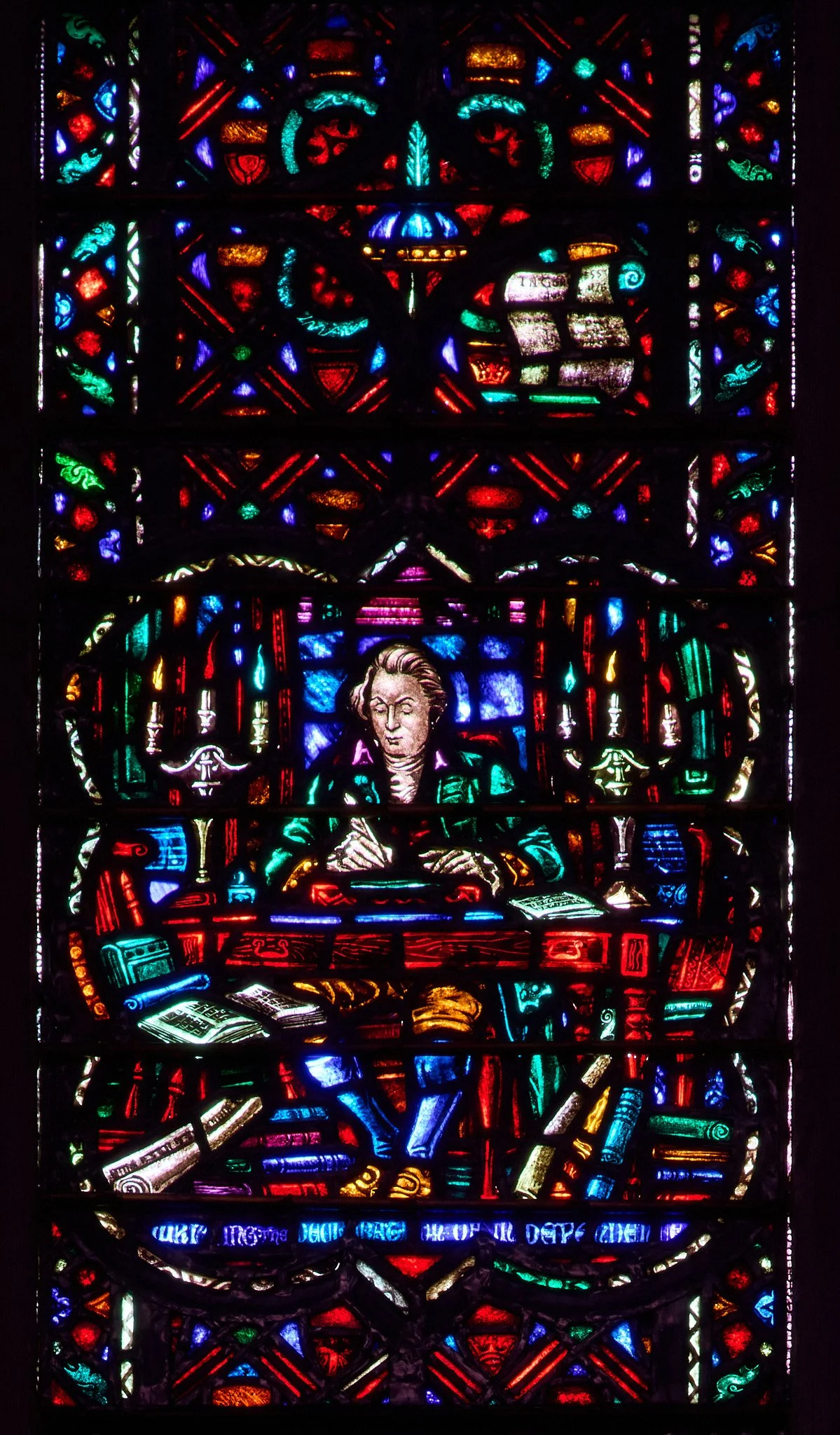
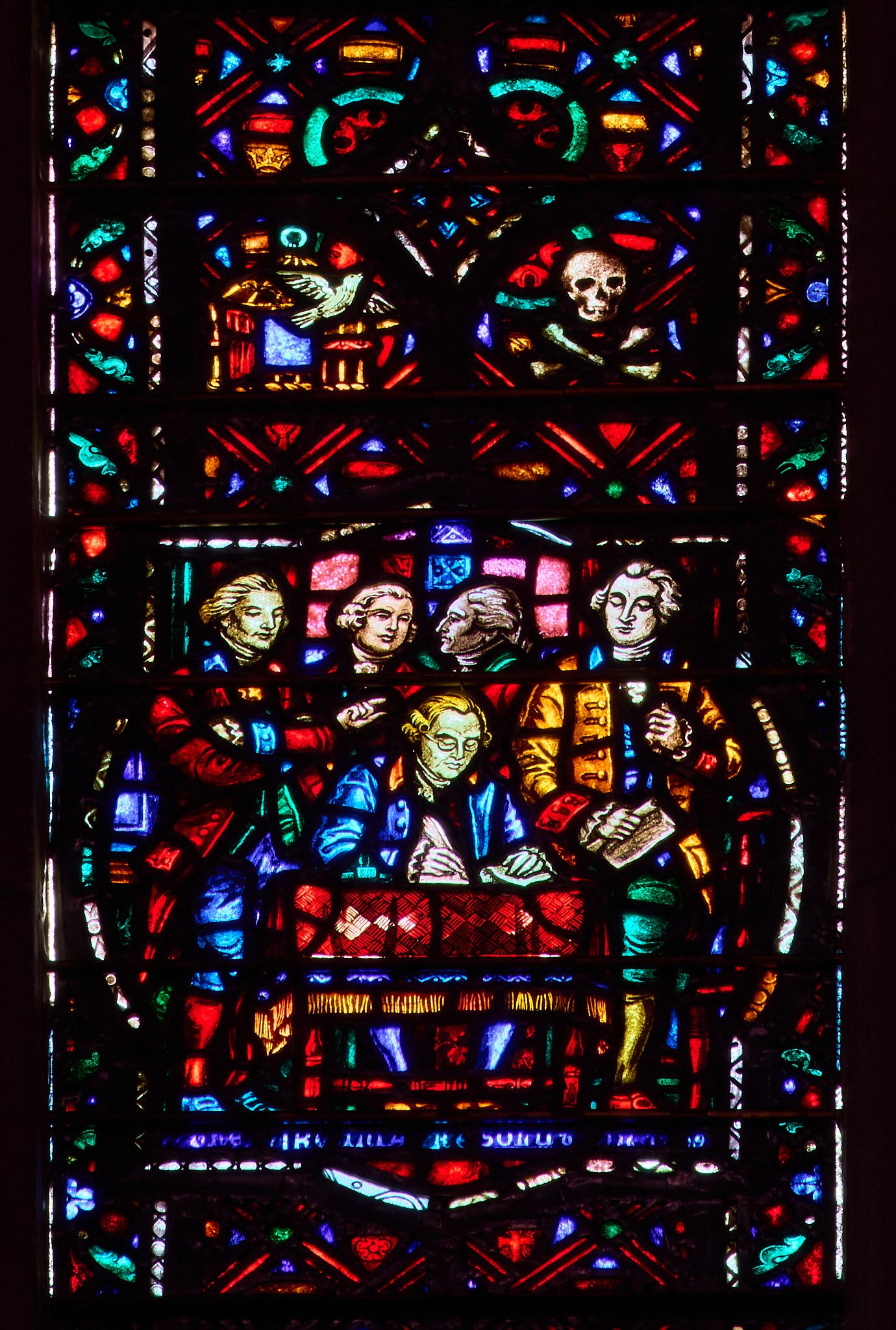
06 Thomas Jefferson Writes the Declaration of Independence
Medallion 6: Thomas Jefferson Writes the Declaration of Independence
Location: Right lancet, third from the top
Description:
In the parlor of his small second floor apartment a few blocks away from Independence Hall, Jefferson is shown sitting at his desk. He is writing with a quill pen on his “writing box,” (made by a Philadelphia cabinet maker). His left arm rests on a sheaf of papers, possibly drafts. In front of his desk on a chair, a small table, and at his feet are scattered books and documents; possibly writings by Locke and others that he consulted as he prepared to write a common sense explanation of Congress’s call for independence.
Background:
As the Second Continental Congress wrestled with the contentious sentiment among its delegates regarding Lee’s resolution proposing independence, it formed a drafting committee to make a persuasive case for independence.
By 1776, after a year of conflict, many colonists were considering independence from Britain, encouraged by Thomas Paine’s pamphlet, “Common Sense,” and by growing threats of the arrival of more British troops and German mercenaries.
At the Second Continental Congress in Philadelphia in June 1776, Virginian Richard Henry Lee submitted a resolution insisting that “all political connection is and ought to be dissolved” between Great Britain and the American colonies. Although this sentiment was not unanimous, Congress nominated a drafting Committee of Five (John Adams, Benjamin Franklin, Thomas Jefferson, Robert Livingston, and Roger Sherman) to write a declaration to justify independence. Thirty-three-year old Thomas Jefferson was chosen to write the draft. John Adams would later explain the choice: Jefferson had a “reputation for a masterly Pen” based upon his petition writing for the Virginia House of Burgesses.
Jefferson submitted his draft on June 28 and Congress made many changes over the next two days. Jefferson would claim dissatisfaction with revisions made, especially the passage about the slave trade and King George, and the softer language toward the British people. After due consideration, Congress adopted Lee’s resolution on July 2nd and on the 4th of July adopted Jefferson’s Declaration of Independence to explain its action.
Shortly before his death Jefferson explained what the Declaration was intended to do: “When forced, therefore, to resort to arms for redress, an appeal to the tribunal of the world was deemed proper for our justification. This was the object of the Declaration of Independence. Not to find out new principles, or new arguments, never before thought of, not merely to say things which had never been said before; but to place before mankind the common sense of the subject, in terms so plain and firm as to command their assent, and to justify ourselves in the independent stand we are compelled to take. Neither aiming at originality of principle or sentiment, nor yet copied from any particular and previous writing, it was intended to be an expression of the American mind, and to give to that expression the proper tone and spirit called for by the occasion.”
Through his “masterly” pen, Jefferson captured the proper tone and spirit in these sentences in what are perhaps the greatest arguments for self-government and individual rights in political literature:
“We hold these truths to be self-evident, that all men are created equal, that they are endowed by their Creator with certain unalienable Rights, that among these are Life, Liberty and the pursuit of Happiness,—That to secure these rights, Governments are instituted among Men, deriving their just powers from the consent of the governed,—That whenever any Form of Government becomes destructive of these ends, it is the Right of the People to alter or to abolish it; and to institute new Government, laying its foundation on such principles and organizing its powers in such form, as to them shall seem most likely to effect their Safety and Happiness.”
KRD
Intermedallion [Surrounding Thomas Jefferson Writes the Declaration of Independence]
- Quill Pen and Inkwell: Center lozenge: This represents Jefferson’s pen and ink used to write the Declaration.
- Completed Declaration: Lower right: This is a depiction of the signed final draft of the Declaration.
NKH
07 Faneuil Hall
Medallion 7: Faneuil Hall
Location: Left lancet, bottom
Description:
Pictured is Faneuil Hall in Boston, Massachusetts, the central political meeting place of Colonial Boston.
Background:
Completed in 1742, Faneuil Hall served as the crucible where political unrest and rebellion were brought to a boil, launching the American Revolution, and ultimately, a new nation. Built by Boston merchant Peter Faneuil, the Hall, named in his honor, served as a multi-purpose facility, with a marketplace on its ground floor and an expansive auditorium and municipal offices above.
Faneuil Hall was a frequent meeting place for the Sons of Liberty, a society of colonial citizens who banded together to protest and resist English parliamentary and monarchical laws and edicts that infringed on their right to local governance and sovereignty. Among the founding fathers who spoke in this “Cradle of Liberty” were Samuel and John Adams, John Hancock, Joseph Warren, and James Otis. Colonial leaders used this forum to shape public opinion and discourse around a variety of contentious events leading up to the Revolutionary War, including the Stamp and Tea Acts, and the Boston Massacre. Perhaps the statement attributed to James Otis epitomized their ethos, “ No Taxation Without Representation. “
President Washington visited Faneuil Hall during a tour of the New England states in the Fall of 1789, during the first Congressional recess of the new federal government. The tour was both a fact finding mission and a promotional tour aimed at garnering support for the Constitution, the new federal government it created, and his administration. He left New York City by coach and stopped along the way to chat with farmers and factory workers about common agriculture and trade. Before arriving in cities and towns, he exited his coach and rode in astride Blueskin, his gray parade charger, usually accompanied by local militia. There he met with local and state politicians and merchants, reviewed militia companies, accepted awards and honors, and toured local sights.
Washington arrived in Boston on October 24, 1789 and stayed for five days. It had been thirteen years since Washington had overseen the siege that led to the British troops’ withdrawal in March 1776 and Boston’s liberation, and thousands of adoring citizens came out to show their respect and love. The celebration culminated with a large dinner in his honor at Faneuil Hall, and was marked by speeches, toasts, songs, and a fireworks display. Faneuil Hall, “the Cradle of Liberty,” was indeed the place where the nascent movement that eventually toppled British rule in America was nurtured and born, and remains an icon to the freedom loving people of America to this day.
DRS
08 Independence Hall
Medallion 8: Independence Hall
Location: Right lancet, bottom
Description:
The south facade of Independence Hall, flanked by trees and greenery, as it appeared in the early 20th century. At top is a red scroll, bearing the legend “The Shrine of the Nation;” at bottom, supported by two Continental soldiers flanking the Liberty Bell, is a white scroll bearing the legend “Independence Hall - Philadelphia.”
Background:
The Province of Pennsylvania, and its capital of Philadelphia, enjoyed rapid growth through the early 18th century. By 1729, the provincial government had outgrown the private residences and Old City Hall in which it had met, and proposals were solicited for the construction of a new State House, to cost £2,000. After a prolonged dispute between the members of the building committee, construction began in the autumn of 1733. The Assembly first met in the unfinished building in September 1735; completion of the building took several years, contingent on funding. A 150-foot brick and frame bell tower was built between 1749 and 1753, and in the first week of June, a bell - one day to be called the Liberty Bell - was installed. Within a year, the tower of Christ Church, a few blocks away, would become the tallest structure in the Colonies - emblematic of Philadelphia’s newfound prosperity. The upper portion of the State House tower was shabbily built, however, and a 1774 description indicates that “The other part of the steeple being entirely of wood is in such a ruinous condition that they are afraid to ring the bell, lest by so doing the steeple should fall down.”
The Second Continental Congress convened at Independence Hall in 1775, meeting in the Assembly Room, in which they ratified the Declaration of Independence on July 4, 1776. The same Assembly Room would host the Constitutional Convention in the summer of 1787, but when Philadelphia was serving as the nation’s provisional capital from 1790 to 1800, the legislature convened in adjacent Congress Hall. Following the relocation of the state capital to Harrisburg, the old State House saw a variety of uses, being sold to the City of Philadelphia in 1816-1818.
The Marquis de Lafayette’s 1824 visit to Philadelphia inspired renewed interest in the old State House, and saw the earliest application of the name “Hall of Independence,” first to the Assembly Room. In 1828, Philadelphia architect William Strickland was engaged to design a new frame tower modeled along the lines of the original, which had been removed in 1781. He altered the proportions and detailing in this new tower, adding height, ornamentation, and a large, four-sided clock. This representation of the Hall depicts its appearance following the 1896-1900 restoration campaign, sponsored by the Daughters of the American Revolution and spearheaded by Mrs. Charles Custis Harrison, whose husband was Provost of the University of Pennsylvania and later headed the committee to raise funds to complete Washington Memorial Chapel.
JRW
Intermedallion [Surrounding Independence Hall]
- Ear of Corn: Right side: Corn was one of the main crops which Jefferson grew at Monticello, in several varieties.
NKH
Overview Endnotes
[1] W. Herbert Burk, “The Chapel Windows,” Washington Chapel Chronicle 7, no. 1 (April 1915): 3.
[2] W. Herbert Burk, “Independence Day,” Washington Chapel Chronicle 7, no. 4 (July 1915): 26-7.
[3] Thomas Jefferson, “First Inaugural Address,” March 4, 1801, The Avalon Project at Yale Law School.
[4] Thomas Jefferson to Samuel Kercheval, July 12, 1816, Teaching American History.
[5] Thomas Jefferson, Notes on the State of Virginia (1787; reprint, Boston, Wells & Lilly, 1829), 169-70.
© Text copyright of Washington Memorial Chapel and courtesy of the God's Glass Project.
© Photos copyright of Sam Cornwall, licensed exclusively to Washington Memorial Chapel and courtesy of the God's Glass Project.
Unauthorized sharing or distribution of text or images from this website is strictly prohibited without written permission from the copyright holders.